Spannerhead Dot ComSpannerhead.com

Some Updates

April 26, 2023 by Matt

Made the unpleasant discovery that the car has been repainted. There’s a run just behind the driver’s door:
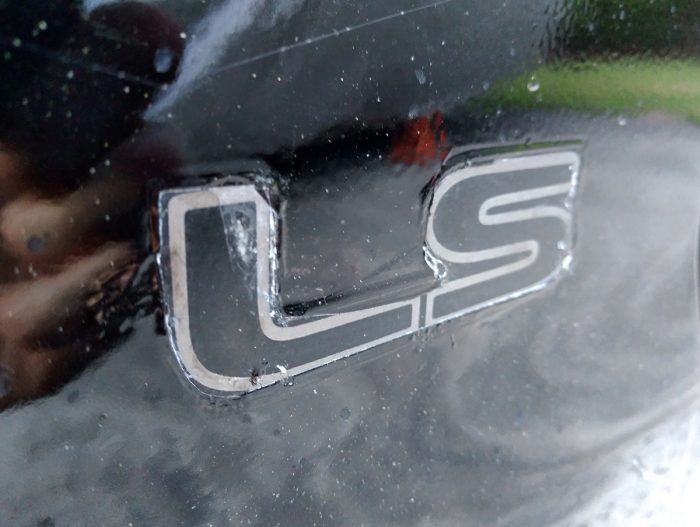
and the LS stickers were (poorly) masked instead of just removed and replaced afterwards.

Otherwise it’s a decent job. Would I like a glossier/original finish? Sure. But at least the clearcoat is intact.

Lots of work to do in the engine bay:
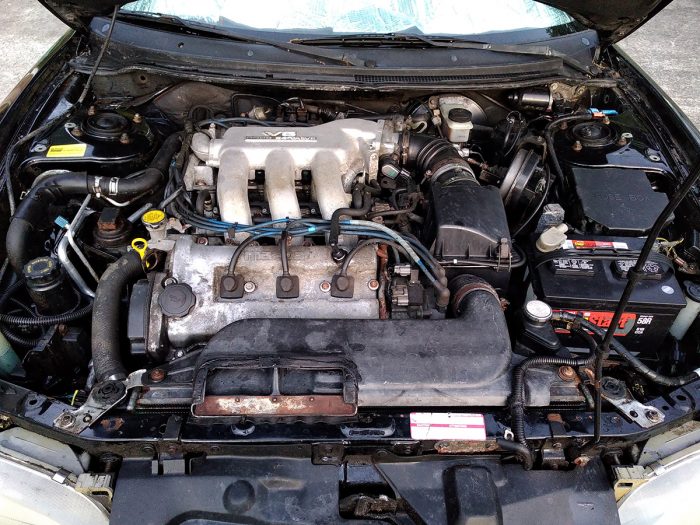
I got him up on jackstands on Friday and started removing parts. Canadian winters have had their way with everything under there. Exhaust leak, check:
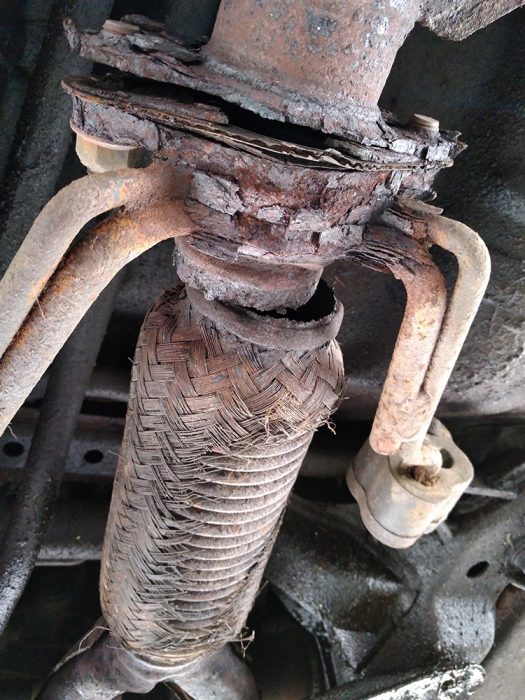
Managed to get most of it off, but the studs securing the downpipes to the exhaust manifolds snapped immediately, so I had to rip off the intake manifold and remove the exhaust manifolds also:
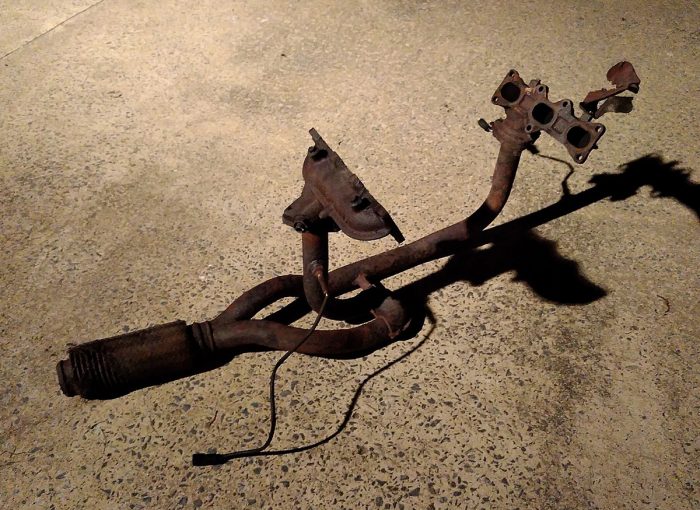
Fortunately, thanks to a combination of heat, penetrant, just the right socket extensions and a lot of patience, all 14 nuts/bolts came off with breaking any. So the engine will not have to be pulled (yet).

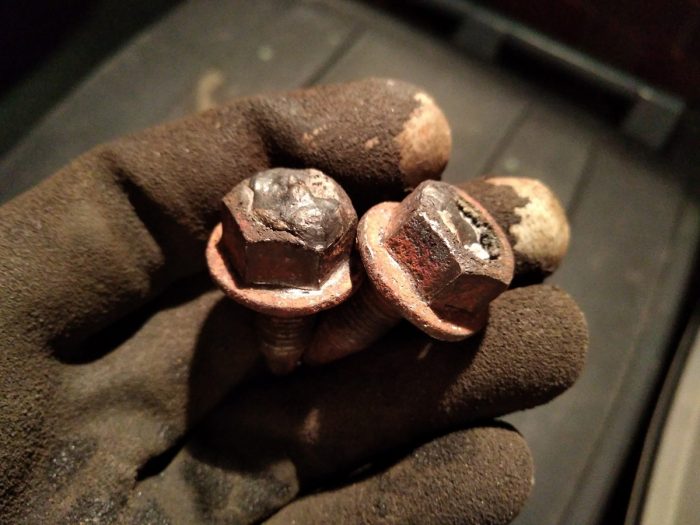
At the rear, 3 out of the 4 subframe mounting bolts snapped:
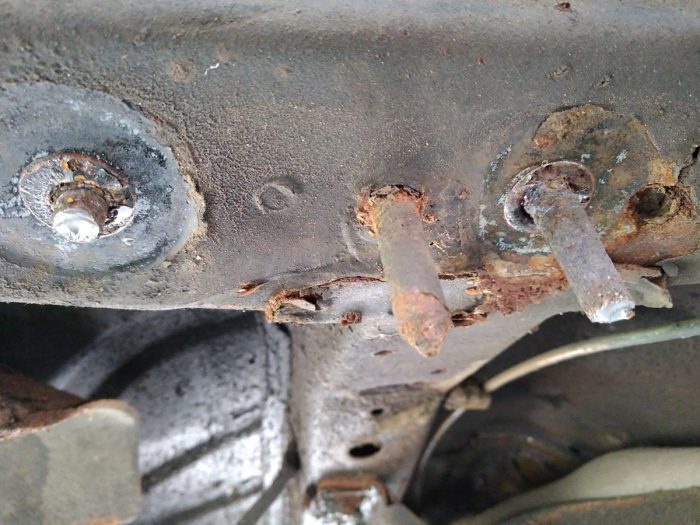
A nice neighbor came off and welded nuts onto the bolts so we could get them off with the air gun:
There’s also a good bit of rust under the shock towers:
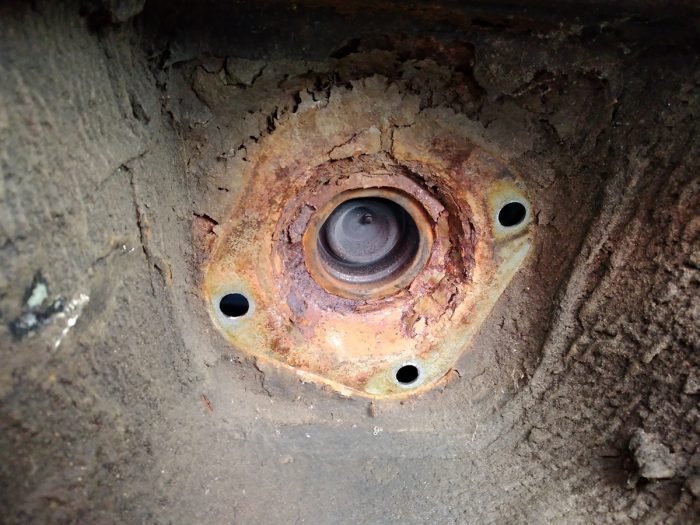
Wire brushed it and hit it with a couple of coats of POR-15.

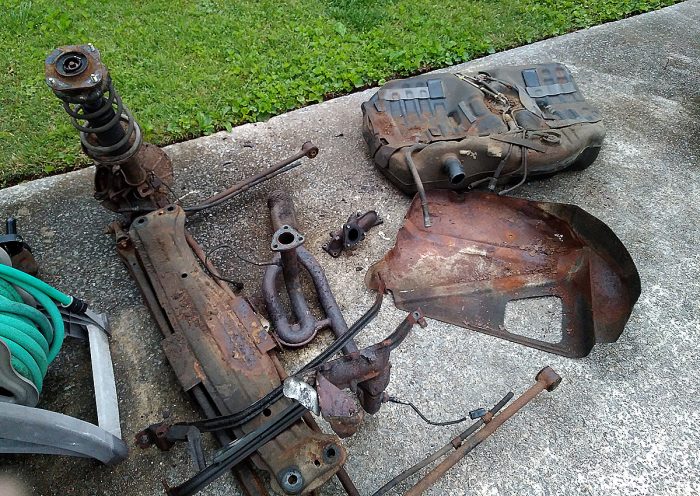
And I finally got the fuel tank off earlier this evening:
Some rusty patches above the tank, which I’ll also wire brush and treat:
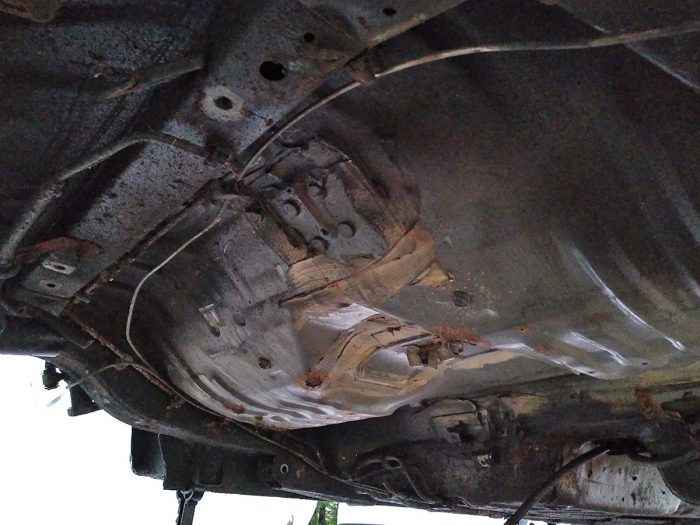
I’d like to powerwash all the undercoating off, but I think that would take something stronger than Simple Green; probably some scrubbing action, which I don’t have time for at the moment.

Very close to being able to start reassembly, which should (hopefully) go more smoothly.
No Comments on Some Updates

Day 1 Progress

April 19, 2023 by Matt

(I only had 1/2 hour):

  • Removed window stickers and ’90s cell antenna
  • Swapped on Megumi’s ’95+ wheels
  • Slam-dunked sunroof shield into trash can

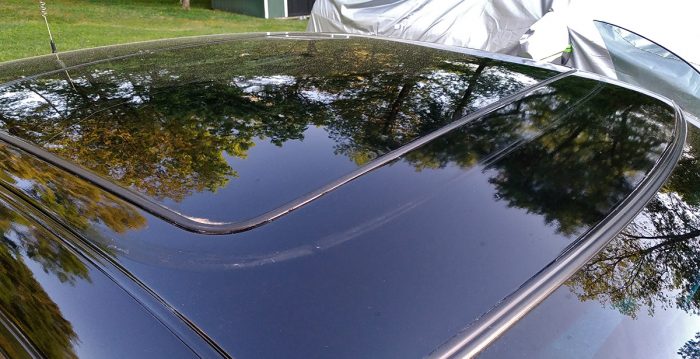
No scratches under the sunroof shield, unlike with Megumi. There’s a line of dirt, but it will clean up/polish out.

Next up: Prepping Megumi’s fuel tank to be swapped over, and starting on the interior deep clean.

No Comments on Day 1 Progress

Arrival

 by Matt

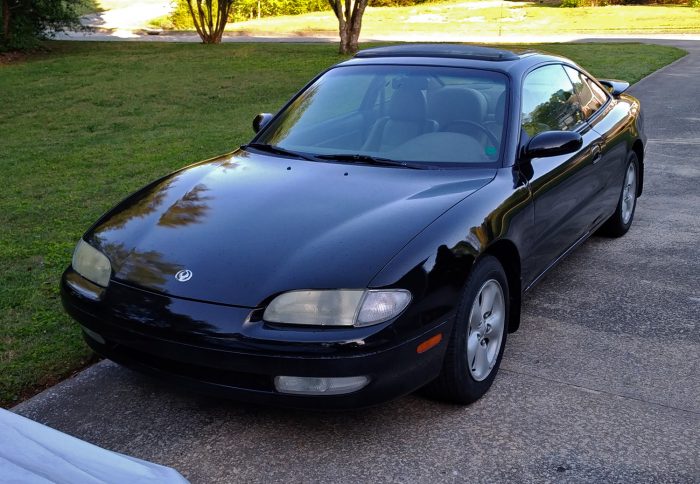
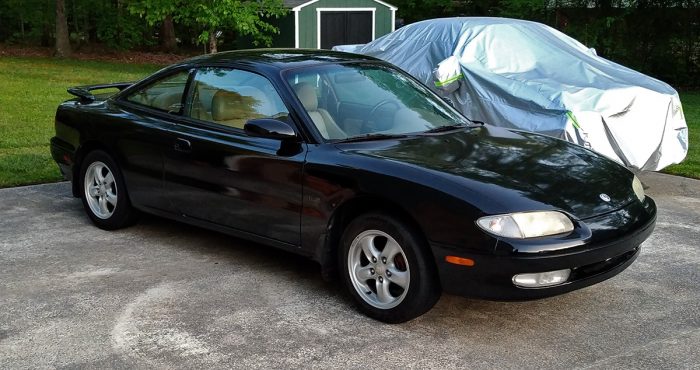
So, this is Nori. He finally arrived early this morning. He needs a lot of help.

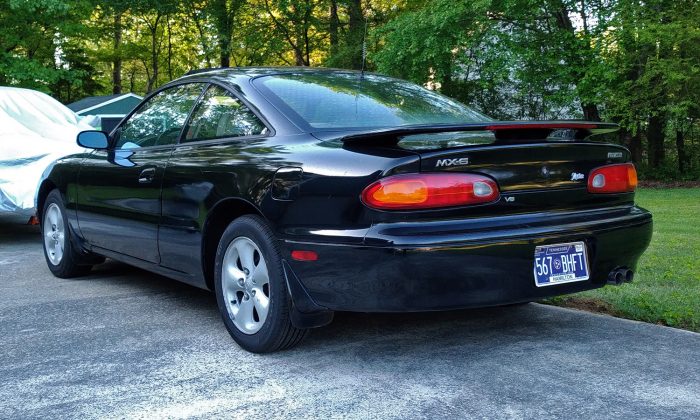
Nori is a ’94 5-speed V6. He was originally a Canadian-market car (hence the “Mystère” trunklid badging). I bought him from the original owner. He has 270K km (~170K mi). He spent the first ~6 years of his life in Canada before moving to Fort Myers, Florida, where he was driven until 2010-2012, when he was parked.

I had planned to drive him up here to Chattanooga, but he wasn’t “ready for prime time” and so I had him shipped instead.

He’ll be getting Megumi’s 108K mi engine/trans + a host of other non-rusty parts, and a thorough clean.

Current (known) issues:

  • Massive exhaust leak
  • Marginal brakes
  • Rusty undercarriage
  • Completely dead shocks
  • Speedo inop (cruise works, though, so I think the speed sensor is OK)
  • Fuel sender inop (seized b/c of bad gas?)
  • Shifter bushings shot
  • Needs a tune up
  • ~3 small dents
  • Cat scratches on sunroof panel

Fortunately, Megumi’s parts will serve to help replace all the non-consumable bits.

Follow along as I bring him back into focus, and eventually give him some mild upgrades. OEM+.

No Comments on Arrival

EV Dreams: Lexus Electrified Sport

December 17, 2021 by Matt

Lexus Electrified Sport LFA EV Sports Car

I hate that I love the way this looks.

To me, speed isn’t an end in itself. It’s a nice-to-have, but a car’s ability to engage me as a driver will always top my list of priorities when assessing its desirability. Axiomatically, then, a car that engages more of my body—whether appendages through the necessity of rowing my own gears or my senses through hearing and feeling the engine’s internal combustion—will always trump the sterile, inert driving experience delivered by an electric vehicle (EV).

So no EV has sparked any desire whatsoever, whether the vehicle/appliance in question is a lowly Nissan Leaf or a multi-million dollar Rimac Nevera, or anything in between.

Until now.

Toyota and Lexus recently unveiled a whole slew of EV concepts, form factors ranging from pickups and economy cars to crossovers and sports cars. Topping the range is a kind of LFA successor called the Lexus Electrified Sport.

And I can’t get enough of it. The classic long-nose, short-deck proportions have more than a hint of Mercedes-AMG GT—an excellent source of inspiration—and the concept touts other Toyota/Lexus cues, like a nose that plays like a 21st-century remix of the Mark 3 Supra’s, and upswept haunches borrowed from the latest sports car in that storied line.

There’s just one problem. While it looks fantastic, sucked to the ground, visual masses distributed like an old-school sports car’s, but with up-to-the-minute modern detailing, the inevitable question arises: Why? Why does the nose need to be so long if there’s no big engine underneath? Why is it shaped that way if it doesn’t have to be?

I have a feeling lack of underlying justification for otherwise familiar shapes is going to be a fairly recurring theme as EVs become more commonplace. Some (most?) designers see that as a net positive, freeing them from packaging constraints and liberating them to redefine the idea of what a car should look like in ways they’ve always wanted to. But for those of us, like myself, who like a little function underpinning the form, it’s a step backward.

Either way, Lexus has a visual winner on their hands. Hopefully they’ll bring it to market in some way.

Image credits: caranddriver.com

No Comments on EV Dreams: Lexus Electrified Sport

Transcending Badge Appeal: Kia Stinger

January 2, 2019 by Matt

I want one. I don’t even care that it’s a Kia.

It’s almost like a latter-day Pontiac G8 or Chevy SS: A good-looking, well-executed sports sedan with the ingredients in all the right places (longitudinal engine, RWD or AWD, great proportions and distinctive details) but doomed to irrelevancy because of the market’s enduring obsession with SUVs and crossovers.

As usual, it’s a shame, since Kia deserves to be rewarded for their daring attempt to take on the upmarket cadre of established sports sedan players. It’s a smarter move than meets the eye, also; instead of copying to a tee something like the BMW 3-series (see: Cadillac ATS), Kia went for a more classically American feel, like a hybrid of the larger BMW 5-series and a Dodge Charger. With the latter at the bitter end of its life cycle, assuming buyers are willing to consider the Kia (and that’s a big assumption), the Stinger would seem to be well-poised to capture a chunk of that market niche.

Sadly, what with the aforementioned fixation on Sitting Up High™ (read: SUVs and crossovers), I just don’t see the Stinger gaining any appreciable traction in the market. It certainly doesn’t help that sister brand Genesis has just released the G70, built on the same platform, but more dynamically polished and available with a manual transmission (though not with the twin-turbo V6 engine option). The Stinger is much nicer to look at than the G70, but the latter has landed not only a spot on Car and Driver‘s annual 10Best list, but also been named Motor Trend‘s Car of the Year. The automotive world just isn’t fair.

The upshot for an enthusiast like myself is that depreciation will probably be very high, especially considering the lack of badge cachet, so a used purchase in a few years could be a realistic proposition. I’d love a slate gray RWD GT model with the twin-turbo V6. The lack of a manual option is a debit, but the compelling design makes up for it. Add the inevitable rarity caused by its position as the black sheep of the sports sedan marketplace, and the potential exists for the Stinger to remain a special car.

For a great review, check out Doug DeMuro’s thorough rundown on the car and all its quirks and features:

Image credits: netcarshow.com

No Comments on Transcending Badge Appeal: Kia Stinger

No Stickshift for New Z4:
What is BMW thinking?

December 23, 2018 by Matt

Buried in Car and Driver‘s report on the new BMW Z4 is this little gem of a statement:

Sadly, there is no manual-transmission option; a ZF eight-speed automatic will be the only transmission…

It’s not entirely unexpected given that the upcoming BMW 3-series, the G20, is equally bereft of a manual transmission option, but the fact that it isn’t even an option for the Z4 is utterly baffling to me. The new BMW roadster is positioned as the most driver-focused, most “compromised” car in the automaker’s lineup, so why shouldn’t every option that fosters driver engagement be at least available? Especially if the car’s primary targets—the Porsche 718 Boxster/Cayman twins—practically flaunt their third pedals by comparison…

What if tomorrow Mazda announced it was discontinuing the manual option on the MX-5 Miata? Or Toyota decided to pull the plug on the 86’s stickshift? I understand rowing your own gears is a dying art, and completely void of any kind of performance advantage the way it used to be. Still—if an automaker positions itself as the enthusiast’s choice; offers a model purporting to carry the top-down, classic roadster torch; and wants to maintain any kind of enthusiast cred whatsoever, it should develop a manual option for that model, even if the take rate is too low to make sense economically. Sell a few more X5s and you’ll break even, BMW.

The other thing that confuses the hell out of me is the fact that BMW offers a manual option with all 2-series models—an arguably less driver-focused and certainly more practical car than the Z4. But that could just be a “legacy transmission” BMW keeps on the option sheet until the next-generation 2-series bows a year or two from now…

The new Z4’s performance is irrelevant. I don’t care if it laps the ‘Ring five minutes faster than the old car, the steering brings back the classic BMW feel and the (admittedly turbocharged) I6 under the hood sings from the classic BMW engine hymnal—without a manual transmission option, it’s nothing more than a boulevardier, a car for retirees to cruise along the A1A at sunset with the top down. It’s a shame.

Image credits: netcarshow.com

No Comments on No Stickshift for New Z4:
What is BMW thinking?

Datsun 240Z Restoration: Dashless

September 8, 2016 by Matt

240Z-no-dash

The dash came out a few weeks ago with little drama. After unhooking the HVAC ducting and removing (what I thought) were all the fasteners, I disconnected the cables from the heater box and tried to pull it out. No dice. Turns out there are a pair of bolts at the very corners of the dash pad up near the base of the windshield that I had missed. These removed and a little elbow grease brought the whole assembly out the passenger door without much trouble.

240Z-no-dash2

Once out, I took out the heater box. Many of the flappers were rusted in place; will have to go over this, free them up and recondition. I removed the firewall insulation, fresh air ducts and hooked up the steering column again. The brake and clutch pedals and a few other things are attached to the column mounting bracket. Once it’s removed they’ll come down too.

All the car’s wiring harnesses converge behind the glovebox area, so it took a fair amount of labeling with blue tape to keep everything straight. I’ve been religious about keeping fasteners in labeled bags, but it occurred to me that I’ve been neglectful in simply keeping a record of the sequence in which components have been removed from the Z. Without this, it’s going to be a real mystery come reassembly time as far as what gets reinstalled first. Beyond the remaining few bits I need to remove under the rear of the car, my task now, before too much time passes, is to go over the car and remember the order in which I removed bits. Shouldn’t been too hard, and even if I’ve forgotten a thing or two, whatever I have should be a good guideline to go by.

Editor’s note: This post is Part 24 of an ongoing series chronicling my efforts toward the restoration of my 1972 Datsun 240Z, originally my father’s. Read the other installments here:

4 Comments on Datsun 240Z Restoration: Dashless

Flawed Beauty: Lancia Gamma

June 4, 2016 by Matt

Lancia Gamma

The Lancia Gamma reprises a familiar story arc when it comes to Italian cars: Beautiful, ambitious, flawed.

Produced from model years 1976 to 1984 and sold only in Europe, the Gamma was offered in coupe and 5-door sedan (berlina) bodystyles. Powered by a SOHC flat four developing a healthy 138 horsepower in its later 2.5-liter version, the FWD Gamma moved with respectable alacrity for its day. The coupe weighed in at 2,850 lbs, a figure that ensured competent acceleration, handling and braking.

Lancia Gamma

The boxer engine configuration was chosen for a couple of reasons. Its lower center of gravity aided handling balance, but the real benefit was in the styling department: The hoodline could be more gradual, allowing for a very sleek profile. The overall design was penned by Pininfarina and is a masterpiece of proportion and understatement, especially considering the tacky, overwrought 1970s context of the car’s genesis.

Lancia Gamma

Rust was a major bugaboo for Lancia unibodies up until the late ’80s, and the Gamma’s sheetmetal had its share of challenges in that department. But the ambitious engine was the source of most of the Gamma’s problems. Its all-aluminum construction was underengineered, and any minor problems with one of the engine’s peripherals had a tendency to cascade and result in total failure. And speaking of peripherals, instead of being driven off the crank pulley as with most cars, the power steering pump was connected to the left timing belt, and when an additional load was placed on the pump—say, the steering was turned to full lock—the timing belt snapped under the strain, and, well, you can imagine the carnage that ensued.

Lancia Gamma Interior

The interior is sensibly laid out and has a decidedly no-nonsense German appearance, mildly surprising for an Italian machine but perhaps understandable in light of the Gamma’s competitors: Executive coupes like the BMW E24, Mercedes SL and Jaguar XJS. At least the switchgear is mostly reliable, especially compared to that of its British and Italian rivals.

Lancia Gamma Engine Motor

The Gamma was never imported to the US. While that might seem superficially unfortunate, at least the car’s lovely shape and powerplant were never marred by the 5-mph impact bumpers, sealed-beam headlights and performance-killing emissions equipment that afflicted those of its contemporaries that did make the trip across the Atlantic. No, the Gamma remains unmolested by US regulations, and the 25-year-old import rule makes it fairly straightforward for a moderately-determined enthusiast to be able to buy one in Europe, ship it and register it here. Sourcing replacement parts would be a challenge, especially given the Gamma’s maintenance requirements, but like with so many lovely Italian machines, I think the rewards of driving one or hell, just looking at one would outweigh the hassles of ownership.

Image credits: ourclassiccars.co.uk, classicitaliancarsforsale.com, driventowrite.com

1 Comment on Flawed Beauty: Lancia Gamma

A Treasure Trove of Japanese Imports

May 9, 2016 by Matt

Japanese Classics Richmond VA Website

This has become of one of my favorite internet hangouts lately.

Japanese Classics, a car importer based in Richmond, VA, has built what appears to be a thriving enterprise catering to the pent-up demand for JDM (Japanese Domestic Market) vehicles recently unleashed by the 25-year import rule. The essence of the law is that for most states, any vehicle over 25 years old (as of this posting, that would be MY 1991) is exempt from crash and emissions testing and can be freely imported and registered. For the enthusiast market, it means that a whole crop of heretofore unavailable Japanese machines can now be bought and driven in the US. Vehicles we lusted after from afar are here. And Japanese Classics’ website, more than simply showing the outfit’s current inventory, really pulls out all the stops in creating very nicely photographed and detailed listings:

Japanese Classics Richmond VA Website

For car nerds like me who’ve had trouble finding pictures of, say, a Mazda JC Cosmo’s interior, or the engine bay of a Nissan Silvia K’s, the site is a veritable encyclopedia of obscure JDM cars. For anyone who’s ever played (especially the early editions of) the Gran Turismo video game series and wondered how all those cars we’d never heard of actually look in the flesh, it’s a revelation. I’ll be revisiting the site regularly. And while I’m quite content with my E46 for the time being, who knows; I may actually spring for one of the featured cars one day. Maybe in a few years when the R33 Skyline hits our shores?

Editor’s note: I have no affiliation with the Japanese Classics.

No Comments on A Treasure Trove of Japanese Imports