Spannerhead Dot ComSpannerhead.com

Is It Possible for Modern Engines to Have “Soul?”

March 15, 2012 by Matt

Lexus 1UR-FSE Engine Bay Motor

An interview with a philosophically-inclined Ferrari master mechanic in the April issue of Car and Driver provoked this question. In the midst of waxing philosophical about the “passion” and “artistry” designed into every Ferrari V12, the mechanic contrasted older, hand-designed, carbureted engines with modern, computer-controlled ones in the sense that the driver feels a connection with the older mills absent the newer powerplants.

Car buffs will discuss an older engine’s “character” from a number of different angles. On the one hand, they’ll talk about its operating quirks—flat spots in the power curve, awkward throttle tip-in behavior, vapor lock problems, tuning difficulties and the like. Conversely, they’ll praise its organic feel and the fact that its very unevenness in operation makes it feel more “alive.”

Engines developed beginning ten years or so after fuel injection became commonplace offer a much more polished experience. Gone are the days of hard winter starts, valve adjustments, points replacements and spark plug gapping. Most modern engines are completely linear and predictable in operation, from idle to redline, stone cold to normal temperature. And along with the engines’ refinement, chassis have come a long way as well, with better-designed suspensions and lighter materials allowing for more sound insulation. The upshot is that even the most raucously potent modern powerplant feels too polished, too inert, too—dare I say it—machine-like compared to its more “flawed” predecessors.

Nissan Datsun L28 L26 L24 Engine Motor Triple Mikuni Carb Carburetor Carburettor

In light of all that, I’m going to go out on a limb here and postulate that modern engines have evolved to a point of relative perfection such that they can have character and even personality, but not soul. Soul requires more humanity than modern, vice-free, computer designed and controlled engines are capable of showing. And even in the midst of attempts to “program in” some of that quality, as in the case of the recent hubbub over BMW and Porsche’s decision to simulate engine noise in the cabins of some of their vehicles, it’s an inauthentic and transparent as the artificial “personality” engineered into a robot. No, in order to have soul, to forge a real connection with its owner, an engine has to be imperfect in design or operation. Perhaps we have to feel that the engine, like us, has aspirations, would like to be more than it is, but is held back by its inherent shortcomings. And maybe we like the feeling of “coming to its rescue,” of nurturing it by tuning and tinkering, and thus helping it to fulfill its potential. It’s difficult to pin down the reasons we feel the connection we do to obsolete tech.

What say you? Is it possible for a modern engine to possess soul in the sense older engines had it? Or at least offer a convincing facsimile of it?

No Comments on Is It Possible for Modern Engines to Have “Soul?”

Left Lane

 by Matt

Lots of orders for Mazda’s new CX-5

No Comments on Left Lane

Jalopnik

 by Matt

An Angry Birds F1 helmet?

No Comments on Jalopnik

Mazda to Reintroduce
More Efficient Rotary Engine?

March 14, 2012 by Matt

New Mazda 16X 16-X Rotary Wankel Engine

For all you rotorheads, this has the potential to be very big news.

Left Lane reports:

According to Mitsuo Hitomi, the general manager of Mazda’s powertrain development department, the company is about to put the final touches on an entirely new rotary engine that will easily comply with upcoming fuel economy and emissions standards.

The new engine is likely the long-awaited 16X. According to the report, Mazda engineers altered the shape of the rotor housing, and modified the intake manifold and ignition sequencing in order to dramatically improve the rotary’s efficiency, always and ever its Achilles heel, and more important than ever given the priority placed in recent years on mileage and frugality.

It’s interesting the revelation that a new rotary is so close to completion comes hard on the heels of another recent report of Mazda’s somewhat perilous financial condition. If nothing else, it’s a sign of the engine’s vital importance to Mazda’s brand identity that development continues, even at such a low level, given that there’s likely very little money in the automaker’s coffers for anything else. As enthusiasts, we can only be thankful for Mazda’s devotion to the design, and wait with bated breath to see what makes its way to the auto show circuit, or even better, the showroom floor.

No Comments on Mazda to Reintroduce
More Efficient Rotary Engine?

Edmunds

 by Matt

Experiencing the Aston Martin One-77

No Comments on Edmunds

Autoblog

 by Matt

Lotus in limbo…again

No Comments on Autoblog

Technical Curiosities: The Turbine Car

March 13, 2012 by Matt

Chrysler Turbine Car Jet Engine Gas Burnt Orange Red Concept

Forget that “nibbling around the edges” school of technological innovation; here’s an example of a car that went all the way, as it were, and adopted a completely different powerplant.

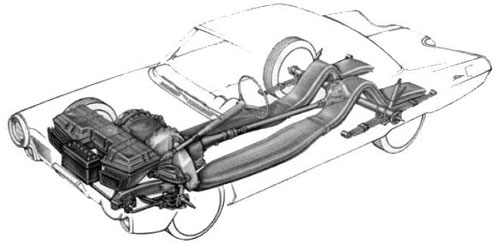
Built in ’63 to the tune of 55 examples, Chrysler’s Turbine Cars were never mass-produced, but did log an impressive number of miles as a demonstrator fleet. Essentially a completely normal car that happened to be powered, via the wheels, by a jet engine, the Turbine Car was a promising innovation dogged by politics all during its long gestation.

Chrysler Turbine Car Jet Engine Gas Engine Motor Powerplant Cutaway Diagram Schematic Drawing

How did it work? Quite simply. The turbine, which spun at up to 44,500 rpm, was connected to an ordinary torque converter and automatic transmission via a gear reduction unit. From there the power was transmitted to the back wheels by means of a basic Hotchkiss axle. The turbine required no liquid cooling system, and the bearings were sealed, so it needed no oil changes. A single spark plug provided the ignition source upon startup; after that the combustion flame was self-sustaining, much like the pilot light in a home furnace. Power output? A respectable 130 hp, and a startling 425 lb-ft of torque available just off idle, a characteristic of the turbine engine not unlike modern electric motors, and one that enabled the Turbine Car to hustle from a standstill to 60 mph in around 12 seconds, decent for the day.

What were some other upsides of the engine, besides the ones mentioned above? The engine could run on just about any combustible hydrocarbon (gasoline, diesel, kerosene, etc), and the operation of the turbine was exceedingly smooth. In addition the simplicity of the peripherals, the engine itself was blessed with only 60 or so moving parts, in contrast to the many hundreds of a typical piston engine. The reliability of the 55 demonstrators affirmed the turbine’s quality: They were an order of magnitude more durable than contemporary reciprocating engines, and that from a powerplant with a miniscule fraction of the development time undergone by its rivals.

Chrysler Turbine Car Jet Engine Gas Concept Cutaway Diagram Schematic Drawing

Disadvantages? In an era used to big, throbbing pushrod V8s, the vacuum cleaner-like sound of the turbine was off-putting. The engine did produce an excessive amount of exhaust heat—being, as it was, an actual jet engine—and Chrysler fitted an oversized and flattened exhaust system to absorb and diffuse as much of the heat as possible. Also, because of the temperatures inside the turbine, some exotic materials were used in its construction, raising the price tag a bit—though mass production and economies of scale would have certainly lessened the blow. One of the biggest downsides to the engine, and one Chrysler worked tirelessly to correct, was persistent throttle lag, caused by the time it took for the turbine to spool up and deliver power to the wheels. Drivers in the muscle car era of the ’60s expected instant power when they punched the gas pedal, and throttle lag cooled considerably whatever enthusiasm they might have felt for the new technology.

It’s a shame the Turbine Car wasn’t picked up for production, killed by politics and a general lack of public enthusiasm in the early ’70s. Perhaps if the red tape hadn’t been present, and the engine had had a company whose devotion to the engine was as strong as, say, Mazda’s for the rotary, we might see a handful of gas turbine-powered models for sale today. Who knows.

Editor’s note: This post is part of an ongoing series spotlighting obscure automotive engineering solutions. Read the other installments here:

5 Comments on Technical Curiosities: The Turbine Car

Left Lane

 by Matt

Goodbye to handheld gadgets in cars?

No Comments on Left Lane

Jalopnik

 by Matt

Must-haves for a well-equipped garage

No Comments on Jalopnik