Spannerhead Dot ComSpannerhead.com

Bionic Future: The Audi e-tron Spyder

October 19, 2011 by Matt

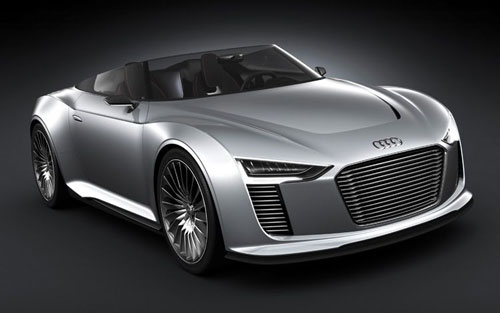
2010 Audi e-tron etron Spyder Convertible Cabrio

Audi has been allowing limited road testing of their e-tron Spyder diesel-electric hybrid concept car. Arguably a more successful design than that of the coupe version, the car represents a statement by the German automaker about its future both design- and engineering-wise.

Motivated by the combined efforts of a mid-mounted 296 hp twin-turbo diesel V6 driving the rear wheels and a pair of 43 hp electric motors powering the fronts, the e-tron Spyder will scoot from 0-60 mph in a claimed 4.3 seconds. Design-wise, the car seems to take the “Tron” part of “e-tron” name quite literally in its retro-futurism. Perhaps more than any other concept car, the e-tron embodies what we thought “cars of the future” would look like from the vantage point of the mid-’80s. It’s a compelling amalgam of the retro and forward-looking, blended so completely that specific cues that connect with either theme are difficult to pick out. The overall effect, though, resonates emotionally by tapping into a kind of nostalgia at the same time it points the way forward. Put another way, the e-tron Spyder at once looks like concept cars we’ve seen before as well as cars we’ll see in the future. It’s a fascinating effect.

In addition to giving automotive journalists restricted wheel time, Audi provides a video of the car in action. It’s well-made, and worth viewing.

Click on the jump to watch.

No Comments on Bionic Future: The Audi e-tron Spyder

0-60

October 18, 2011 by Matt

The GT-R experience, summed up

No Comments on 0-60

Sophomore Slumps: The Series 2 Jaguar E-Type

 by Matt

1970 Jaguar E-Type XKE Series 2 Mark 2 II

This one defines the automotive sophomore slump. Following the home run ’61-’68 Series 1 Jaguar E-Type, the ’69-’71 Series 2 was a complete whiff, and a cautionary tale for other manufacturers about how not to mess with a successful formula.

In essence, for every decision the company made right with the first generation car, they made wrong with its successor. Every subtle styling touch was tampered with and spoiled, and the resulting car lost almost all the delicacy and poise of the original car’s design. Rather than hone and refine the Series 1 E-Type’s look, Jaguar actually went backward, cluttering the shape with ham-fisted, amateurish features.

1970 Jaguar E-Type XKE Series 2 Mark 2 II

There were engineering justifications for many of the decisions. The switch from the earlier car’s beautifully-shaped mouth with a simple bisecting chrome bar to the second-generation’s gaping maw was driven by greater cooling needs. And the wart-like turn signal clusters that appeared on the Series 2’s jowls were probably added to improve lighting visibility. The giant chrome box that took up residence under the newly-connected rear bumper bar was probably unnecessary, though, and its visual weight and angularity clashed with the rest of the car’s sinuous curves. The simple headlight covers disappeared as well, replaced by exposed lights caked with far too much chrome icing.

1970 Jaguar E-Type XKE Series 2 Mark 2 II

Even the engine suffered a styling downgrade. The polished, exposed cam covers gave way to ribbed, matte aluminum pieces surmounted by the carb warming duct. Even when it’s clean, the engine just looks dirty compared to the Series 1’s work of automotive art.

I’ve focused on the styling, but the detuning of the mechanicals also deserves mention. For as much drivability the styling changes added (better cooling, lighting, etc), the dual emissions-strangled Stromberg carburetors took away with vapor lock problems, airflow restrictions, etc. Performance decreased notably compared to the Series 1 E-Type, and reinforced the notion that the Series 2 was actually a step backward from its predecessor.

In fairness, the impetus for many of the changes didn’t arise from the automaker itself, but from the external pressure of US emissions and safety regulations, an important consideration for Jaguar’s biggest export market. That said, I would have hoped the Coventry firm would have dug a little deeper and found a way to accommodate the regulations while still integrating the needed changes more harmoniously with the E-Type’s shape and purpose. The car has eye-popping curb appeal and excellent performance; don’t uglify and neuter the primary reasons 99% of buyers purchase the car. I understand the regulations came out of left field for many automakers and caught many unprepared, but Jaguar wasn’t yet in dire financial straits in the late ’60s; they had the resources to, well, try a little harder. How I wish they would have.

Editor’s note: This post is part of an ongoing series highlighting cars whose second generation failed to live up to the promise of the first. Read the other installments here:

3 Comments on Sophomore Slumps: The Series 2 Jaguar E-Type

Left Lane

 by Matt

Electric DeLorean in the works?

No Comments on Left Lane

0-60

 by Matt

Toyota FT-86 conquers the ‘Ring

No Comments on 0-60

Left Lane

 by Matt

Updated Mazda 3: Still smilin’

No Comments on Left Lane

The BMW F30: A Design Analysis

October 17, 2011 by Matt

2012 BMW 3-Series 335i 328i F30

Arguably the biggest car news of the year, BMW last Friday unveiled their 6th-generation 3-series, the 2012 F30. Every previous generation has represented the template, the high-water mark for sports sedans during its reign, so expectations are somewhat lofty for the new arrival.

With the F30, there are dozens of new features and attributes to consider; tonight, though, let’s ignore the mechanical and electronic and focus on curb appeal, or the styling of the new bread-and-butter BMW.

The nose. Probably the most-discussed aspect of the new car’s design are the unprecedented “tear ducts” connecting the headlights with the trademark “kidney” grilles. This element seems to serve two purposes: It draws its inspiration from recent BMW concept cars like their i8 EV, so is forward-looking in that respect, and it also hints at more classic BMW fascia styling, e.g. the ’80s E30, whose kidneys and headlights were embedded in a large rectangular grille. More questionably, it seems to inject a dose of “squinting” anthropomorphism into what was one of the most refreshingly non-human automotive visages in the business. At least the car doesn’t look happy. Goodness knows how that would have gone down.

2012 BMW 3-Series 335i 328i F30

The rear. Easily the most conservative angle of the car. An amalgam of the previous generation’s refreshed rump and BMW’s new F10 5-series, there’s absolutely nothing groundbreaking about the taillight area. We get a slightly higher trunk line than on the outgoing model, putting a bit more wedge into the profile, and the lights are arranged in BMW’s classic L-shape, nicely framing the car’s athletic tush. Considering recent BMW trunk disasters like the E63 and E65 “Bangle-butts” and the pre-refresh E90’s “clenched” rear end, I think we should all breathe a sigh of relief over the F30’s treatment.

2012 BMW 3-Series 335i 328i F30

The proportions and other details. My favorite styling attribute to discuss, and an area where BMW has traditionally excelled, the proportions are the car’s most successful design quality. In profile, where the distribution of visual masses is most easily distinguished, there are a couple of noteworthy changes from the previous-generation 3-series. First, the front overhang is more pronounced. The preceding three iterations of BMW’s 3-series—the E36, E46 and E90—featured front wheels that were pushed as far forward as possible, the front overhang becoming little more than a glorified fender holding the lights and grille. This benefited agility by lowering the polar moment of inertia around the car’s center of gravity, but it made for somewhat awkward wheel arch placement in profile. With the F30, the relationship between various areas of sheetmetal on the side of the car is normalized, creating a very harmonious effect.

The second significant deviation from its predecessor’s design resides in the angle of the nose. Pleasingly, it’s more upright, following its bigger brother the F13 6-series by moving in the direction of another classic BMW styling trademark, the sharknose. It’s an aggressive, distinctive nose treatment that subtly highlights the car’s RWD bias by suggesting that the styling doesn’t have to be stretched tight over an engine hanging out in front of the axle line. It gives the overall aspect of the profile a ready, forward lean—the car is set to lunge ahead, to attack the turns. Well done indeed.

2012 BMW 3-Series 335i 328i F30 M-Sport Interior

The interior. As with the rear end, the interior is nothing more than an evolutionary update of the previous generation’s. The trademark driver-angled, wide center console is present, as are the quad of analog gauges in the cluster. As conservative as it all is, the steering wheel of the M-Sport trim package (shown above) deserves special mention for looking especially bionic, attractive and, well, grasp-able. I feel like I need to sheath my hands in some sort of Tron-like exoskeletal gloves before I wrap my fingers around it. Very cool.

From a design standpoint, then, BMW did exactly what they needed to do to move the car forward, and nothing they didn’t. The F30 is a remarkably well-executed effort. Styling-wise, the BMW 3-series is dead, long live the BMW 3-series.

1 Comment on The BMW F30: A Design Analysis

Autoblog

 by Matt

Turn your Civic into a Veyron

No Comments on Autoblog

Top Gear

 by Matt

Hammond drives BMW Clownshoe

No Comments on Top Gear