Spannerhead Dot ComSpannerhead.com

What Might Have Been: The BMW 840Ci

August 19, 2011 by Matt

BMW E31 840Ci 850i 850Ci 850CSi

This one’s a bit dissimilar. In the case of the ’94-’99 BMW 840Ci range-topping GT, it’s not one, but two decisions I wish the automaker had made differently: They should have made the 6-speed manual transmission available with the V8 engine option in the US, and they should have trimmed at least 500 lbs from the car’s curb weight. Actually, the last wish really should have been something built into the car from its inception—4350 lbs (an even 4 grand for the V8 car) is ridiculously overweight for anything short of a Bentley with pretenses of sporty capability.

I’m well aware the market for big coupes was incredibly soft in the mid-late ’90s. Unlike the previous installment in the What Might Have Been series, where the alternate course of action I laid out made a certain degree of business sense, my desire to see a lighter, 6-speed 840Ci make it to our shores isn’t really driven by a regard for BMW’s bottom line. Rather, it’s borne out of a longing for a true E24 6-series successor—something the E31 intentionally was not. Even though it would have likely flopped in much the same way as the actual car did, a more downscale BMW E31 variant would provide an additional buffer of sorts between the much-missed E24 and its “official” successor, the perilously hideous E63. In other words, the E31 had the styling chops to follow the E24 (and how!); it just didn’t have the moves, a deficiency a manual tranny and a diet would have handsomely rectified.

BMW E31 840Ci 850i 850Ci 850CSi Interior

For what it’s worth, the E34 and E39 540i shared the 840Ci’s M60/M62 V8, and could be had with 6-speeds in the US, so in theory, a manual swap is very possible (if pricey). Also, the early V12-powered 850i was offered with a manual on our side of the pond, but the extra 4 cylinders added even more weight, the extra poundage being more than enough of an issue to excise for its lesser stablemate.

Again, I know full well the desires of enthusiasts frequently make little sense from a financial perspective, especially when the entire E31 program was a dubious investment in the first place. And truth be told, BMW actually did briefly consider a further downmarket expansion of the 8-series with the 830i, before having second thoughts and scrapping all but a single prototype. Still, the idea of a lighter, more driver-oriented BMW in the jaw-droppingly gorgeous E31 shape is an appealing one.

Editor’s note: This post is part of an ongoing series highlighting key decisions I wish automakers had made differently, for divers reasons. Read the other installments here:
2 Comments on What Might Have Been: The BMW 840Ci

Taking the Measure of the RX-8

August 18, 2011 by Matt

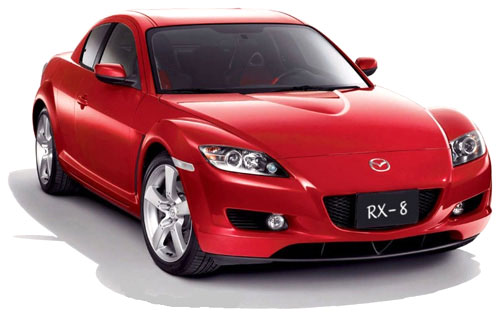
Mazda RX-8

As production of Mazda’s aging RX-8 sports coupe winds down and with it, production of the automaker’s signature rotary engine, I think it’s worthwhile to pause and scrutinize the car’s 8-year model run.

Introduced in 2004 in the US, the RX-8 represented the long-awaited reintroduction of the rotary engine to our market after the too-hasty departure of the 3rd generation RX-7 in 1995. Rumors had been swirling for years about which form the return would take, and after a series of teaser concept cars like the RX-01 and RX-EVOLV, it’s fair to say no one really knew how Mazda would package the engine, if indeed it did return. Would it be a fire-breathing road-eater like the 3rd-gen RX-7? A cheap and tossable sports car like like the 1st-gen? Or something completely different? More than anything, speaking as a Mazda fan and rotary buff, we just hoped Mazda wouldn’t compromise in the fun-to-drive department.

Mazda RX-8

We got something of a mixed bag. Jeremy Clarkson remarked in his review that the car looked like it had been “styled by suggestion box,” and that statement could have held true for the engineering as well. To summarize the pros and cons of the then-new RX-8, the good points:

  • Low weight. Mazda admirably kept the car around 3000 lbs for the entirety of its model run.
  • Excellent handling. Review after review praised the responsiveness of the chassis, and in their recent comparo, Car and Driver ranked the 7-year-old RX-8 an astonishing third, beating out even the M3.
  • Some measure of practicality. Stung by criticism of the late 3rd-gen RX-7’s single-minded focus on performance at the expense of everyday livability, Mazda added a pair of so-called “freestyle doors” to enhance rear seat access. They might well have been added to assuage the bean-counters’ fears, but they’re undeniably practical.

And the negatives:

  • Uneven styling. Compared to its arch-rival Nissan 350Z, released shortly before the RX-8, the Mazda’s design is much less coherent. The concession to a more practical roof line is partly to blame (the 350Z is a pure 2-seater), but no one can claim the added rear seat volume is responsible for the mess of lines called the nose. The smiley face grille (exacerbated with the styling refresh in ’09, shown below) and headlights are cartoonish when they should be sleek and serious, and the profile is bulbous instead of tapered and focused. And the clear taillights and other details represent, yet again, the worst tendency of Japanese designers to chintz up the outside of their cars.
  • Low power. I won’t take Mazda to task for the inherent high-revving nature of the rotary engine. The power’s at the top of the rev range, and you have to spin it—there’s no getting around that (good thing the engine makes the task so effortless). That said, what power was available wasn’t competitive in its class, and Mazda committed the cardinal sin of over-promising and under-delivering just as the car was released: They quoted a power figure of 250 hp; reality was closer to 232, and after independent dyno tests called Mazda’s bluff, they embarrassingly re-rated the car and offered to buy back those of any who were dissatisfied. At least they did damage control, but it happened at the worst possible time and to the ambassador of Mazda’s key technology. Stupid, dumb, unfortunate.

Mazda RX-8

Overall, I was a huge fan of the car’s dynamics, could have lived with the power (I don’t mind winding out my cars’ engines), but had real issues with the styling, especially the ’09 refresh. I don’t think the car hurt Mazda’s or the rotary’s image—public perception is still that it’s a gas-guzzling, oil-burning hamster wheel—but the RX-8 didn’t help matters either. Basically, it dutifully carried the “halo car” torch for Mazda for 8 long years, but didn’t broadcast itself to a wider audience in any capacity other than pleasant placeholder.

Does this mean I wish Mazda had “mainstreamed” the rotary, incorporating it into a more mass-market sedan or GT bodystyle, like the automaker did in the early ’70s? Not necessarily, but the RX-8 at least could certainly have benefited from a larger dose of conviction—the amalgam of roles and compromises bundled into the car spoke of an automaker that may have soldiered on with their signature technology as a matter of duty, but not necessarily as a matter of pride. As good as it was in many ways, the RX-8 simply wasn’t focused or stunning enough. Here’s hoping that whatever form the the next wrapper for the rotary takes, it at least has a strong identity—buyers can relate to that, and respond to it; witness what Mazda itself accomplished with the Miata. As for me, I’ll be eager to see what they come up with next.

No Comments on Taking the Measure of the RX-8

FWD Champions: The Honda Prelude

August 17, 2011 by Matt

97-01 Honda Prelude

Honda really can work wonders with their front-wheel-drive architecture. Take the 5th-generation (’97-’01) Prelude—the example under consideration here—which Car and Driver declared in ’97, after a comparo, to be the best handling car available for under $30K. And even when, just for kicks, they pitted the car several months later against the $30K-and-up crop of cars, the Prelude, hampered by the inherent limitations of FWD and only 197 hp from its H22A 4-cylinder, posted a respectable mid-pack finish, garnering the same score as the brutally fast Viper GTS. It’s a remarkable achievement for a 3000 lb FWD car with 63/37 weight distribution.

97-01 Honda Prelude Interior

What makes the difference? In a word, details. As mentioned above, the ’97-’01 Prelude was the 5th incarnation of Honda’s top-of-the-line sporty coupe, so they really had perfected the formula by the time of its release. The ideal suspension setup for handling—double wishbones all around—laid a strong foundation, and the steering feel’s perfection was matched by the action of the typically slick-shifting 5-speed. And the interior, liberated of the previous generation’s universally-decried weirdness, was a paragon of no-nonsense ergonomic efficiency.

97-01 Honda Prelude

All that said, as you might expect, the attribute that moves the car from “that’s nice” to “I’d seriously consider one as a daily driver” territory is the styling. Again eschewing the hunchbacked oddity of the ’92-’96 car’s design, Honda wisely chose to normalize the proportions, free the flanks of any chunky cladding, and inject a little Nissan R32 Skyline into the profile. It gives the car an aggressive, upscale look that has aged very well indeed. The only questionable element is the portrait-orientation headlight treatment, but even that isn’t a dealbreaker. It’s an exceedingly handsome car, and between that and the universal acclaim heaped on its handling prowess, I’d drive one in a New York minute. Even if the front wheels are doing all the work.

Editor’s note: This post is part of an ongoing series highlighting FWD cars I think highly of, in spite of my overwhelming RWD bias. Read the other installments here:

3 Comments on FWD Champions: The Honda Prelude

A Styling Non Sequitur

August 16, 2011 by Matt

BMW 328 Homage

I don’t get this one.

I want to give the designers the benefit of the doubt, but it just doesn’t pass the “obvious test;” in other words, when all’s said and done, what does the object in question most obviously resemble? And the answer in the 328 Homage’s case: An angry beaver. Once that comparison is stuck in your mind, there’s no getting around it.

The larger question is, how exactly is it an homage? Here’s the original ’36-’40 car, for reference:

Original BMW 328

So there’s a superficial resemblance in some of the details, like the wheels, hood straps, split windshield and long-nose / short-deck proportions. But otherwise… There’s little, if anything, in the homage that unambiguously recalls the original. I don’t think the homage needs to slavishly ape the original, either, but there’s a way to honor a legend stylistically without having to resort to campy details and the beat-me-over-the-head-with-it title of “BMW 328 Homage.” If I can’t draw the connections myself and be impressed with the coherence of the effort, the designers haven’t done their job. And with the Homage, they most certainly phoned it in. Thumbs down.

1 Comment on A Styling Non Sequitur

Underrated Lookers: The Y34 Infiniti M45

August 15, 2011 by Matt

2003 Y34 Infiniti M45

During the course of any model year, the automotive press and community investigate the merits of hundreds of different cars. Given the amount of sheetmetal that passes in front of the eyes of the typical automotive journalist, it’s inevitable that the styling of a few otherwise worthy-looking cars would be simply passed over as a matter of expediency. Today we take a look at an example of one such aesthetic diamond in the rough: The ’03-’04 Infiniti M45.

2003 Y34 Infiniti M45

Assigned the factory model code Y34 and only present in the US market for 2 years, the ’03-’04 M45 was hastily adapted from the Japanese-market-only Nissan Gloria, then nearing the end of its model run, in order to plug a BMW 5-series and Lexus GS-sized gap in the Infiniti model range. Its styling, then, was a bit long in the tooth from the get-go, in addition to being ill-tailored for the American market. So the cards were stacked against it, and the automotive press was cool in their appraisal of its looks; Edmunds wrote:

The M45 offers the sort of sheetmetal that would never get accused of walking on the wild side; viewed head-on, it calls to mind the infinitely unobtrusive Ford Crown Victoria, with a front end that’s broad and low. Wide rectangular high-intensity discharge xenon headlamps light the way, flanking a prominent, chunky grille. In back, rear overhang is significant.

Whatever the merits of the above critique, I think the car is a timeless classic. It will be said that in order to truly appreciate its lines, it helps to view it in the flesh. Last school year, a silver Y34 was always in the line of cars when I dropped my son off in the morning, and I couldn’t take my eyes off it. Overall, the quality that stands out is proportion. Contrasting with more modern vehicles (even the current iteration of the M45) whose distribution of visual masses is more or less identical from car to car, differentiated only through details like splashes of chrome or sheetmetal flourishes, the Y34 M45 achieves its distinctiveness not through bling, but through relative sizing of key components like the greenhouse, beltline and overhangs. The upshot is that as automotive detail fashions (twin exhaust tips, clear taillights, etc) come and go, the emphasis on proportion gives the car a more tailored, classic feel, meaning the Y34 looks fresh even 8 years after its introduction. And even from a distance, when all you see are the proportions, you’ll never mistake it for anything else on the road, so it achieves a kind of distinctiveness in spite of itself. I love it; I’d drive one.

Editor’s note: This post is part of an ongoing series featuring cars whose design I find appealing, in contrast to mainstream opinion. Read the other installments here:

11 Comments on Underrated Lookers: The Y34 Infiniti M45

Heart Transplants

August 14, 2011 by Matt

SBC Engine and 1st-Gen Miata

Let’s clear the air. After ages participating in car communities of many different makes and models, online and otherwise, I’ve come to the conclusion that there’s no more contentious issue than the idea of doing a cross-make engine swap; in other words, of swapping into a particular car an engine from a different make.

Examples abound and usually, but not always, involve dropping some flavor of American V8 into a lightweight or otherwise desirable import body:

  • Small-block Chevy V8 into RX-7
  • Ford V8 into Mazda Miata
  • SBC into Jaguar XJ6 or XJS
  • Toyota 1JZ into Datsun Z-car

For what it’s worth, it’s not a new phenomenon—professional tuning outfits and even OEMs have been splicing disparate powerplants and chassis for donkey’s years. The AC Cobra, De Tomaso Pantera and Ultima GTR have rightly become the stuff of legend; the cars may have had their flaws, but without the easy availability and modularity of the engines (and the ingenuity of the designers), the aforementioned cars wouldn’t have seen the light of day. More than that—the engine and body each supplied something the other lacked and created cars that were more than the sum of their parts.

So what say you? Is a cross-make engine swap acceptable, and if so, under what circumstances? Is the union between factory engine and chassis sacrosanct; that character inviolable? And if you would never, ever, desecrate a car by shoehorning an engine of a different persuasion under the hood, what about another engine of the same make—say, a BMW V8 into an E24 6-series, or a Nissan RB26DETT into a 240Z? Do you take a stand for a car’s purity, or simply choose the best tool for the job?

No Comments on Heart Transplants

Electric Decisions

August 13, 2011 by Matt

Tesla Model S

New pictures surfaced today showing the upcoming Tesla Model S sedan side by side with the headline-grabbing EV automaker’s much-hyped Roadster.

At this point, I’m not sure whether the attempt to completely rip off the styling of the Maserati Quattroporte and especially the Aston Martin Rapide is an utterly shameless lack of design originality, or a masterful recognition of the qualities that give those two cars instant pull in the stratospheric price points they inhabit ($125K and $200K, respectively).

That said, if Tesla manages to talk potential owners through uneasiness over the car’s electric range, and they can get their logistical ducks in a row (production capacity, dealer network, advertising, etc), the car has the potential to be a game-changer at its target MSRP of just over $55K. I mean, who wouldn’t want a car as sexy as the $20K more expensive Audi A7, with the added trendiness of being an EV, at a “paltry” 15 grand (pre-incentives) over the exponentially frumpier Chevy Volt? I’ll speak for myself, but between those two, it’d be a no-brainer to hunker down and save the extra cash (or cough up the extra monthly premium) to drive the Tesla over the Chevy.

1 Comment on Electric Decisions

Left Lane

August 12, 2011 by Matt

Fan of the Bond cars? Check it out. (more…)

No Comments on Left Lane

Motor Trend

 by Matt

Whoa: D3 CTS-V wagon tested (more…)

No Comments on Motor Trend