Spannerhead Dot ComSpannerhead.com

Technical Curiosities: Nivomat Dampers

April 8, 2013 by Matt

Volvo 780 Bertone Silver Rear

Editor’s note: As a point of clarification, I will be using the more technically correct term “dampers” to refer to what are normally, but misleadingly, described as “shock absorbers.”

Fitted prominently to the Volvo 760 sedan and 780 coupe, among many others including Rovers, Opels and Mitsubishis, Nivomat dampers should be more well known. But they seem to remain an obscure detail uncovered only by new owners of cars fitted with the system, and then usually only when it fails.

Nivomat Shock Absorbers Dampers

A combination of the French words niveau (level) and automatique, Nivomat dampers combine the function of the car-supporting spring and damper into one self-contained unit. As a result, they can be a source of particular frustration when they go bad, since the whole unit must be replaced, unlike a conventional suspension which isolates failure to either the spring (uncommon) or damper (more common). Not only that, Nivomat dampers’ relative rarity compounds the challenge by making parts that much more difficult to source and expensive.

Does the Nivomat system have any redeeming qualities? Absolutely; as mentioned, the units combine springs and dampers, but more than that, as implied by the name, they automatically level the car regardless of the load conditions. No more sagging rear end when the back seat and trunk are fully loaded—the Nivomats’ internal pressure rises to compensate and restore the normal ride height. It’s worth noting, as well, that most, if not all applications fitted the system only to the rear wheels, leaving the fronts with a conventional spring-and-damper setup.
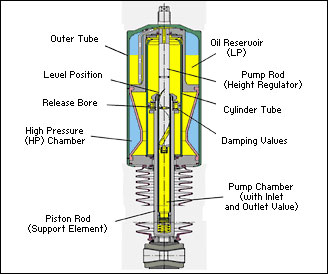
Nivomat Shock Absorbers Dampers Diagram Drawing Schematic

The Nivomat system is hardly the only self-leveling suspension (SLS) on the market—BMW and Mercedes, just to name two, developed their own SLS systems—but what truly sets it apart is its completely self-contained design. Where other SLS systems require a support network of pumps, lines and valves, raising the part count and drawing (an admittedly small amount of) power from the engine, a Nivomat damper has an internal pump and relies on car’s normal up-and-down suspension movement as it drives for the energy needed to operate, much like a self-winding watch depends for its power on the movement of the wearer’s arm. It’s a remarkably clever design that harnesses what would other be wasted energy in service of a useful function.

Sadly, as widespread as they were, Nivomat dampers never really became mainstream. The system persisted for 20+ years, but modern electronic suspension setups eventually eclipsed the Nivomat system’s mechanical novelty.

Image credits: netcarshow.com, wardsauto.com, ipdusa.com

Editor’s note: This post is part of an ongoing series spotlighting obscure automotive engineering solutions. Read the other installments here:

2 Comments on Technical Curiosities: Nivomat Dampers

A Collection of Cars That Were Debadged…
By Their Manufacturers

April 5, 2013 by Matt

In the automotive world, the ultimate badge of shame is the lack of one applied by the factory. The following are a few examples of cars effectively disowned by their manufacturers while they still remained in production.

Pontiac Aztek Yellow Rear

Pontiac Aztek. The modern byword for complete automotive failure, it appears Pontiac had an inkling that the Aztek’s reception would be…less than favorable almost as soon as it hit showrooms, and quietly downsized its badging. The car’s name is still present, but only in non-contrasting body colors, and the trunklid bears the smallest logo imaginable. I wonder if they repurposed the keychains from the Pontiac gift store in order to create the emblems?

Hyundai Genesis Silver

Hyundai Genesis. This one’s somewhat unfortunate, since by all accounts the Genesis is a very nice car, and pleasing (or at least not offensive) to look at as well. Conscious that potential buyers might harbor concerns about brand cachet, its manufacturer designed the car with an unadorned grille and hood, as shown above. Here’s an idea, Hyundai: Why not create a new luxury marque and release the car under that brand? It’s not like it’s never been done before, and would give you the opportunity to, you know, actually seem proud of the worthy car you’ve created?

1995 Buick Skylark Grille

Buick Skylark. Between its angular grille (which paid homage to that of the 1940’s Buick Special), and its overwrought, late-’90s-Pontiac-ish plastic body cladding, the 1992-1995 Skylark was hardly a looker. It had the potential to be attractive, but Buick seemed to take all its designers’ worst ideas and combine them on one car. Initially released with a badge, after a year or two the emblem was removed from the grille, the prominence of which made the design decision very obvious. The Skylark underwent a full refresh for 1996 and the result looked much more normal…if more forgettable. So it goes.

Kia Amanti Gray

Kia Amanti. Like the Genesis above, this is another case of an economy car automaker attempting to go upmarket, but worried (somewhat justifiably) customers would cringe at the idea of driving a “luxury Kia.” So off came the badge, leaving other drivers to wonder exactly what kind of car was filling their rearview mirrors. As for the Amanti itself, other than styling that slavishly aped that of the W210 and W211 Mercedes E-Class sedans, Kia’s first crack at an entry-level luxury car was merely serviceable.

Image credits: netcarshow.com, carsdirect.com, caranddriver.com, cars-on-line.com

9 Comments on A Collection of Cars That Were Debadged…
By Their Manufacturers

FWD Champions: The Peugeot 205 GTI

April 1, 2013 by Matt

Peugeot 205 GTI White

The alloy wheels, the wedgy, aggressive stance… Growing up a budding car enthusiast in southern France and blind to little else besides high-end exotics, the Peugeot 205 GTI made an impression. It stood out.

It helped that I wasn’t so inured to the sight of visually hopped-up economy cars; in the mid-late ’80s a budget hatchback with sporting pretensions was something new. And in the case of the 205 GTI, the appeal extended beneath its skin. As with its VW equivalent, the specs weren’t anything to get excited about: 1.6 and 1.9 liter engine options producing a maximum of only 126 hp pulling a chassis whose underpinnings were decidedly bargain-basement. A little carefully-applied suspension tuning and some detail changes here and there, though, made the 205 GTI feel positively alive behind the wheel, never mind the fact that power was delivered to the front wheels.

Peugeot 205 GTI Red

It just looked light, lithe, playful, spritely—and the chassis delivered in massive fashion with telepathic steering response and an eagerness to rotate that beggared belief for a FWD car. The simple, unadorned lines have aged remarkably well too; it still looks almost as fresh as it did 30 years ago. It’s a case study for car designers in how carefully proportioning (as opposed to mere decoration) can dramatically extend a car’s stylistic shelf life.

Peugeot 205 GTI Interior Inside Cockpit Console Dash Dashboard

Sadly, the 205 GTI was never imported to the US. The car’s massive success overseas prompted talks of bringing it stateside, but in the end it came to naught. However, with the recent loosening of import restrictions for cars at least 25 years old, the very real possibility exists that a 205 GTI could be brought over and registered. The car was made from 1984 to 1994, so at least the first few years of production are theoretically available to us here in the US, and given its popularity in Europe, decent examples could probably be had relatively cheaply. Worth checking out!

Image credits: driversgeneration.com, mad4wheels.com, sub5zero.com

Editor’s note: This post is part of an ongoing series highlighting FWD cars we think highly of, in spite of our RWD bias. Read the other installments here:

8 Comments on FWD Champions: The Peugeot 205 GTI

Winter Romance: The White Shark

March 29, 2013 by Matt

1986 BMW E24 6-Series 635 635CSi Alpine White

Selling this one was the right thing to do. At least that’s what I tell myself.

Ending a self-imposed 3-year “exile” from interesting cars, during which time I commuted to work in a beat-up late-’90s Saturn wagon (which served me admirably, I should add), the acquisition of my 1986 BMW 635CSi was at the same time a very deliberate purchase and an impulse buy.

I’ve always had an affinity for big GTs. I had just sold our (very faithful) 1993 Volvo 940 Turbo, and was still somewhat involved with the Volvo Brick community. But I also wanted something more engaging to drive, and I’d never owned a BMW before. Taking all that into consideration, I gravitated toward either a Volvo 780 Bertone—Volvo’s quirky, academic coupe of the late ’80s—or the E30-generation BMW 3-series. I knew an E30 would surely satisfy me from a driver’s standpoint, but there was (and is) something about the Volvo 780’s uniqueness—not to mention the familiarity of its platform—that I found very appealing.

1986 BMW E24 6-Series 635 635CSi Interior Inside Cockpit Console Dash Dashboard Manual Stickshift

So combine some of the driver’s car qualities of the E30 with the big, unique GT angle of the 780, and during the course of my deliberations, I arrived at the BMW E24 6-series. The E24 had presence, adequate pace, perfect proportions and was available with a 5-speed. I found the example shown here on Craigslist. I e-mailed the seller; he was the third owner and lived just down the road. I arranged to meet him one late summer evening in local grocery store parking lot; with my first in-the-flesh glimpse of the car, I knew it was something special.

It had 253K on the odometer, an amazingly stiff clutch pedal and the dash was cracked in multiple places (typical E24 interior problem), but the paint was in fantastic shape, it ran perfectly and most importantly, there wasn’t a hint of rust on the car, being as it was of west-coast origin. The big M30 straight six made a lovely sound as it hustled its way up to redline and the engine’s midrange punch was very impressive. So with little research, only a day or two after the very idea of acquiring an E24 had popped into my head, I bought one.

I owned the 635 for 9 months, from late August through the following April. It never let me down; never missed a beat, even with as many miles as it had. Autumn cruises through the piedmont with the windows rolled down were heaven. I got admiring glances from folks at gas stations and thumbs up from other BMW drivers. I was introduced to the wonderful E24 community, chock-full of helpful, unpretentious owners with encyclopedic reservoirs of knowledge about the car. With all that, though, I still began to be, if not exactly eager to sell, at least resigned to the fact that I had to get something else, for a number of reasons.

1986 BMW E24 6-Series 635 635CSi Alpine White

The first problem is illustrated above: The E24 was my daily driver all throughout a particularly snowy winter. The car was rust free, and ’80s BMWs not exactly being known for their comprehensive and durable rustproofing, I was on pins and needles every time I drove it through the slush, or even in the rain. I took it to the coin-op car wash at least twice a week during that period, but that didn’t assuage the feeling that I was accelerating whatever seeds of deterioration were planted in the fenderwells and rocker panels. It was awful owning such a classic and knowing I had to drive it in those conditions.

Next, the car didn’t fit our family’s car project paradigm. My 240Z project had yet to commence, but I knew it would, and if I’d kept the E24, my car affections would have been split between it and the Z. In the end, our family budget wouldn’t support more than the Family Hauler + Daily Driver + Project Car equation, and the 635 ventured too far into the Project Car category.

1986 BMW E24 6-Series 635 635CSi Engine Motor M30 M30B34

And finally, I simply hadn’t done enough research before buying the car. If I had waited a week or two and gathered additional information, I might have learned that a gray-market Euro import E24 can be had in similar condition to the one I bought for a very small premium over the price I paid—if not the same price. Euro E24s are blessed with a higher-compression engine, oftentimes can be had with a close-ratio dogleg gearbox and most importantly, sport the lovely thin-profile Euro bumpers that absolutely make the lines of the car. I liked my 635 very much, but I never got over the hideous US-spec “diving board” bumpers and the way they contrasted with the beautiful Alpine White paint.

I was sad to see it drive away. Its present owner lives in the sunny, snow-free Florida panhandle and is an ’80s BMW enthusiast, hopefully putting many happy miles on the car.

5 Comments on Winter Romance: The White Shark

A Gallery of Tailpipe Placement

March 27, 2013 by Matt

Rear Mercedes Benz W210 E55 AMG Silver

Left-mounted. A common arrangement, the only practical disadvantage has to do with the fact that the fuel filler door is almost always located on the opposite side of the car from the tailpipe. The configuration makes pulling up to a gas pump a bit trickier for those of us in LHD countries. Many Toyotas, Nissans, BMWs and Mercedes locate their cars’ tailpipes on the left side.

Rear Mazda RX-7 FD White

Right-mounted. My favorite arrangement, for the simple reason that when observing a LHD car from the rear, looking through the rear window, the silhouette of the driver’s head is located on the left side of the car. This visual asymmetry is neatly balanced by locating the tailpipe on the right side, under the rear bumper. Mazda particularly seems to favor this setup.

Rear Honda Accord Gray

Dual. Once confined to exotics and high-end sports cars, the dual tailpipe arrangement has trickled down into every car category, from luxury SUVs to hot hatches. Its ubiquity has diluted much of its visual impact, and now dual tailpipes seem rather cliche and unoriginal, especially when added to cars with transverse or inline engines, where there isn’t a direct correspondence between a longitudinal, V- or flat-engine’s cylinder bank and one tailpipe side.

Rear Porsche Boxster Yellow

Center-low-mounted. The Porsche Boxster (shown above) and Cayman, along with Mini’s performance line, among others, feature the center-low-mounted tailpipe setup. Advantages include perfect visual symmetry (so long as the driver isn’t in the car); a downside is the tendency for the arrangment to make the rear of the car look taller and narrower than it is—and most performance cars would prefer to project a lower, wider image.

Rear McLaren MP4-12C Orange Red

Center-high-mounted. So far, this layout has only appeared on high-end exotics like the McLaren MP4-12C (above) and Pagani Zonda. A full-width, perfectly-optimized rear diffuser can be developed for these cars without having to work around tailpipes. The weight of the muffler(s) and tailpipes does have to be mounted higher in the chassis, though, raising the CG somewhat, and any risks to passers-by from a thigh- vs ankle-level exhaust outlet have yet to be assessed.

Rear BMW M635CSi Gray Grey

Whatever. Vintage BMWs (among others) make me smile. Featured most prominently on cars such as the classic 2002 and E24 6-series, in that golden era BMW obviously had higher priorities than tucking their cars’ tailpipes neatly into one particular corner of the bumper. The slightly off-center layout says “I don’t really care where the exhaust comes out; I’ve got bigger fish to fry development-wise, like perfecting the suspension design and harmonizing all the controls.” I love it.

13 Comments on A Gallery of Tailpipe Placement

The New King of the Hill:
950-hp Shelby GT1000

March 25, 2013 by Matt

Ford Mustang Shelby GT1000 1000 Dark Blue

This is getting a little ridiculous.

Top Gear has info today on the newest Mustang breathed upon by the tuning gods at Shelby, the 950-hp GT1000.

While I’m not quite sure about the chronology here:

[It] arrives on a wave of history: exactly 50 years ago Carroll Shelby premiered the Cobra at the ’62 New York motor show, announcing the arrival of a new tuning house.

seeing as how it’s 2013, there’s no doubt Shelby’s creation is designed to steal some of the new C7 Corvette’s thunder at the upcoming 2013 New York Auto Show and to stoke enthusiasm for the outgoing Mustang generation, even as a new one is being readied by Ford.

Ford Mustang Shelby GT1000 1000 Engine Motor Supercharger Blower

What we have here, essentially, is an officially-sanctioned version of a particular flavor of tuner car familiar to almost all enthusiasts: The dyno queen. Bragging rights are the GT1000’s sole raison d’être. Whoever shells out the asking price of $200K (for a Mustang!) for one of the 50 that will be produced can claim ownership of unarguably the most monstrous pony car ever screwed together by an official tuning house. Nevermind the fact that there’s absolutely no way that kind of power is usable in a street or track setting; wheel that baby up onto the dyno rollers, fire up the digicam and get ready to upload the video of the pull to YouTube and achieve instant Internet fame. That’s it, really, aside from sedate cruises to local meets and being lovingly waxed every couple of weeks. I understand Shelby’s reasoning behind the GT1000’s build, but as a prospective automotive experience, to me, it’s less than desirable. No thanks.

Image credits: mustangsdaily.com, motortrend.com

4 Comments on The New King of the Hill:
950-hp Shelby GT1000

3 Cars With Attractive Rears
Let Down By Ugly Noses

March 22, 2013 by Matt

Subaru Legacy Rear Black

Subaru Legacy Front Silver

2003-2009 Subaru Legacy. Every time I come up behind one of these, I make a mental note to look for a nice 5-speed on Craiglist when I return home…and then I pass it and catch a glimpse of the nose in my rear view mirror. The concave rear treatment combined with the inswept taillights and general stance give the ’03-’09 Legacy a taut, arrow-like presence from the side and rear. But the fascia is so awkward, so anodyne it completely undercuts the effect.

Nissan Altima Rear Silver

Nissan Altima Front Silver

2007-2012 Nissan Altima. While maybe not attractive in the conventional sense, the ’07-’12 Altima’s rear gets major points for being immediately recognizable and adventurous. The way the tops of the taillights flow into the horizontal surface of the trunk recalls a sports car’s low, wide rear—even if the Altima’s isn’t; the visual effect is there. Come around to the nose, however, and all the adventurousness melts away, replaced by a yawn-inducing, stock corporate grille treatment. Unfortunate.

Acura CL Rear Silver

Acura CL Front Silver

1997-1999 Acura CL. The 1997 CL’s lovely rump was actually featured on a Car and Driver cover back in the day. The nose, however, was buried further in the story, and for good reason. Compared with the distinctive taper of the trunklid and elegant simplicity of the taillights, the fascia was depressingly conventional. The grille, the headlights—they were all in the usual places, but none of it converged with the same eye-catching grace as the elements in the rear.

Image credits: netcarshow.com, motortrend.com, theautochannel.com

7 Comments on 3 Cars With Attractive Rears
Let Down By Ugly Noses

On Unfinished Car Projects

March 20, 2013 by Matt

Toyota Supra 1JZ Swap Wiring Harnesses

I miss my previous cars. I think about them often, reminiscing about overall qualities and specific situations, snapshots from my experiences with the RX-7s, the Supra and the Audi 4000, among others. From time to time, though, my nostalgia for a particular car seems to spike, and I think I’ve identified at least one possible culprit: The feeling of an unfinished project.

No, not open-ended projects currently in progress—outright failures. The images at the top of this post represent arguably my biggest failure when it comes to automotive projects. They’re a before-and-after of the wiring harness of my 1988 Toyota Supra Turbo, whose engine, during the fall, winter and spring of 2003-2004, I decided to replace with a Japan-only, half-as-powerful-again 1JZ-GTE unit. The physical swap itself went perfectly smoothly and was complete within a couple of weeks, but the necessary wiring harness lengthening operation wasn’t. The harness I acquired had already been hacked by a previous tuner, and in the process he had made a complete hash of it, to the point where, with everything connected, the car would barely start and stay running for a couple of seconds. After a few experiments and rabbit trails, I eventually decided to completely pull the harness and clean up the wiring, the result shown at right. To my great dismay, although the overhauled harness improved the situation to the point where the car was (barely) drivable, it didn’t solve the car’s fundamental running problems, and after struggling with it for several more months and losing motivation (and running out of money, natch), I decided to unload the whole project.

The right decision it may have been at the time (I was in the midst of some pretty major life changes during that period as well), but in retrospect I desperately wish I had at least had the persistence to overcome the car’s problems and sell it as a fully-functional driver. The new owner, a Toyota tech from Charlotte, camped out in my apartment complex garage for an evening or two, sorting everything out, and drove the Supra home, fueling the immediate feeling of regret by demonstrating how close I had been to a solution. Even now, it just bothers me that there was a car project I didn’t finish. The car was not complete. I didn’t have a chance to experience it at 100%, to assess it on its merits after having been swapped and make an decision about whether to sell then. Yes, I probably would have kept it, at least for longer than I did, but there wouldn’t be any loose ends dangling in my personal car history.

What about you? Do you have any unfinished projects or unsolved problems lurking in your automotive past? If so, does it bother you?

No Comments on On Unfinished Car Projects

Styling Misfires: The ’04-’06 Pontiac GTO

March 18, 2013 by Matt

2004 Pontiac GTO Red

It could have been great. Really.

Arriving in showrooms a year before Ford’s acclaimed Mustang reboot in 2005, the 2004-2006 Pontiac GTO had a real chance to vault past its eventual competitors, including the Chevy Camaro and Dodge Challenger, as the first of a new generation of muscle cars. Pontiac’s “GTO” nameplate has volumes of automotive history and lore to draw from, aesthetically and philosophically, and the platform chosen for the new car was GM Australian subsidiary Holden’s excellent Monaro sports GT.

2004 Pontiac GTO Red

Such potential…such failure. The GTO never even approached GM’s sales expectations and lingered in showrooms for a few lonely years before being quietly euthanized. What happened?

To put it mildly, the enthusiast community was underwhelmed. I pin the vast majority of the blame on the looks. It really is hard to fault the combination of a GM pushrod V8, RWD chassis, 6-speed manual transmission and competent suspension tuning. All reviews of the day noted that although the dynamics of the car lacked the ultimate polish of the GTO’s European rivals, they were exemplary for an American car, and for Pontiac especially, who, as noted in the recent post on the equally ill-fated G8 sports sedan, had been forced for years to convince the buying public that warmed-over, badge-engineered FWD family sedans were the last word in “performance.” Finally, finally, they received a platform with all the mechanical organs in the right places, and…the styling deep-sixed the car’s chances before the enthusiast community even entered the showroom.

It’s not that the GTO is an ugly car—it’s not—it’s just… Utterly anonymous-looking. Plastic. Jellybean-like. It could have been the 2-door version of a contemporary FWD Pontiac family sedan and no one would have been the wiser. It did not mine any classic GTO design themes or cues, and its innocuous aesthetics were completely at odds with any kind of rip-snorting “bad boy” muscle car feel its chassis tried to convey.

2006 Pontiac GTO Silver

For its last two model years in 2005 and 2006, Pontiac attempted to “beef up” the car’s visual flair with a pair of hood scoops and true dual exhaust tips, among a handful of other detail changes, but it was too little, too late, and anyway the changes didn’t alter the GTO’s fundamental styling shortcomings. Pity; there was so much goodness under the skin.

Image credits: netcarshow.com

Editor’s note: This post is part of an ongoing series wherein we discuss unsuccessful cars whose styling was their overlooked (or denied) Achilles heel. Read the other installments here:

3 Comments on Styling Misfires: The ’04-’06 Pontiac GTO