Spannerhead Dot ComSpannerhead.com

Audi R8 V10 Plus Ad: The Animal Within

March 15, 2013 by Matt

Note to other performance automakers: This is how you do a commercial if you want to get your enthusiast base fired up about your flagship’s capabilities. None of that gentle-winding-through-a-wooded-backroad crap—which, ironically, Audi’s also done—just pure, raw, unadulterated power, full stop.

Aside from the visceral appeal, it’s quite a brilliant ad for Audi in that it directly addresses one of the main criticisms leveled against their R8 supercar: It’s too user-friendly, too sterile, too easy to drive quickly and not edgy enough to be called a proper supercar. As a result, the entire focus of the clip is on the roaring, crackling, popping, savage, well-nigh alive quality of the car’s engine—with a nice shot of the ultra-wide rear tires thrown in for good measure—dispelling any notion that the R8 is some kind of ho-hum “speed appliance.”

Between this and their well-received Super Bowl commercial, Audi’s marketing has been firing on all cylinders lately. I particularly appreciate the ads’ focus on the cars themselves, instead of simply trying to gin up an emotional reaction via a non-automotive storyline. It speaks to the confidence Audi (rightly) has in their design and engineering that in many cases the spots highlight those aspects of their cars which, according to conventional wisdom, would have less mass appeal. Well done, Audi, and carry on.

2 Comments on Audi R8 V10 Plus Ad: The Animal Within

Interesting Engines:
Saab’s Variable Compression Engine

March 13, 2013 by Matt

Saab Variable Compression Engine Motor SVC

This engine had real promise.

Killed by Saab’s GM overlords due to budgetary reasons, the Swedish automaker’s variable compression engine, or SVC, had one of the most favorable risk/reward ratios I’ve ever seen. In other words, for the small amount of new, unproved technology used, the potential benefits were phenomenal.

As with most new engine technology, the touted benefits of the SVC included (much) more power from a given displacement, along with substantially increased efficiency. The proof-of-concept engine, shown in the accompanying images, was a supercharged 5-cylinder displacing only 1.6l, yet it delivered a remarkable 225 hp, with 30% less fuel consumption than a conventional engine of similar output.

Saab Variable Compression Engine Motor SVC

The secret to the SVC’s capabilities was the movable “Monohead” that allowed the engine’s compression to vary dynamically between 14:1 and 8:1. The engine’s control unit would raise the compression toward the higher setting in low load situations in order to squeeze the most energy from a given amount of fuel. And when higher power was required, the compression was lowered to accommodate the boost delivered by the supercharger and avoid engine-damaging detonation.

Saab Variable Compression Engine Motor SVC

The Monohead was hinged on one side, and actuated from the other with a stepless hydraulic crank (shown above). In practice, the system moved the cylinder head alternately closer to and farther away from the top of the pistons at top dead center, decreasing or increasing the “squish” volume, thereby varying the compression ratio.

Simple, robust, effective: The Monohead was really the only innovation introduced by the SVC; everything else—pistons, ignition system, intake and exhaust, supercharger, etc—was proven, off-the-shelf technology. As I mentioned, given the engine’s promise, the amount of R&D required was shockingly low.

So what happened? After being unveiled at the 2000 Geneva Motor Show, Saab’s corporate bosses at General Motors decided the project would consume too much development capital, and pulled the plug. They apparently thought badge engineering Subarus and GMC Envoys as Saabs was a better direction for the brand than potentially groundbreaking new engine technology… Given the Swedish automaker’s demise last year, we’ll never know if the SVC would have secured Saab’s future, but we know for certain that GM’s pathetic and shameful marketing strategy didn’t.

Check out Saab’s promotional video for the engine:

Further reading: SaabNet article, autozine.org article

Image credits: autospeed.com, carenthusiast.com, autocentral.com

Editor’s note: This post is part of an ongoing series examining unique and significant powerplants. Read the other installments here:

3 Comments on Interesting Engines:
Saab’s Variable Compression Engine

Hoping for Mediocrity?
The Alfa Romeo 4C

March 11, 2013 by Matt

Alfa Romeo 4C 2014 White

A “launch edition” of Alfa Romeo’s mid-engined Boxster-fighter, the 4C, was recently unveiled during the 2013 Geneva Motor Show, Motor Authority reports. As the first morsel of Alfa’s upcoming reintroduction here in the States, we enthusiasts should sit up and take notice.

Alfa Romeo 4C 2014 White

It will be fantastic to see Alfa return to the American market. There’s been a real decline in the number of desirable new cars that make absolutely no rational sense from an ownership perspective, and however Alfa has improved its cars’ reliability and other left-brained attributes, the brand will forever be associated with their charismatic yet heartbreaking cars of years past. So as crazy as it sounds, I actually hope their 4C compares unfavorably to its competitors like the Boxster in a number of key areas; being unable to make a case for the Alfa from a rational standpoint will only enhance its romantic appeal. A healthy dose of numeric mediocrity (as long as it doesn’t come at the expense of subjective sweetness) will only ensure that those who buy it are fully committed to the idea that the essence of a car is more than its power figures or Nürburgring lap times, and who better to make that case than Alfa Romeo?

Image credits: netcarshow.com

No Comments on Hoping for Mediocrity?
The Alfa Romeo 4C

Audi Concepts: The TTS

March 8, 2013 by Matt

Audi TTS Concept Gray

Whatever your thoughts about the production version (too cute, not a real sports car, etc), there’s no denying Audi’s initial TTS Concept, unveiled in 1995, was groundbreaking.

Let me explain. The TTS Concept is an exercise in context—every single styling feature has meticulously thought-out relationships with the ones surrounding it, and the overall result is an incredibly cohesive-looking vehicle. Most significantly, Audi gave the car’s wheels a context—notice how the curve of the front and rear of the car neatly echoes the circular arc of the wheels. This has the effect of integrating the wheels more closely into the TTS’ overall look.

Audi TTS Concept Gray Rear Back Taillights

Big deal, you say; cars have had wheel arches and fender flares for ages. True, but to my knowledge the TTS was the first car to have such a tight connection between its wheel design and placement. Consider: If you changed the average car’s wheelbase by an inch or so in either direction, it would hardly alter the car’s look, but with the TTS, the wheels are located precisely where they are because of how they relate to the car’s front and rear styling; any change in their location would wreck the design.

Audi TTS Concept Interior Inside Cockpit Console Dash Dashboard

With its chunky “baseball glove” stitching mated to clean, geometric shapes, the interior is a home run as well. Some elements didn’t survive the transition to production, primarily the aforementioned stitching, the gauge typography and the raw aluminum door bars, but Audi wisely kept most everything else intact. Between the color combination (chocolate leather and battleship gray paint), meaty switchgear and a perfectly laid out control arrangement, the TTS’ interior looks like a very inviting place to be.

Audi TTS Concept Interior Inside Cockpit Console Dash Dashboard

I think what I appreciate most about the TTS Concept is its fusion of the beautiful with the rational. Every single line, curve and feature seems designed and placed with a definite sense of purpose; it’s the antithesis of the “Well, it just looks right” school of design. No, the best styling efforts have thought and intentionality behind them, and that design creedo shines through the TTS Concept.

Image credits: fourtitude.com

Editor’s note: This post is part of an ongoing series discussing Audi’s rich history of legendary concept cars. Read the other installments here:

2 Comments on Audi Concepts: The TTS

Design Showdown:
McLaren P1 vs. LaFerrari

March 6, 2013 by Matt

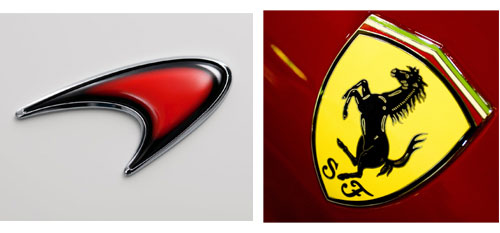
McLaren Ferrari Logos

In anticipation of their reveal at the upcoming 2013 Geneva Motor Show, the automotive world is abuzz with talk of the latest offerings from perennial Formula 1 and road-going supercar rivals McLaren and Ferrari.

You can read more about their staggering technical specs here; for now, let’s examine them from a design standpoint and weigh in on which one is more aesthetically successful, or, to tip my hand a bit, which one is less ugly.

Our first contender is McLaren’s so-called F1 successor, the P1. Sinewy and organic, the eyebrow-like McLaren logo is echoed in many places throughout the bodywork. Like its little brother the MP4-12C, though, the P1 manages to look dramatic and somewhat anonymous at the same time. Its lines don’t strike me as being particularly resolved, and as such the whole car has a nervous, fragile, unsettled look about it.

McLaren P1 Yellow

McLaren P1 Yellow

McLaren P1 Interior Inside Cockpit Console Dash Dashboard

Next up is the brand new follow-on to the Enzo, the ridiculously-named Ferrari LaFerrari. Unveiled in the past couple of days, the LaFerrari certainly looks more conventional than its British competitor. Still, the black roof and stock supercar proportions combine to make it look like a cutting-edge supercar for, say, 1994.

Ferrari LaFerrari Red

Ferrari LaFerrari Red

Ferrari LaFerrari Interior Inside Cockpit Console Dash Dashboard

On the merits of its styling, which do you prefer? I honestly can’t pick a favorite. I appreciate the creativity of the P1, but the LaFerrari’s lines are more resolved overall. Until an automaker can pen a supercar design at once fresh-looking, well-proportioned, with exquisite detailing and above all, beautiful—yes, I do believe it can be done—I don’t know that I will have a dog the burgeoning supercar fight, a conflict that includes not only the cars featured in this post, but offerings from Porsche, Pagani and Lamborghini as well.

Image credits: netcarshow.com

3 Comments on Design Showdown:
McLaren P1 vs. LaFerrari

Automotive Art: The OS Giken TC24-B1Z

March 4, 2013 by Matt

Nissan Datsun L-Series L24 L26 L28 OS Giken Cylinder Head DOHC TC24

Dovetailing nicely with my recent post about Nissan/Datsun L-series tuning lore, I came across this page featuring the OS Giken TC24-B1Z, a stroked 3.2l, 420-hp L-series topped with the legendary OS Giken DOHC, 24-valve cylinder head.

Nissan Datsun L-Series L24 L26 L28 OS Giken Cylinder Head DOHC TC24

While it’s perhaps not the most romantic piece of machinery out there, the engine exudes a kind of precise beauty, sort of like an immensely powerful Seiko watch. The gear-driven cam arrangement, chosen for durability at the engine’s 10,000 (!) rpm redline, reinforces that analogy. Fuel injection is optional; the TC24-B1Z leaves the craftman’s bench with a lovely set of triple Webers, shown above.

Nissan Datsun L-Series L24 L26 L28 OS Giken Cylinder Head DOHC TC24

The beauty comes at a price, though: Only nine have been built, and if the cylinder head alone is worth over $30,000, it’s not a stretch to imagine the whole package costs perilously close to 6 figures, if not more. Still, as the Bugatti Veyron of naturally-aspirated L-series engines, it’s a stunning sight to behold, and as a vintage Datsun owner, it’s affirming to know the platform is receiving such attention.

Image credits: Dino Dalle Carbonare for speedhunters.com

2 Comments on Automotive Art: The OS Giken TC24-B1Z

Embarrassing Flirtations: The Geo Storm

March 1, 2013 by Matt

Geo Storm Blue Green Teal

I actually wanted one of these back in the day. Yes, yes I did.

As a face-saving measure, let me clarify back in what “day” I wanted a Geo Storm: 1993. I was 14 years old. Surely there’s some allowance for my not knowing better at that age? Furthermore, the flirtation was exceedingly brief—the length of one month, during our annual trip back to the States from France for Christmas break. I had been around European cars all year, heaven for most of us, but the upshot for me at that time was that American cars like the Storm were the exotic, unfamiliar ones, so even the most mundane ones held at least some appeal by virtue of their novelty.

Geo Storm Black

As for the hapless 1990-1993 Storm, as with so many sporty-looking FWD coupes, its peppy looks hid some pretty bargain-basement running gear. A stripped-down, badge-engineered Isuzu Impulse, the Storm’s engine choices ranged from a whizzpopping 95-hp SOHC 1.6l 4-banger to an indifferent 1.8l 140-hp 4-pot. Acceleration was merely adequate, although the handling of the lightweight 2,300 lb car was competent. Still, more than anything else, the car was a marketing exercise aimed at the younger driver set, so the resources directed toward its design naturally outweighed those earmarked for developing the Storm’s dynamics.

Geo Storm Interior Inside Cockpit Console Dash Dashboard

So why did I like it? The explanation isn’t very interesting: As with most of its buyers, I think I was simply drawn in by the Storm’s sporty looks, oblivious to mediocrity of its engine and chassis. If I had valued what was under the sheetmetal as least as much as its external appearance, I might have thought as poorly of the car as I do now.

Image credits: cars-database.com, edmunds.com, featuredcars.com

Editor’s note: This post is part of an ongoing series discussing cars we used to be fans of, but have since reconsidered our enthusiasm. Read the other installments here:

2 Comments on Embarrassing Flirtations: The Geo Storm

FWD Champions:
The B4 Volkswagen Passat

February 27, 2013 by Matt

Volkswagen VW Passat B4 Black

Sandwiched between the block-ish B3 Passat and its upmarket, posh B5 successor, the 1994-1997 B4 Passat has always been a favorite of mine. I like its stance, its detailing, its “Euro-ness” and its variety of engine choices.

Volkswagen VW Passat B4 Wagon Green

Fitted with the lovely 15″ 8-spoke wheels and adorned with a roof rack, the B4 Passat looks light on its feet, capable, about as mountain-goat-ish as you can get without going for a full-on SUV. The driving lights embedded in the bumper is a favorite detail, an element that echoes my old Audi 4000’s treatment in that area. The B4’s Passat’s proportions still scream “family hauler,” yet its lines have a little extra punch, a tautness that sets the car apart from its more turgid-looking peers.

Volkswagen VW Passat B4 Interior Inside Cockpit Console Dash Dashboard

The interior is all business, with VW’s then-standard dash design that placed all bells and whistles high up, within easy reach of the driver. The steering is pleasingly direct and the damping firm according to the European paradigm. A 5-speed was available with all engine options, which included the base 2.0l 4-cyl, a 1.9l turbo-diesel and the range-topping, muscular 2.8l VR6 engine. The wide variety of choices, along with the sedan and wagon bodystyles, gave the customer a full palette from which to mix and match their ideal family sedan.

No, I like the B4 Passat very much. Above all, it seems capable—a kind of car equally at home trundling to the grocery store, absorbing the daily commute, devouring some backroad twisties or taking my son and our camping gear up into the Appalachians for a few days of hiking and fishing. A companion, in other words. I like that impression from a car, even a FWD one.

Image credits: autoevolution.com, greasecar.com, cars-directory.net

Editor’s note: This post is part of an ongoing series highlighting FWD cars we think highly of, in spite of our RWD bias. Read the other installments here:

4 Comments on FWD Champions:
The B4 Volkswagen Passat

The Perfect Porsche? The 928 GTS

February 25, 2013 by Matt

Porsche 928 GTS Blue Silver Gray

The perfect Porsche for me, that is. The German performance automaker’s history is so studded with greatness that it’s inevitable there would be almost as many different favorites as there are enthusiasts. But I remain a fan of the GT category, and as such, the ultimate 928—the 1992-1995 GTS—is it.

Porsche 928 GTS Engine Motor V8

Sporting a front-mounted 5.7l, 345-hp water-cooled V8 sending power to the correct wheels via a rear-mounted transaxle, the 3,700 lb 928 GTS could hustle from a standstill to 60 mph in the high 5-second range—not jaw-droppingly quick, but the sheer thoroughbred competence of the chassis more than compensated for any dearth of straight-line speed. Besides, even though they occupied different niches—the 911 has always been more of a pure sports car—Porsche understandably wanted to position the big GT a suitable distance back from their evergreen icon, performance-wise.

Porsche 928 GTS Interior Inside Cockpit Console Dash Dashboard

The 928 GTS’s interior hold particular appeal. Perfectly complementing the space capsule exterior with its “command center” ambiance, the interior features the upswept-into-the-dash console I love so much and a lovely bank of instruments rendered in a pleasingly businesslike, no-frills theme.

Porsche 928 GTS Black

In spite of its lack of success—production numbers for the 4 model years the GTS was produced only amount to a tick over 2,900—I love the final 928 for its handling composure, timeless “rocket sled” appearance, and especially the fact that it demonstrates Porsche’s commitment to a concept. In contrast to, say, yesterday’s post about the short-lived-yet-excellent Pontiac G8, the 928, whose future was in doubt more than once in the face of a changing marketplace, remained with us for 18 long model years, constantly improving until the final evolution was nothing less than a consummate GT car. In an automotive world of one-and-dones, Porsche bucks the trend, meticulously researching a particular corner of the market before throwing all its (considerable) engineering and development know-how behind the eventual car.

On a side note, it’s this resolve that gives me hope that the automaker will refine the technically peerless but aesthetically hideous Panamera to the point where I can actually stand to look at it. But that’s a topic for another post. For now, among all Porsches—yes, even over the 993 Turbo—give me a 928 GTS.

Image credits: cartype.com, cargurus.com, classicargarage.nl, 928registry.org

2 Comments on The Perfect Porsche? The 928 GTS