Spannerhead Dot ComSpannerhead.com

Just When They Got It Right…
The Pontiac G8

February 22, 2013 by Matt

Pontiac G8 GXP Silver

Pontiac should’ve built the G8 20 years before it arrived at dealerships in 2009. Instead, it lasted two whole model years and was axed along with the entire brand.

The GM marque’s cars’ bark was always worse than their bite. Notorious for ages for being festooned with sporty-looking plastic side cladding, amped-up interior trimmings and yet being decidedly lackluster to drive, Pontiacs arguably represented all that was wrong about GM’s approach to performance cars. Sure, they may have had big engines and moved respectably well in a straight line, but the automaker’s lineup—cars like the Grand Am and later G6, Bonneville and Grand Prix—were all built on FWD platforms shared with cars from other GM divisions. In addition to wrong-wheel-drive, conspicuous in their absence were the option of a stickshift paired with the cars’ higher-end engine choices as well as any semblance of being fun to drive.

Pontiac G8 GXP Silver

A truly easy formula to master, after years of trying to convince the buying public, with varying degrees of success, that what matters vis-a-vis performance is the appearance of it, in the G8, Pontiac finally, finally had its first true sports sedan. And then killed it.

Pontiac G8 Engine Motor V8

A rebadged version of the Holden Commodore (a front-engined, RWD sports sedan produced for years by GM’s Australian arm), the top-of-the-line G8 GXP was available with a 6-speed manual gearbox bolted to a 415-hp iteration of the Corvette’s LS3 6.2l pushrod V8. The car’s 4.6-second sprint to 60 and excellent road manners belied its 3,950-lb weight. After years of trying to compete with the likes of BMW and Audi on a superficial level, Pontiac finally had a sedan with the engine, driveline and chassis chops to take them on. Was it really that hard?

Pontiac G8 GXP Interior Inside Console Cockpit Dash Dashboard

Even the interior is well laid-out and largely fluff-free. Coupled with the handsome, tailored, linebacker-ish exterior, the G8 was nothing less than the realization, in the flesh, of 30+ years of Pontiac marketing promises.

As for its demise, who’s to blame? GM has a history of misguided and shortsighted product development decisions, so it could well have been the penny-pinchers in upper management deciding that the perfect car for Pontiac really wasn’t worth it from a cost/benefit perspective. The more likely explanation is simply the fact that the G8 came out in 2009 in the throes of the recent economic downturn, when the Big 3 were holding their respective fire sales and axing anything and everything they could in order to remain solvent. Thus when Pontiac was selected for the block, the G8 was simply collateral damage. Shame.

Who knows; perhaps lightning does strike twice and GM will “get it” once more… But at the moment that’s too much to hope for.

Image credits: cars.about.com, netcarshow.com, autoevolution.com, neonista.blogspot.com

2 Comments on Just When They Got It Right…
The Pontiac G8

The Tuning Lore of the
Nissan/Datsun L-Series Engine

February 20, 2013 by Matt

Nissan Datsun L28 L-Series Engine Motor Rebuild

During Tuesday night’s Triad Z Club meeting, I listened to one of the older members give a quasi-dissertation on early Z-Car history.

Nudging my way into the vintage Datsun world as my 240Z restoration progresses, I’m amazed at the depth of knowledge about the cars and their engines.

Other makes have their tuning gurus and accepted bodies of expertise when it comes to performance enhancements, but in my mind, a few things set the vintage Datsun tuning scene apart:

  • The Datsun 510 and Z-Car were the first performance cars from Japan that captured any kind of mass market appeal. From a tuning/racing standpoint, no Japanese import goes back farther.
  • The racing Datsun was an institution in the ’70s and early ’80s, akin to the success of the Miata in recent years. If you wanted to get into racing, it was practically the only cost-effective choice.
  • The cars themselves and their engines were, and remain, very robust and responsive to a wide variety of upgrades. Yes, there are preferred “paths” to unlock additional power, but the L-series engine also rewards creativity.

Thumbing through the classic How to Modify Your Nissan/Datsun OHC Engine reinforces the sense of standing at the foot of a giant accumulated mountain of knowledge. The book naturally covers tuning tips, tricks and rules of thumb in exacting detail, but the illustrations of vintage Datsun racers from the early ’70s through the present day really convey the impression that there are decades of L-series lore to draw from.

Nissan Datsun L28 L-Series Engine Motor OS Giken Cylinder Head Twin Cam DOHC

One of the “legends” covered briefly in the book is the part shown above, arguably the holy grail of vintage Datsun tuning: the OS Giken DOHC, 24-valve cylinder head. Produced in tiny numbers and only available in Japan, the OS Giken head will set you back north of $30K today. From a cost/benefit standpoint, it’s far from worth it, but just the fact that it exists supplies the vintage Datsun scene with one its “mythical beasts,” so to speak, a necessary pillar of any classic car tuning lore.

Image credits: datsunzgarage.com, Dino Dalle Carbonare

1 Comment on The Tuning Lore of the
Nissan/Datsun L-Series Engine

Forbidden Gem: Mazda HB Cosmo

February 18, 2013 by Matt

Mazda HB Cosmo Silver

I often wonder why Japanese automakers decline to bring their some of their most desirable creations stateside.

The car that immediately comes to mind when pondering this reluctance is the Nissan Skyline, but there have been a raft of other very nice automobiles withheld from our market, among them the 1981-1989 Mazda HB Cosmo. The predecessor of the even more delectable JC Cosmo, it was Mazda’s rotary flagship, a slightly larger grand tourer complement to the RX-7 and a direct competitor to cars like the Skyline and Toyota Soarer.

Mazda HB Cosmo Silver Engine Motor 12A Turbo

Available with no less than 7 engine options during its 8-year model run, among them gasoline- and diesel-powered piston engines as well as the aforementioned rotary, the most exciting mill on the option sheet was the first production turbocharged Wankel, the 12A Turbo. A non-intercooled, lower-compression variant of the standard 100-hp 1.1L 12A, the 12 Turbo featured a so-called “impact turbo” designed to better harness the rotary’s unique exhaust pulse signature. With additional injectors and a sophisticated (for its time) knock sensor system, the 12A Turbo developed a highly respectable 163 hp, more than enough to move the 2,500-lb Cosmo forward at a brisk pace.

Mazda HB Cosmo Silver Interior Inside Cockpit Console Dash Dashboard

Naturally, the car’s rear wheels received the power, and Mazda blessed the chassis with their characteristically brilliant tuning expertise. A manual transmission was standard equipment, and the interior was clean and functional, if very “period.” Of note are the upright cassette player, the near-ubiquitous ’80s maroon cloth interior scheme and the faux-digital instrument cluster.

Mazda HB Cosmo Silver

Of all the cars that could’ve but didn’t make the trip over the Pacific, the HB Cosmo is a real head-scratcher. The engine is smack dab in the middle of the chassis, and a quick glance at the interior layout leads me to think the cluster could very easily have been moved whole-hog over to the left side of the dash, eliminating a couple of reasons related to the potential difficulty of adapting the car to a left-hand-drive market. A more likely theory is that Mazda felt the HB Cosmo wasn’t a good fit from a marketing standpoint. After all, they had been burned by the failure of the previous Cosmo to catch on in the US, and there weren’t really any small-ish, quick GTs for sale here at the time, probably because there simply wasn’t any demand for them. Mazda also could’ve felt like sales of the Cosmo would have cannibalized those of their RX-7, which shared an engine, a mechanical layout and really wasn’t that much smaller. Still… As a rotary, GT and ’80s styling enthusiast, I say it’s a shame the HB Cosmo never made it here.

Image credits: Tennen-Gas

4 Comments on Forbidden Gem: Mazda HB Cosmo

A Production Chevy Code 130R?

February 15, 2013 by Matt

Chevy Chevrolet Code 130R Red Concept

Yes, please.

Left Lane reports Chevy may be considering a production version of their well-received Toyota FR-S/ Subaru BRZ-fighter, the Code 130R concept car:

GM hasn’t officially green lighted the 130R, but the Detroit-based automaker is at least considering ways to make the car a reality. …

[A] production version of the 130R would be loosely based on a version of the rear-wheel drive Alpha platform that underpins the Cadillac ATS.

Considering the Alpha platform is arguably the most successful piece of the ATS package—most reviews gush over its handling poise, steering feel and overall balance—a dealership-ready Code 130R built on that chassis would likely stand a good chance of being Chevy’s first real driver’s car since, well, ever.

Granted, to secure my fandom, Chevy would have to cleave to the concept’s formula and develop a FR-S/BRZ alternative. In practice, this means they would have to keep the weight low (sub-3,000 lbs), keep the car low-priced and basic, emphasize the fun-to-drive factor and above all, keep it RWD. If Chevy does all that, they’ve got a least one banner-waver in the enthusiast community right here.

Chevy Chevrolet Code 130R Concept Interior Inside Cockpit Console Dash Dashboard

The sticking point in the whole idea is the fact that Chevy’s own V6-engined Camaro occupies roughly the same low-$20K price point as the Code 130R presumably would, packs a good deal more punch under the hood and has massive name recognition to boot. Is the market for small, back-to-basics RWD sports cars strong enough to support both the FR-S/BRZ twins and the Code 130R? Given the choice, would enough buyers opt for a slower but more fun-to-drive 130R over a V6 Camaro if both are similarly priced? Open questions, but ones I’d love to see explored.

Image credits: cars.about.com, otoplush.com

18 Comments on A Production Chevy Code 130R?

Embarrassing Flirtations:
The Lincoln Mark VIII

February 13, 2013 by Matt

Lincoln Mark VIII White

While I have a broad “base” of interest in cars in general, the spotlight of my attention is usually only focused on one car at a time—a focus that frequently wanders. During the years when my automotive taste was more malleable than at present, there were many cars I was into for a short period of time, which interest I look back on, now that I know better, with a degree of regret.

One of those is the car featured in this post, the 1993-1998 Lincoln Mark VIII. A large “personal coupe” intended to compete with the likes of the Cadillac Eldorado and Lexus SC400, it featured swoopy, futuristic styling draped over a RWD chassis powered by a 280 hp, 4.6l V8.

Lincoln Mark VIII White Green Rear Back Taillights LSC

My interest in the Mark VIII was piqued by one thumbnail-sized photograph in one of my grandmother’s Consumer Reports annual “Car Reviews” issues. The slight blurriness and angle of the picture combined to distort the Lincoln’s proportions just enough that it appeared to have a sportier long-nose/short-deck visual layout. To me, at the time, in that image, it looked purposeful, powerful, desirable… And given the fact that it was new and rather expensive, I never really saw enough of them on the road to right the ship, as it were, and convince me that maybe the photo my fascination was based on hadn’t been the most accurately descriptive of the car’s looks.

Lincoln Mark VIII Interior Inside Cockpit Console Dash Dashboard

In reality, the Mark VIII really wasn’t such a bad car, but it was the last of a dying breed, an obsolescent, overstyled dinosaur and a example of how American luxury automakers in general were (and to a degree, still are) flailing about in the marketplace, trying to sell a distinctively American approach to a buying public rapidly becoming disenchanted with the traditional luxury car = land yacht equation. Its modern engine notwithstanding, the Mark VIII’s blobby design and overwrought interior were signs that Lincoln didn’t “get it,” and it disappeared from the automaker’s lineup within 5 years, to date the last of their personal coupes.

During the period of contact between my car interest and the Mark VIII, in my mid-teens, I probably knew better, but as mentioned, that one photograph, combined with my enthusiasm for GTs and big coupes in general, provided the tinder for a brief spark of desire.

Image credits: motortrend.com, ls1tech.com, lincolnvscadillac.com

Editor’s note: This post is part of an ongoing series discussing cars we used to be fans of, but have since reconsidered our enthusiasm. Read the other installments here:

3 Comments on Embarrassing Flirtations:
The Lincoln Mark VIII

Put the Ruler Down:
The Mark 2 Toyota Supra

February 11, 2013 by Matt

Toyota Supra Mark 2 Mk2 Boxy Black Dark

I love boxy cars from the ’80s, but I just can’t warm up to the 1982-1986 (Mark 2) Supra.

On paper, it checks all my boxes (pun intended): RWD, 5-speed, cruiserweight of 3,000 lbs, rack-and-pinion steering, all-independent suspension, straight-6 engine up front and imbued with just the right mix of sportiness and luxury. It’s a classic GT, the car type I’m most drawn to.

Toyota Supra Mark 2 Mk2 Boxy Black Dark

Contemporary auto reviews back up my regard for the Mark 2 Supra’s objective virtues. Car and Driver, in awarding it a close second in a 1985 comparison test, wrote about it:

The big reason we love this car is that it does everything elegantly and never seems to breathe hard. Around the burbs and out on the freeway it coddles you with a ride that’s cushy but never wobbly. Its straight-line stability is laser-keen. Lane changes are sharp. The twin-cam six is pure velvet. There is some wind, road, and rear-axle noise, but it’s less than disturbing.

When you want to boogie, the Supra is right there to be your partner. The engine howls as if it believed it’s in a BMW. Come to think of it, the whole driving experience is what you’d expect from a big Bimmer coupe. The difference is that we mere mor­tals can afford the Supra.

This car’s footwork is nearly flawless. It’s absolutely at home clawing along the jag­ged coastal highways at go-to-jail veloci­ties. Its steering accuracy and feel rival the big-name brands’. And when you make a mistake, the Supra covers for you.

Toyota Supra Mark 2 Mk2 Interior Inside Cockpit Console Dash Dashboard

Add to that glowing review the fact the Mark 2 Supra is about 500 lbs lighter than its successor, the ‘86.5-’92 Mark 3 Supra, and nearly as upgradeable—either the Mark 3’s single-turbo 7M-GTE or twin-turbo 1JZ-GTE engine will nestle perfectly into the Mark 2’s bay—and a dismissal of it as a platform becomes even more difficult. A 3,000 lb car with a converted single-turbo 1JZ pushing 500+ reliable hp is a recipe for serious speed, and the kind of formula that makes my pulse quicken.

So what’s up? Why am I not on this car like white on rice? The looks. As much a fan as I am of angular, wedge-y ’80s styling, the Mark 2 Supra just crosses the line, in particular with its Borg-like nose treatment that looks for all the world like a docking proboscis for some kind of interstellar battleship. In light of its sub-sheetmetal qualities, I’ve tried mightily to like its design, stared at images of it for some time trying to get used to the styling details, but…if I’m honest with myself, I simply can’t do it. In fairness, there are certain color combinations in which the fascia rises to the level of acceptability, if not outright attractiveness—usually when color-keyed to the body—but the design still never rises to the point where I’d seriously consider it as a potential purchase. The angularity is simply too much.

Image credits: caranddriver.com, toyotanation.com

7 Comments on Put the Ruler Down:
The Mark 2 Toyota Supra

Technical Curiosities:
The Desmodromic Valve

February 8, 2013 by Matt

Desmodromic Valves Valvetrain Stem Cam

Much like our earlier installment of the Technical Curiosities series discussing the Laycock de Normanville overdrive, I couldn’t not talk about desmodromic valves for the awesomeness of the name alone.

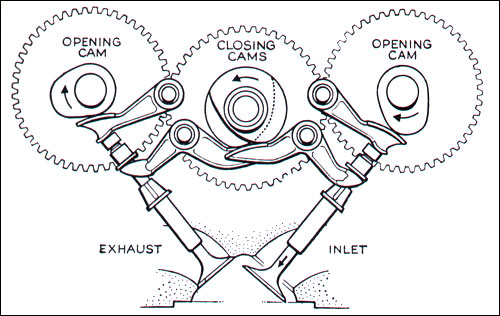
In essence, what we have here is a valve not only opened using positive mechanical pressure from a camshaft lobe (as in nearly every conventional reciprocating piston engine), but also closed by a camshaft lobe and follower, doing away with the valve spring. With precise timing, one lobe clicks the valve open; the other slams it closed.

By eliminating the valve spring, all possibility of valve float is removed. Valve float occurs in a conventionally-sprung valvetrain arrangement at high rpm when a valve spring is unable to pull the valve shut quickly enough, disrupting timing and in extreme cases allowing the valve to contact the piston, leading to their mutual destruction. Engines with desmodromic actuation can thus rev higher without the threat of internal damage, and the multiple camshaft arrangement allows for slightly more sophisticated valve opening and closing profiles.

Desmodromic Valves Valvetrain Stem Cam Diagram Schematic Drawing Illustration

The downsides of the a desmodromic valvetrain include added complexity, twice as much mechanical noise (clicking and tapping and such) as a conventional setup, and more required maintenance in the way of valve adjustments. Also, if maintenance is neglected and the clearance between the closing cam lobe and follower is allowed to become too large, the valves might not held fully closed, leading to a whole host of running problems.

In spite of its advantages, the configuration has only been adopted by a few manufacturers, most prominently Italian motorcycle firm Ducati, who use desmodromic valves in their bikes to this day. On the automotive side, only Mercedes, back in the 1950s, designed a handful of racing engines (fitted to their W196 and 300 SLR racers) around the unique valvetrain. Eventually, as with the sleeve valve, more sophisticated engineering and metallurgy all but eliminated the disadvantages of a conventional engine arrangement, and the alternative solution fell into obscurity (with the noted exception).

Image credits: oocities.org

Editor’s note: This post is part of an ongoing series spotlighting obscure automotive engineering solutions. Read the other installments here:

6 Comments on Technical Curiosities:
The Desmodromic Valve

Styling Faux Pas: Giant Logos

February 6, 2013 by Matt

Infiniti FX Logo Badge Emblem

This unfortunate trend seems to be especially virulent among Japanese firms, notably Infiniti, Mazda, Lexus and Honda.

It’s hard to grasp how large these logos really are except by viewing them in person. They’re honestly close to saucer-sized.

Honda Odyssey Logo Badge Emblem

There are a couple of theories as to the cause of the trend. One is a recognition of the fact that many Japanese cars share very similar and bland styling and their automakers want to distinguish them from their peers by way of branding instead of rest-of-car design. Also, it could be that there’s a trend toward larger grilles in general, and thus logos must grow in size proportionately.

Lexus CT200h Logo Badge Emblem

Lexus has indisputably been the worst offender lately, having seemingly fallen completely into the “make the logo bigger” upper-management mindset that drives designers, like myself, nuts. Not only that, in contrast to the other automakers’ good sense in reserving the larger logo for, oh, their larger cars, Lexus seems to take great pleasure in slapping the massive emblem on even their entry-level models, like the CT200h shown above. Furthermore, the automaker’s logo isn’t the most attractive, smacking of a corporate focus-group development process; more detailing within the logo itself (think Porsche or Cadillac) might make it work better.

Here’s hoping this tacky trend peters out rapidly.

Image credits: netcarshow.com

Editor’s note: This post is part of an ongoing series highlighting automotive styling missteps. Read the other installments here:

5 Comments on Styling Faux Pas: Giant Logos

2014 Lexus IS: A Design Analysis

February 4, 2013 by Matt

2014 Lexus IS Sedan

The problem here is context.

The details of the next generation Lexus entry-level sports sedan, the IS, are certainly generating a buzz. Next to the C7 Corvette, it’s been arguably the most aesthetically dissected car to emerge from the recent 2013 Detroit Auto Show.

The reviews haven’t been overwhelmingly positive. The consensus seems to be that although observers appreciate the fact that Lexus is taking chances, design-wise, the new IS’s shape leaves them unsatisfied. Personally, I want to like the new “spindle grille” motif the Japanese luxury automaker has cooked up, but somehow it just doesn’t sit right; I respect aesthetic risk-taking, but between the grille and the new taillights (the new IS’s two most prominent features), I’m left feeling…uneasy as I contemplate the new car’s lines.

The nose. Evident in the picture at top, the nose is far and away the most prominent feature of the new car. An attempt to create “visual tension” by giving the impression the bodywork is stretched tightly over some muscular internal structure, the feature falls flat simply because none of the rest of the car matches its design drama. Put your hand over the new Lexus’s fascia and the car becomes another run-of-the-mill sports sedan. It’s the aesthetic equivalent of a stage actor turning in a powerhouse performance…while his castmates phone in their lines. There’s just no visual support from the rest of the car.

2014 Lexus IS Sedan

The tail. Slightly more successful is the 2014 IS’s other “showcase” styling element, its downward-sloping taillights. By visually connecting the taillights and the rocker panels, the rear wheels and thus the car’s RWD configuration are emphasized. So far, so good. But there remain two major problems: The styling effect employed makes it look like the bodywork is tearing or breaking so that the taillights can push through, giving them a sort of half-finished look, and their taper around the side of the car leads the observer’s eye forward back onto the car’s flanks, when the tail should be a smooth resolution and neat conclusion of the car’s look. As it is, our eyes are constantly thrown back toward the IS’s profile, kept in a kind of awkward visual limbo.

2014 Lexus IS Sedan

The proportions. The new Lexus’s context problems are on full display here. There’s nothing in the car’s proportions that even comes close to the impact of the car’s extremities. Really the only update over the previous generation is a lower decklid, reintroducing a traditional bit of “three box” styling into the new IS’s profile, but otherwise… Ho hum.

2014 Lexus IS Interior Inside Cockpit Console Dash Dashboard

The interior. For its part, the interior is serious and tasteful with a strong sense of structure. Taken in isolation, it’s quite well done…but then you remember what the outside, and particularly the nose of the car, looks like, and scratch your head that there could be such a marked difference in feel between the two areas.

I wonder how isolated the design teams working on different parts of the car were from each other? From the looks of it, they must’ve had minimal, if any, contact with each other prior to applying their efforts to the new Lexus’s basic shape. There are lots of good ideas here, just no cohesion. Maybe next time.

Image credits: netcarshow.com

No Comments on 2014 Lexus IS: A Design Analysis