Spannerhead Dot ComSpannerhead.com

Alluring At Every Speed:
The 2nd-Gen Chevy Corvair

September 10, 2012 by Matt

1965 Chevy Chevrolet Corvair Black

Is this the best-looking American car ever made?

Honestly—I’d take a ’65-’69 Corvair in a heartbeat over contemporary muscle cars. It’s arguably more attractive than even the C2 Sting Ray ‘Vette. Yes, I think it’s that good. Add in a generous helping of uncharacteristically daring (for GM) engineering, and it’s a done deal. Sign me up.

1966 Chevy Chevrolet Corvair Red

1966 Chevy Chevrolet Corvair Red Rear Back Taillights

The well-written Ate Up With Motor article on the history of the Corvair calls out its “Italianate curves” as a debit relative to its then-new, formidable competition—the Mustang—what with the Ford’s long-nose, short-deck proportions and less exotic styling, but I’ll take the ‘Vair hands down. The subtle hips, the rakish nose, the unadorned flanks—it’s got it.

1965 Chevy Chevrolet Corvair Engine Motor Edelbrock Carb Carburetor

While still sporting the rear-mounted, air-cooled flat six, the 2nd gen Corvair was in many ways a completely different car than the notoriously-flawed ’60-’64 1st generation. The earlier car was the subject of Ralph Nader’s career-making exposé of unsound decision-making practices at GM that knowingly produced a car occasionally difficult for the average driver to handle, but the 2nd gen was improved in every way. Gone was the rudimentary swing axle rear suspension in favor of a new multilink design, and the independent front suspension was revised as well to better coordinate with the rear, producing a car with remarkable—and predictable—dynamics for a car from Detroit. Firm up the suspension a bit, tighten the steering a hair and it could easily pass for something European.

1965 Chevy Chevrolet Corvair Interior Inside Cockpit Dash Dashboard Gauges Console

Even the cabin showed atypical restraint for the day. A clean swath of vinyl with only minor chrome fluting, the only “excessive” element was perhaps the over-instrumentation. The driver was treated to six gauges: A speedometer, tach, fuel, clock, cylinder head temp and manifold pressure. As an enthusiast who likes to have as much information as possible about the car’s current state, the plethora of gauges is actually a major selling point.

Yes, even though I’m not generally of fan of cars from my native country, I’d make a very notable exception for the 2nd gen Corvair. Lovely looks, interesting (and unique) engineering, and treats in the details. It’s a standout.

No Comments on Alluring At Every Speed:
The 2nd-Gen Chevy Corvair

On the Return of Iconic Engine Layouts

September 7, 2012 by Matt

Audi TT RS Engine Motor 07K.3 CEPA

So yeah, it’s sideways. So what? At least there’s a brutally turbocharged 5-cylinder back under the hood of an Audi (the TT RS), where it belongs.

I give Audi a lot of credit for recognizing and acknowledging their engineering legacy, and I’d like to think that it was an intentional engineering decision; in other words, that it was more than just a happy coincidence that 5 cylinders ended up working better than 4 or 6, and Audi decided to capitalize on that fact from a marketing standpoint. Whatever the case, it’s wonderful to hear the distinctive rasp of the 5-cylinder firing order again. With the configuration’s reintroduction, the German automaker establishes a real, tangible connection with their legacy—it’s more than lip service paid to some abstract tuning philosophy; the engine layout that powered their all-conquering Group B rally cars is under the hood of a current offering, in honest-to-goodness cast iron and aluminum. It counts for a lot to be able to touch, hear and experience an automaker’s history in real time.

How incredible would it be if other automakers followed Audi’s lead in fitting a car or two with an engine configuration inspired by their manufacturers’ greatest hits? BMW could roll out a “reimagined” update of their classic “big block” (M30, M88, S38) six. Nissan and Toyota could reintroduce fresh takes on their legendary twin-turbo straight sixes (JZ, L, RB, etc). Volvo could develop a modern version of their vaunted Redblock turbo 4 from the 200- and 700/900-series. Porsche could fit at least a few of their myriad flavors of 911 with an actual air-cooled flat-6, an engine that left with the much-missed 993 generation. And finally, Mazda, whose signature engine, the rotary, has most recently been given the axe, could breathe new life into their stalled 16X program.

The sad fact is, though, that in our current regulatory climate, it’s doubtful the reintroduction of any of those configurations would be possible. Ballooning front crumple zones (as well as the marketing allure of the almighty V8) killed the big straight 6, and emissions and efficiency considerations spelled the end for the air-cooled mill and the rotary. Furthermore, part of the character of those classic powerplants is wrapped up in their lo-fi technology, like single overhead cams and distributor ignition systems. With the understanding that those certainly won’t be returning, how far would a prospective “throwback” engine have to go to maintain a connection with its inspiration? In Audi’s case, the recipe was simple—5 cylinders, between 2 and 2.5 liters of displacement, and a turbocharger—but it’s not as cut-and-dried with other automakers. It is fun to think about, say, a lighter, simpler post-F10 BMW M5 with a big, free-revving naturally-aspirated straight six under the hood, but with modern materials and styling. One can dream.

No Comments on On the Return of Iconic Engine Layouts

Earthbound Spaceship: The Subaru SVX

September 5, 2012 by Matt

Subaru Alcyone SVX Blue

Let’s talk some more about the Subaru SVX. Why? Because I want to.

Yes, it’s already been featured as part of the “Underrated Lookers” series, but I think the car is interesting enough for more than just one post.

Subaru Alcyone SVX Red Rear Back

I remain fascinated by its appearance. For all Subaru’s studied weirdness, for me, the ’92-’97 SVX is the one point of intersection between actual attractiveness and the automaker’s deliberate aesthetic nonconformity. In other words, even a stopped clock is right twice a day, and the SVX represents one of those times for Subaru. The proportions are good, the slight fender flares a nice touch, and the whole car radiates a kind of pitch-perfect fighter-jet aggressiveness. Not only that, as pointed out in my earlier post, I challenge anyone to name a more spaceship-like car. Honestly—close up the wheel arches, graft on a pair of ion engines, strap in, engage the hyperdrive and you’re good to go. It’s nerd-tacular, and I love it.

Subaru Alcyone SVX Interior Inside Cockpit Console Dash Dashboard

The interior is subdued compared to the extroverted bodywork, but it still has a couple of odd touches, most prominently the decorative “door” for the stereo controls in the center console, as well as the handle-like, horizontal handbrake lever. Beyond that, it sports a nice bank of clear gauges and all secondary controls are laid out in a sensible manner.

Subaru Alcyone SVX Engine Motor EG33

The EG33 engine was Subaru’s first flat-6 fitted to a production car. A 3.3l, 230-hp mill, its basic design is very sound, but at the time of its release, Subaru had no manual transmission capable of handling its 228 ft-lbs of torque. So there was sadly no stickshift option available from the factory, even in Japan, which limited the car’s appeal among enthusiasts. Fortunately, for we shadetree mechanics, many later Subaru manuals (from the WRX, Legacy, etc) will bolt up, albeit with some modification needed to the shift rods and driveshaft. A swap isn’t an unattainable ambition, and kits even exist to facilitate the process.

Dynamically, the car is a bit of a mixed bag. Its permanent AWD system gives it sure-footed handling, but the front weight bias compromises the car’s balance, and its admittedly hefty 3,500 lb girth dampens the fun as well. That said, any prospective buyers hopefully aren’t expecting a light and lively sports car, but a larger, stylish, comfortable, competent-handling GT, and in the latter capacity the car excels. I have a penchant for cars with those attributes; add a dash of the SVX’s weirdness, and I’m sold.

13 Comments on Earthbound Spaceship: The Subaru SVX

Needs A Good Home:
Joel’s 1973 Porsche 911T

September 3, 2012 by Matt

1973 Porsche 911 911T Classic Red

My experience behind the wheel of this beauty is, to date, my only time in a Porsche. As a long-time car guy, I’d be lying if I said I wasn’t a bit ashamed of that fact. But it doesn’t take anything away from the transcendence of the event.

Joel and I had been friends for a little over a year, and I was on the verge of a significant move. As a kind of going away present, he let me tool around for a little while at the helm of the car pictured in this post, his 1973 Porsche 911 911T, now for sale.

1973 Porsche 911T Classic Red

It was everything I thought it’d be and more. The steering’s communicative nature was evident even at low speed, and there was a pleasing mechanical directness to the gearchange and the bottom-hinged pedals. I loved the overabundance of gauges spanning the dash, and the 911’s racing pedigree was evident in every response; the classic air-cooled thrum from behind me eager for more gas, more speed.

1973 Porsche 911 911T Interior Inside Cockpit Console Dash Dashboard

For those who don’t know, the “T” submodel of the 911 was the new entry level replacement for the outgoing, 4-cyl 912. Featured a slightly detuned, 140-hp variant of Porsche’s signature 2.4l flat-6, the 911T slotted in nicely below the contemporary 165-hp 911E and 190-hp 911S. The 911T’s lack of power compared to its brethren may initially seem like a turnoff, but the classic lines and handling and still present in spades, the engine still has six cylinders, and even the range-topping 911S isn’t going to win any stoplight drag races nowadays. Any Porsche is partially about the speed, sure, but the classics are more about the experience, and that the 911T delivers just as well as its stablemates.

I’d love to see it go to a good home. From Joel’s description, it’s in excellent, original condition (read: pre-restored), with only hints of surface rust in a couple of places. It deserves to be well looked after.

3 Comments on Needs A Good Home:
Joel’s 1973 Porsche 911T

Early Impressions: Mark 3 Ford Capri

September 1, 2012 by Matt

European British Ford Capri Mark 3 III Mk3 Blue Gray Grey

The year was 1988. I was 9 years old, living in southern France with my family. A third grader, I took the bus home from school every day with my best friend Timothy.

By some incredible chance, the house in which we were living was situated directly across the street from one occupied by a British family, with boys whose ages corresponded almost exactly to those of my brothers and me. Not only that, but our interests were nearly identical as well, so Timothy and were inseparable for the 2 and a half years we lived in France.

One day, though, we didn’t take the bus home. Timothy’s uncle was visiting from the UK, and instead of flying, he decided to drive his late-model Mark 3 Ford Capri, and that afternoon, picked us up from school in it.

European British Ford Capri Mark 3 III Mk3 Silver

It was low and rakish. I did like cars, to the point of having the requisite white Lamborghini Countach poster on my wall, but didn’t know much about “lesser” vehicles like the Capri. Still, I liked what I saw. Crammed in the back seat with Timothy on the way home, I remember being mildly amused by the fact the steering wheel was on the right side (this being my first ride in a British car), and beyond that, by the size of the wheel. It may be an odd thing to stick in one’s mind, but the one thing that stood out was how incredibly small it was. Beyond the car’s external shape, that steering wheel communicated an undeniable sportiness, as impractical as it must have been, and made an impression on me.

European British Ford Capri Mark 3 III Mk3 Interior Inside Cockpit Console Dash Dashboard

I’m still slightly jealous that Europe got multiple generations of the Capri while we here in the US had to make do with pony cars like the Smokey and the Bandit Firebird and the Fox body Mustang. Ours were worthwhile in a straight line, but profoundly crude with respect to handling. The Capri, on the other hand, possessed a remarkable amount of cornering sophistication, low (~2,500 lb) weight and a whole host of engine options, ranging from a miserly 1.3l 4-banger to a 185-hp 2.8l turbocharged V6. Sure, it still sported a live axle out back and it was rough around the edges compared to its pricier rivals, but its priorities were in the right place, and for that, I wish my memory of it hadn’t been isolated to my time in France.

No Comments on Early Impressions: Mark 3 Ford Capri

New 2014 Mazda 6 Looks Brilliant

August 29, 2012 by Matt

2014 New Mazda 6 Six Red

If I were in the market for a new midsize sedan, I’d pick up one of these in a New York minute.

Autoblog recently reported on the upcoming 2014 Mazda 6, unveiled this week at the Moscow Auto Show, and boy, is it a looker. The second Mazda (after the comparo-winning CX-5 mini-SUV) to feature Mazda’s new Kodo design philosophy, the new 6 solidifies the automaker’s move away from grotesque smiling grilles toward a more attractive, distinctive face. The new 5-pointed grille opening is at once lower, giving the nose a more sports-car-like profile, and more upright, lending it additional aggressiveness as the headlights sweep into the very prominent front fender bulges. While they may initially seem out of sync with the slightly more slab-sided rear flanks of the car, recall that flared rear fenders on a sedan can seem a bit cartoonish if done incorrectly (see: current Nissan Maxima) and besides, the fronts serve a visual purpose: To highlight Mazda’s traditional emphasis on handling and driving enjoyment.

2014 New Mazda 6 Six Red

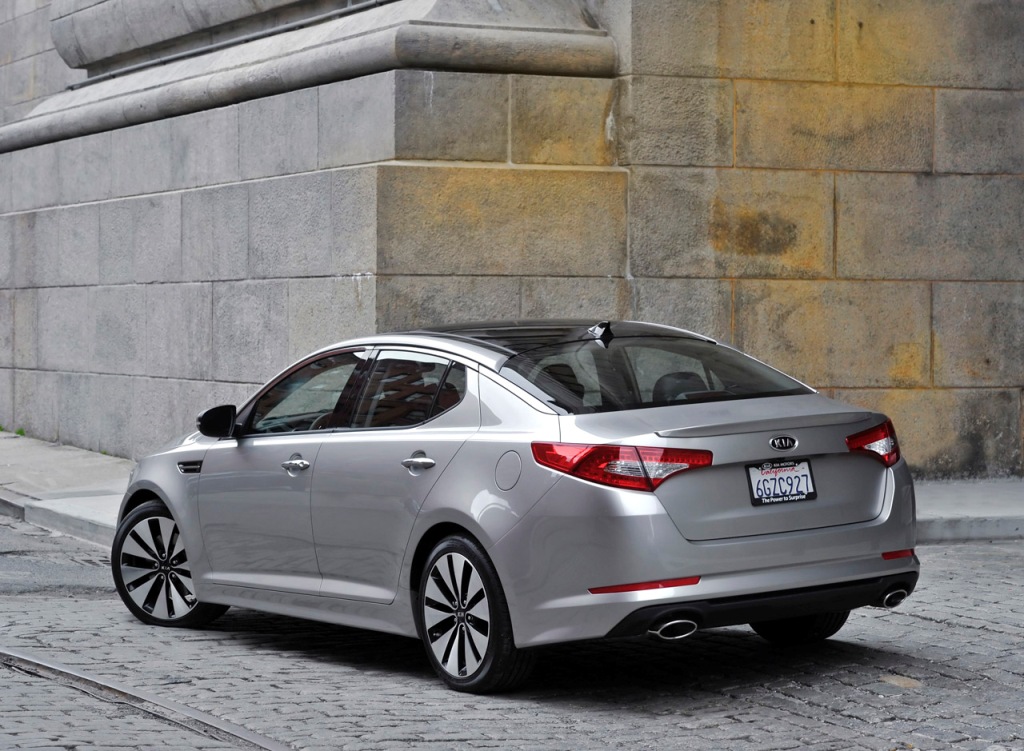
The rear, for its part, is nicely tailored and reminiscent of the very handsome Kia Optima’s. It’s also thankfully free of any trinkets and extraneous ornamentation that would quickly date the car; as a result, I have a feeling the shape will seem fresh for quite some time.

2014 New Mazda 6 Six Interior Inside Cockpit Console Dash Dashboard

The interior is spectacularly well done. It features a meaty 3-spoke wheel, pleasing lighting and detailing and a neatly laid out center stack with actual grasp-it knobs flanking the multifunction screen. I don’t think it’s overstating the case to call the new 6’s interior Audi-esque, and ’round these parts, cabin styling accolades don’t get any higher than that.

With the shape spot-on, the only potential cause for concern is the output of the engines Mazda plans to offer under the new 6’s hood. The aforementioned CX-5 won the recent Car and Driver comparo on the basis of its chassis dynamics; speed-wise it ranked dead last among its competitors. Mazda has an unfortunate history of creating brilliant-driving, yet underpowered cars, and here’s hoping the new 6 bucks that tendency. I will say things don’t look so rosy at the moment: The only engine available with a 6-speed manual is a 2.0l, 148 hp 4-cylinder. The new 6 would have to be made of feathers and aerogel for that kind of output to be able to move it at a respectable pace. There will be a 189-hp 4-cylinder option, still a rather pathetic number nowadays, but sadly it looks as though the stronger engine will only be mated to a slushbox.

If styling and cornering acumen alone were enough to secure the top spot in the hotly-contested midsize segment, I’d say Mazda hits the bulleye with their new 6. Let’s just hope the automaker’s engine choices don’t let down the rest of the car.

8 Comments on New 2014 Mazda 6 Looks Brilliant

Styling Misfires: The Chrysler Cirrus

August 27, 2012 by Matt

Chrysler Cirrus Green

I have a feeling Chrysler vehicles will appear as parts of the “Styling Misfires” series with distressing regularity. It’s unfortunate, really, given the automaker’s penchant for engineering creativity (when sufficiently funded) compared to its rivals, that its designs should be so enduringly bad.

The car spotlighted in this post, the ’95-’00 Cirrus, was kind of a big deal for Chrysler. Coming on the heels of the unlamented, epically frumpy LeBaron, it was expected to spearhead a surge of popularity for its manufacturer in the lucrative midsize segment. Designed to compete against the Honda Accord, Toyota Camry as well as the newly-introduced Ford Contour, the Cirrus had its work cut out for it.

Chrysler Cirrus Brown Auburn Maroon

And while the basic chassis dynamics were good, the car certainly wasn’t as polished and refined as its Japanese rivals. Not only that, the fascia was just hideous to behold. If it had any appeal within the current styling climate, that trend evaporated before its wheels hit the showroom floors. To state the obvious, the Cirrus looks like its bumper got clobbered and was cursed to forever carry a bloated lower lip as a reminder of the altercation. The cause must have been an all-too familiar scene from the design world: Stylists get too engrossed in their creation without pausing and taking a few steps back to examine the context of their work and ask themselves the hard questions like “What would this look like to the average passerby? What bodily feature would they immediately compare it to?” Nope—the designers must have simply put their heads down and carried on.

For what it’s worth, I tried very hard to like the Cirrus. I really did. Most automotive publications actually praised the styling direction, complimenting its “daring” and “distinctive” lines in contrast to its competitors’ more conservative shapes—and I took them at their word. Rather than trusting my intuition that what I beheld in the Cirrus was a ghastly, bloated-looking design, I distinctly remember concluding that I just must not have been able to appreciate it; that the fault lay with me; that I needed to recalibrate my taste. Contributing to this mindset was the fact that Chrysler was, and still is, the “underdog” compared to the other two, more robust members of the Big Three: GM and Ford. I liked the underdog; the idea of taking chances both mechanically and stylistically appealed to me, so I was even more predisposed to approve of the Cirrus’ design.

In the ensuing years I came to appreciate the fact (obvious to most) that even the so-called “experts” among the journalism world can be guilty of bandwagoning just as much as the rest of us, and with a more confident aesthetic sense, I realized my gut reaction to the Cirrus styling had been spot-on. Lesson learned.

Editor’s note: This post is part of an ongoing series wherein I discuss unsuccessful cars whose styling was their overlooked (or denied) Achilles heel. Read the other installments here:

4 Comments on Styling Misfires: The Chrysler Cirrus

FWD Champions: The Mazda Millenia

August 24, 2012 by Matt

Mazda Millenia White

Here’s an oddball.

The ’95-’03 Mazda Millenia was essentially an orphan: It was built on a unique chassis, and no direct predecessors or descendants. It was intended to be one of the initial pillars of Mazda’s Amati luxury brand, but when that project was shelved, the automaker decided to roll out the Millenia under their main brand as a kind of replacement for their range-topping RWD 929 luxury car. The Millenia, though, hewed to a substantially different philosophy than the 929, being smaller, lighter, FWD and with more of an emphasis on handling excellence as opposed to smooth, serene highway cruising.

Mazda Millenia White

It was never a roadburner, even with the optional 210-hp 2.3l Miller Cycle V6 (more on that later), but its chassis dynamics were typically polished and lively, a rarity for cars in its class. Also, the Millenia weighed in at a trim (for its class) 3,400 lbs, a figure that benefited performance and fuel economy.

Debits? Pretty anonymous styling, although the basic proportions are well-executed and handsome, especially in person. It has the same overall stance as my BMW E34 525i: Solid yet flowing, and perfectly tasteful. My only quibble is with the nose area: The grille is oddly placed and shaped, and the other elements seem to have been located with an arbitrariness uncomfortably recalling the contemporary Chrysler 300M. As nice as the rest of the styling is, it’s a shame Mazda couldn’t give the Millenia a more cohesive face.

Mazda Millenia Engine Motor Miller Cycle V6

The top-of-the-line V6 engine was unique. Wringing 210 hp from only 2.3 liters of displacement, it employed a variation of the traditional 4-stroke suck-squish-bang-blow process known as the Miller cycle. The idea is to reduce pumping losses during the compression stroke by holding the intake valve open for much longer, well into the piston’s upward rise, and relying on a supercharger to force the intake charge to stay inside the cylinder. The power loss from the supercharger is less than would be incurred by the piston having to compress as much of the fuel/air mixture as it would with a conventional cam profile, so the upshot is more net power from less displacement. It’s a neat idea, and it worked, giving the Millenia class-leading fuel economy with respectable power from a smallish engine, as the cost of a bit of added complexity.

Mazda Millenia Interior Inside Cockpit Console Dash Dashboard

The Millenia was treated to a refresh for the 2001 model year, with most of the emphasis going to a fascia redesign which, ironically, made the car even more bland-looking and anodyne. And when the axe finally fell at the end of 2003, after a long, eight-year model run, Mazda never fielded a replacement, ending their participation in the luxury + performance market niche.

The Millenia deserved more success. Never quite sure how to market the car, Mazda seemed to suffer from much of the same ambivalence about their own product that afflicted the early Infiniti Q45’s model run. It was a luxury car with a few novel technical tricks up its sleeve, and blessed with a taut chassis and a dash of performance, and the Japanese just weren’t sure how to take on BMW on their own turf. I’m still not quite sure they are. Perhaps with more marketing resolve the Millenia could have been pitched as a worthy contender (the chassis was certainly up to par). Pity it wasn’t.

Editor’s note: This post is part of an ongoing series highlighting FWD cars I think highly of, in spite of my overwhelming RWD bias. Read the other installments here:

3 Comments on FWD Champions: The Mazda Millenia

Thrust: The Audi B5 S4

August 22, 2012 by Matt

Audi B5 S4 Blue 1999 2000 2001 2002 Stock

Well, I love this car. I love its sleeper quality. And I especially love the audacity of its engineering: As pointed out in my “Audi’s Greatest Hits” post, at a time when performance in the automotive world in general was on the wane, and Audi in particular was still emerging from their stolid, conservative image in the US, the automaker brazenly decided to stuff a pair of turbos into the B5’s cramped engine bay alongside the AWD gear and sell it to the public. You want mechanical density? Here it is, folks.

Audi B5 S4 Silver 1999 2000 2001 2002 Stock

I can’t think of a single line I’d change on the exterior. I don’t say that about many cars. I even like the stock ride height and 17″ “Avus” wheels. Starting with the already spot-on shape and detailing of its lesser statemate, the A4, Audi added extra grille vents, side skirts and gave the S4 a much more aggressive stance overall—but not overpoweringly so. It represents the quintessential sleeper, its visual prowess deriving not so much from secondary elements as its proportions. The upshot is a much more timeless kind of style, understated but communicated in a way enthusiasts of many different automotive eras can appreciate.

Audi B5 S4 Interior Inside Cockpit Console Dash Dashboard 1999 2000 2001 2002 Stock

Audi consistently makes the best interiors in the industry, and the B5 S4’s fits right in with their pattern of excellence. The consummate driving environment, all business yet perfectly tasteful, demonstrating a mastery of materials unrivaled by any other automaker.

Audi B5 S4 Engine Motor Biturbo Twin Turbo 1999 2000 2001 2002 Stock APB AGB AZB

The S4’s “biturbo” 2.7l, 251-hp (in US trim) V6 marked the beginning of a new era for Audi vis-a-vis performance engines. Eschewing the inline-5 that had served them well for nearly 20 years, they began hanging a pair of turbos off the sides of “V” engines, starting with the S4’s and progressing through the later RS6‘s V8, and so on. Another noteworthy detail is the fact that the engine sports 5 valves per cylinder, a configuration adopted only by Audi and Ferrari, and later abandoned by both as not worth the added complexity. The benefits with respect to airflow are undeniable, though, as demonstrated by the fact that the S4’s engine is capable of generating twice its rated horsepower with the simple addition of larger turbos, some enlargement of intake and exhaust paths, and some software tuning. No changes to the engine core whatsoever.

Fitting all that kit under the hood is a masterpiece (or nightmare; take your pick) of packaging, and I stand amazed Audi decided to entrust its buyers with a level of powerplant and driveline complexity more in line with that of high-end race cars. And truth be told, the B5 S4 has developed a bit of a reputation for fragility, but when everything’s working properly under that perfectly-penned bodywork, there are few cars I’d rather own.

2 Comments on Thrust: The Audi B5 S4