
The Aesthetics of Racing: Ferrari 412T

As much as automakers (especially those in the performance business) would like you to think otherwise, 95% of any road car’s external shape is driven by style. The aerodynamicists may have a bit of input around the edges, and there are certain interior volumes dictated by marketers and engineers, but by and large, style rules the roost.
Race cars, on the other hand, are designed and built with no concern over whether or not a pleasing shape results. If severe, brick-like contours will help it “do the job” and cut through the air faster on its way to a win, those are the priorities that shape the car. That said, in spite of the fact that form overwhelmingly follows function in the auto racing world, stunning and often beautiful bodywork frequently emerges from the engineers’ drawing boards. Today we begin a new series looking at race cars that, successful or not, in their single-minded pursuit of speed, happened to be visually arresting as well.
The Ferrari 412T, campaigned by the storied Italian team during the ’94 and ’95 F1 seasons, with Gerhard Berger and Jean Alesi at the wheel, was the last hurrah for the Ferrari V12 in Formula 1. After turbocharging was banned starting with the ’89 season, teams had reverted to naturally-aspirated 3.5l V8s, V10s and V12s, Ferrari being the last holdout for the latter configuration. Compared to its competitors, the Ferrari engine was more powerful, offering more straight-line speed, but was heavy and complex, impeding handling and making reliability an issue.
Still, the 412T undoubtedly represented the beginning of Ferrari’s comeback after the championship drought of the ’80s and early ’90s, a resurgence that culminated with Michael Schumacher’s string of 5 world titles starting in 2000. Conservative and simple, the 412T also happened to be quite a beautiful car, and its shape, along with Ferrari’s underdog status that year, secured my fandom for the seasons that followed.
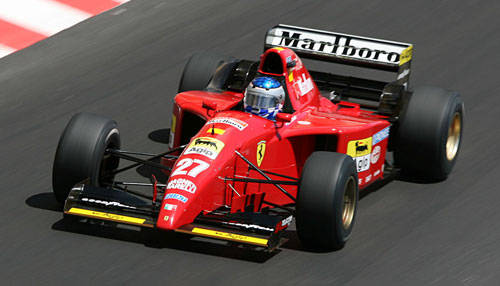
In a constant state of development throughout the ’94 and ’95 seasons, the 412T appeared in two primary external shapes, the switchover happening partway through the ’94 season. The first iteration was called the 412T1 (shown at top) and featured a raised, rounded nose and smaller sidepod air intakes. The 412T1B and 412T2, the latter pictured above driven by Jean Alesi, eliminated the raised nose and greatly enlarged the sidepod intake area. Coupled with the knowledge that they’re sporting a hugely powerful, classic Ferrari V12, either variation of the 412T shape is brutally elegant and completely stunning. In my mind, it’s the last “classic” Ferrari F1 car, its immediate successor the F310 and all the cars that followed being maimed by safety and regulatory changes, and looking far too computer-designed as well. The 412T was the swan song of the organic, assembled-by-an-actual-human Ferrari F1 car, and as such it stands alone.
Editor’s note: This post is part of a series examining the aesthetic merits of cars designed almost wholly with function in mind. Read the other installments here:
Technical Curiosities: The Sleeve Valve

This technical curiosity is a personal favorite of mine. Used a few high-end pre-WW2 cars, the sleeve valve was far better known for its exploits during the war inside a number of renowned aero engines developed by the British firms Napier and Bristol.
A different method of controlling intake and expulsion of the air/fuel mixture, the sleeve valve system dispenses with conventional valvetrain, including poppet valves, spring, rocker arms and pushrods. Instead, a cylindrical sleeve nestles between the piston itself and the wall of the engine block. The sleeve rotates and moves vertically, its motion controlled by a shaft driven off the crankshaft further down in the block. Ports in the side of the sleeve admit the mixture and allow exhaust gases to be expelled in sync with the movement of the piston, and a conventional spark plug in the roof of the combustion chamber provides the ignition source.
The sleeve valve was a solution to the difficulties posed by conventional poppet valves of the pre-WW2 era. Metallurgy being in a more primitive state then than now, the internal sealing of most engines was less than ideal, and virtually all engines burned a degree of oil as a matter of course, whether they used poppet or sleeve valves. Before advances in sealing that would later vault poppets past sleeve valves in engineers’ consideration, sleeves presented a number of important advantages over their counterparts.
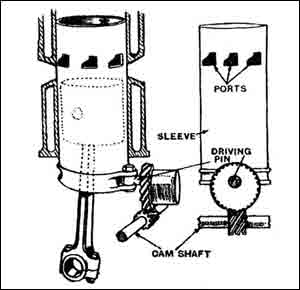
Without the inertial restrictions of spring-actuated valves, the engine can spin much faster without worrying about valve float and piston-to-valve contact. Also, with careful shaping of the ports, intake and exhaust timing can be precisely controlled, and port area can be much greater than with poppets, unrestricted by the size of the combustion chamber ceiling. Without 2-4 valves per cylinder, the valvetrain is greatly simplified, and the spark plug can be located in the optimum location in the combustion chamber, unencumbered by valves.
Given these major advantages, why aren’t we all driving cars with sleeve valve engines? Sealing. As with the rotary engine, sealing is and will always be the major difficulty of the sleeve valve engine. Not only do the piston rings have to fit tightly against the inside of the sleeve, the outside of the sleeve itself must press up against the block wall. And given that all these parts move relative to each other, they must be lubricated, and some oil leakage into the combustion chamber is virtually guaranteed. As mentioned, during the engine’s heyday, poppet engines were just as bad, so there were virtually no downsides to the sleeve valve engine, but after the war, great strides in materials and processes allowed poppet valves to trump sleeves, sealing-wise, and the sleeve valve engine faded away. It’s a shame, really; given consistent development time, the engine might have overcome its issues, and blossomed into the superior configuration, since it is a fundamentally more efficient design than engines on the road today.
Editor’s note: This post is part of an ongoing series spotlighting obscure automotive engineering solutions. Read the other installments here:
Audi Styling Mistakes
Yes, they have happened.
Regular readers here may think I’ve adopted an “Audi can do no wrong” mindset, especially after posts like this, this or this. Certainly, when it comes to beautifully tasteful and understated design, Audi is in a class by themselves. They’re perhaps unique among automakers in that, unlike virtually all their competitors, Audi has never released a car that was a styling disaster. So I can’t critique whole cars; if I’m going to pick apart their design missteps, I’ll have to do it piecemeal. Note that what follows isn’t a comprehensive list; they’re simply the three aberrations that came most immediately to mind:

’88-’95 80/90 C-pillar. This issue could just as easily apply to the C3 5000/100/200 as well, but it’s most pronounced on the 80/90, given that car’s more bathtub-ish below-the-beltline shape. The C-pillar is simply far too visually thin—there’s no “return” to the greenhouse that would accentuate the car’s wedge shape in profile. No, the C-pillar just looks flimsy, and the design suffers from its lack of visual strength.

’05-’08 A4/S4/RS4 Fascia. It’s difficult to determine what Audi was thinking when they put this together. Let’s start with the obvious: The nose could just as well belong to a generic Japanese or Korean econobox. It looks completely plastic, there’s nothing distinctive about it, and the grille’s “dip” is very characteristic of lower-end cars’ styling. The bottom edges of the headlights are inexplicably convoluted. And this being Audi’s first attempt at their now-trademark front plate-surrounding grille design, the rest of the car’s lines weren’t yet in harmony with such a strong nose element.

’04-’10 A6/S6/RS6 Rear. I don’t take issue with the shape of the taillights—although their simple square-ish shape is perhaps a bit too safe—so much as the dip in the lower edge of the trunklid. There are no other lines in the car that agree with this one. The trunklid edge is isolated, random, and as such it draws attention to itself and gives the rear of the car an unfinished look—very atypical for Audi.
Interestingly, in most cases, the offending element is gone by the car’s next generation, or even with a mid-cycle refresh; to their credit, Audi seems to quickly recognize where they went wrong and rectify matters post haste. The A6’s taillights were much more integrated with the trunklid after the refresh, and the ’96-’01 A4’s C-pillar was beefed-up considerably in order to strengthen the rear styling. And the A4’s front end came beautifully back into focus with the ’09-present generation; no more awkwardly tortured headlights or irresolute lines.


New Ferrari F620 GT: Diabolically Boring

Hot off the presses (h/t Jalopnik and GTSpirit), here’s the first photo of the new front-engined V12 flagship from Ferrari, to be named the F620 GT.
The replacement for the outgoing 599 Fiorano will be the most powerful road-going Ferrari ever made, with a staggering output of 740 hp from its 6.3l mill. A RWD car, one can’t help but wonder how just the rear tires will manage to put all that power to the ground effectively. We’ve long reached the point where AWD is practically a necessity for any self-respecting supercar with an engine output north of 600 hp or so, but… That’s a post for another day.
Back to the F620. Design-wise, the car looks like an unfortunate pastiche of styling cues from past and current Ferraris, including the FF’s gaping maw, the 458 Italia’s vertical headlight lenses and even the long-dead 550 Maranello’s bulging rear fenders. Perhaps stung by criticism of the 599 as too avant-garde—specifically with respect to the jerky grille and “flying buttress” C-pillar treatment—Ferrari seems to have penned a very conservative-looking replacement.
Every new Ferrari has a chance to be a design trendsetter, perhaps none more so than their classic front-engine V12 model, and it’s a shame when Ferrari doesn’t seize the opportunity to push the envelope stylistically. Not only that, but if the car looks dated before it’s even rolled out at the Geneva Motor Show in a few weeks, the fact that Ferrari dialed down the design’s edginess doesn’t bode well for its long-term viability in a market so driven by looks and visual impact. With any luck, as with the reveal of the F-117 Nighthawk, the car will look much better in subsequent photos than it does in the initial first grainy snapshot.