
Will BMW buy Saab?

Saab’s body isn’t even cold yet, having just filed for bankruptcy and liquidation a few months ago, and yet, as Left Lane reports, BMW appears to be in the running to be the one to perform a Dr. Frankenstein-style reanimation of Saab’s cadaver, jolting new life into the Swedish automaker.
The article points out:
The association between the two companies wouldn’t be as random as it might seem. In 2010, BMW agreed to provide Saab with 1.6-liter four-cylinder engines. The cooperation between the two was supposed to start this year.
Furthermore, the Munich-based company has announced recently that it needs extra production capacity in order to expand its MINI brand. Picking up the Trollhättan facility could be a viable solution to the problem.
If they decide to acquire Saab, BMW would undoubtedly be a better partner than GM had been. During its 20-year partnership with the Swedish automaker, GM drained from it every last ounce of brand identity, shamelessly rebadging Cadillacs, Chevys and even Subarus as Saabs in a series of flailing attempts to create a successful model. BMW’s history of alliances with other automakers is a bit spotty (Rover got the shaft), but chances are much better they’d give Saab more autonomy and restore at least some of its brand identity, as the German concern has done for Rolls-Royce and MINI. BMW would likely supply engines and provide engineering assistance when needed, rather than completely manhandling Saab’s product line, a la GM.
Unfortunately, GM holds the patents to many key Saab engine and chassis components, since all recent Saabs have been built on GM platforms, and for any sale to proceed, the American giant would have to give their blessing to the union. That said, I can see GM being a bit less hesitant about a BMW purchase than one by a Chinese firm, given the fast and loose relationship between many Chinese companies and international copyrights and patents, and thus the increased likelihood of GM having to compete against its own innovations in the Chinese domestic market, an area of exponential growth for the American automaker. BMW faces off a bit less directly with GM, and access to certain proprietary GM technologies by BMW wouldn’t put the former at as much of a competitive disadvantage.
We’ll see what happens. I for one hope BMW goes through with the sale and keeps Saab alive.
Datsun 240Z Restoration:
First Triad Z Club Meet

Attended my first monthly meet of the Triad Z Club earlier this evening. Paid my annual dues, my laminated (!) membership card will soon be in my sweaty palms.
I had a great time. I printed out a big stack of pictures of my 240Z to discuss, and I think the guys appreciated having the visual reference. 7-8 guys showed, mostly older, and from what I could tell all with their heads on straight as far as restoring and modifying their Z-cars; in other words, no preoccupations with “stance,” sound systems or 19-inch wheels. They, like me, were refreshingly focused on retaining the classic look and feel of their cars even as they upgraded them, and that more for the simple enjoyment of driving rather than all-conquering speed. Their priorities tracked with mine.
Perhaps more than that, I was struck with how friendly everyone was. More often than not, when I go to a car meet I’ll be the only one talking, sharing stories, asking questions and so on; most of the guys who show seem to think standing mute posturing next to their “ride” amounts to participation, but the Triad Z guys were gregarious to a fault. I thoroughly enjoyed talking to everyone.
I didn’t think anyone would actually venture out in their Z, so I didn’t take my camera, but when I arrived, I kicked myself for not having brought it just in case. One of the members drove his restored ’74 260Z with tucked bumpers, in 901 Silver (same color mine will be) with BF Goodrich Radial T/As (same tires mine will have). It wore an air dam, headlight bucket covers and a fresh coat of foot-deep paint. It was beautiful. Interestingly, the car was running de-emission-ed Hitachi “flattop” carbs as fitted to the later 240Zs and early 260Zs, which most will dismiss as particularly poor carbs; however, the car ran perfectly fine with them.
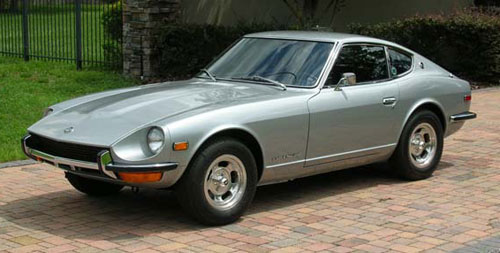

I received a deluge of advice and contacts concerning all aspects of the upcoming restoration effort, which, along with the social aspect of the meet, was exactly what I wanted. I have a mind to invite some of the guys over when I try to start my Z for the first time; it would be great to have an experienced set of eyes and ears trained on the car during that effort. Great group.
Editor’s note: This post is Part 9 of an ongoing series chronicling my efforts toward the restoration of my 1972 Datsun 240Z, originally my father’s. Read the other installments here:
- Part 23: Gutting the Interior
- Part 22: The Teardown Begins
- Part 21: …And the Engine Comes Out
- Part 20: Treasure Hunting
- Part 19: Beginnings
- Part 18: VIN Discoveries
- Part 17: The Bad News
- Part 16: On The Road
- Part 15: Getting It Back On The Road
- Part 14: It Lives!
- Part 13: Restoring the Fuel System, Part I
- Part 12: Meat on the Wheels
- Part 11: Inspiration (Sort Of)
- Part 10: Carbs’ Return
- Part 8: Wheel Work
- Part 7: Tactical Changes
- Part 6: Little Things
- Part 5: Coming Home
- Part 4: The Rollout
- Part 3: Confessions of a Poor Car Enthusiast
- Part 2: Opening the Tomb
- Part 1: Projecting Forward