
Hideous Excellence:
The Porsche Panamera

Porsche recently released an upgraded “S” variant of their Panamera Turbo 4-door super sedan, and I don’t even care.
I have yet to find an angle, in pictures or in person, where the car looks even remotely acceptable. I find it hard to believe it was signed off on by all the responsible parties, since if you know Porsche’s car development philosophy, you know they rarely introduce new models, and those they do the company is completely committed to. So they knew the shape would be with them for a while; it wasn’t a case of “Oh, let’s try this; if people don’t dig it we’ll reel it back in a few years later.” And they can’t defend it, as BMW did with their Chris Bangle creations of the past 10 years, on the grounds that it’s an avant garde, envelope-pushing design; no, the details of the styling are resolutely conventional. It’s not a coherent yet unique vision of a 4-door Porsche like a Bangle take on the concept might be; the Panamera is really nothing more than a 911 stretched in odd places to accommodate two extra doors on its haunches. End of story.
That said, the car’s dynamic prowess and performance chops were a foregone conclusion—its manufacturer knows how to build an Autobahn dominator like no one else. With the Panamera Turbo S, the 0-60 drops to a truly epic 3.4 seconds, and the braking and roadholding are standard Porsche issue. But again, none of this really matters to me or, I’d wager, many of the car’s would-be buyers. If I’m going to fork over almost $200 grand for a car, I don’t want to have to apologize for my purchase by changing the subject to its performance every time its looks are brought up in conversation. I’m not saying the car has to be a complete stunner (though some are), but it should exceed a certain “threshold of appeal.” Sadly, the Panamera misses the mark.

Technical Curiosities:
The Hydraulic Cooling Fan

I first ran across this one when I was doing the 7M-to-1JZ engine swap in my old Supra Turbo. Before the thought of a swap had even entered my mind, I remember puzzling over pictures of Japanese-market-only Supra engine bays fitted with the 1JZ-GTE from the factory, wondering why they seemed to have not one, but two power steering fluid reservoirs (yes, I sit and ponder things like that). I couldn’t figure it out, but when I finally had my hands on one and was lining up my ducks for the swap, I quickly discovered the reason for the extra container of hydraulic fluid: The car was fitted with a hydraulically-powered cooling fan.
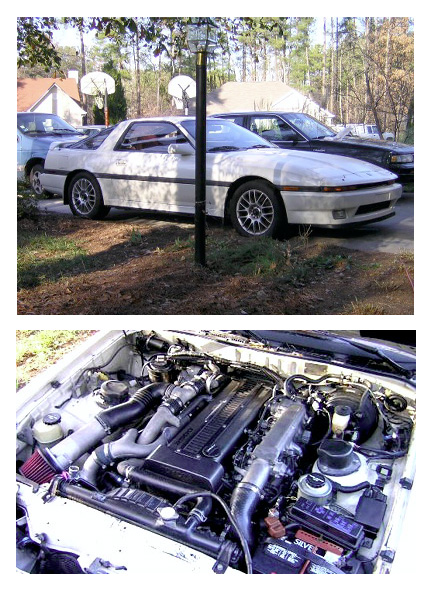

In almost every instance, car engine cooling fans are powered one of two ways: Either directly by the engine off the front of the water pump pulley, or electrically using a large-ish motor. Typically, longitudinal (front-to-back) engines feature direct-drive, whereas engines mounted in a transverse (sideways) fashion, with their accessory belts rotating perpendicular to the ideal orientation for a direct-drive cooling fan, receive electric units. However, in a handful of cars, the engineers decided to grant the cooling fan its own, dedicated hydraulic circuit for motive purposes. In addition to the 1JZ-GTE in my ’89-’92 Supra application (the 1JZ was directly-driven in other Toyotas), the ’92-’96 Toyota Camry V6, Lincoln LS and ’99-’04 Jeep Grand Cherokee all featured hydro fans.
The disadvantages are obvious, but not outright deal-breakers for sensible and careful engineers: The setup adds another layer of complexity to the engine, with more parts to fail, and another fluid level for the owner/mechanic to check and service. As with Audi’s UFO brakes, the rarity of the solution means added expense for parts.

There are some distinct advantages, though: The decoupling, as it were, of the fan from the engine gives the developers some leeway in term of radiator and accessory placement. The hydraulic drive can draw more power from the engine than an electric fan, and thus move more air through the radiator for more effective cooling. And compared to a directly-driven unit, the hydro fan’s speed isn’t dependent on engine speed—the solenoid that controls the flow of hydraulic fluid through the fan motor can opt to run the fan on high speed as the engine idles, for example, or completely freewheel the fan on the highway.
In the final analysis, if you can accept a little added complexity under the hood, the hydro fan combines the best qualities of both directly-driven and electric cooling fans: high power and flexibility, respectively. It’s a wonder to me that it hasn’t been more widely adopted.
Editor’s note: This post is part of an ongoing series spotlighting obscure automotive engineering solutions. Read the other installments here: