Spannerhead Dot ComSpannerhead.com

Design Highs and Lows: Bertone
October 12, 2011 by Matt

Lambo Lamborghini Miura Muira Bertone Gandini

The great car designers and styling houses have produced their share of automotive art. They’ve also penned some designs that left the critics and viewing public scratching their heads. Today we begin a new series highlighting, per post, one example of notably excellent and one case of notoriously questionable styling from individual designers and firms.

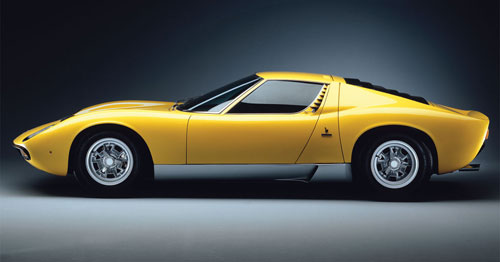
Perhaps no Italian automotive design concern has allied itself with a wider range of clients than Bertone, based in Turin. Over the years, from Abarth to Volvo, they’ve earned their keep by shaping some achingly lovely sheetmetal. Their first design for Lamborghini, with whom they’ve enjoyed a long and productive relationship, is arguably Bertone’s finest shape. The ’67-’72 Miura mid-engined supercar, shown at top, was the work of a 25-year-old quasi-prodigy named Marcello Gandini, who got it right in almost every respect, from the wildly provocative—but not gaudy—proportions emphasizing the transverse orientation of its V12, to details like the post-window vents and rocker panel scoops. Simultaneously expressive and tasteful, it’s a design tour de force.

On the other side of the ledger, we have the car shown below, the ’78-’81 Volvo 262C:

Volvo 262C Bertone

For this exercise, Bertone took the already-frumpy shape of the Volvo 240 coupe and pushed it full-tilt into pure ’70s camp. Everything below the greenhouse was essentially left untouched, the roof was lowered a few inches and the windshield raked—and that’s it. The upright C-pillar and other superficial similarities to American luxoboats of the era aren’t coincidental; allegedly, it was Volvo’s attempt to wedge themselves into that market niche by tailoring their 240 to our tastes. Fortunately, even if we kept buying our tacky American land yachts, we had the good sense to see through such a half-baked marketing ploy, and the 262C met a cool reception. Bertone later tried to disavow their hand in the car’s design, claiming they had only built the car, not penned its lines. Sorry guys, you’re stuck with it. At least you have dozens of superb designs to balance it out.

Editor’s note: This post is part of an ongoing series where I highlight one example of both excellent and awful design from a noted styling house or designer. Read the other installments here:

11 Comments on Design Highs and Lows: Bertone

Motor Trend

 by Matt

Audi RS5 cabrio spied

No Comments on Motor Trend

A Car of Depressing Complexity

October 11, 2011 by Matt

BMW F30 3-Series Concept Sketch

In anticipation of the Friday reveal of the upcoming BMW F30 3-series, the Bavarian automaker released a series of videos commemorating the history of the 3-series.

I suspect BMW’s intent is to remind the automotive world of the new car’s rich lineage and reinforce the 3-series’ status as the archetypical sports sedan. For many enthusiasts, though, the series of videos may backfire, reminding them instead of additional bloat and complexity of each succeeding generation. And as promising as the F30 looks visually—essentially a 75% version of the very attractive, recently-released F10 5-series—the signs don’t point to a letup in the rate of feature addition or overall convolution. The new 3-series looks like it will be at least as electronically-enveloped as its larger brother the F10, and that’s saying a lot.

The larger question here is: Why does BMW do it? Why does a car company ostensibly focused on the quality of the driving experience, the elemental connection of the driver with the road, insist on cramming so much technology into their cars? It’s not the first time the criticism has been leveled at the automaker, either—the electronic layering of the ’02 E63 7-series and ’04 E60 5-series, just to cite two of several examples, was very poorly received, even if the fundamentals of the cars’ chassis and engines were very well done. Granted, BMW isn’t the only manufacturer to stuff its cars to the gills with the latest doodads and geegaws. But they do tend to receive a proportionally larger amount of criticism for it compared to say, Mercedes or Lexus. So why does BMW feel the heat? Or is that my own skewed perception, being a part of the BMW-specific community as an owner and enthusiast? Your thoughts?

No Comments on A Car of Depressing Complexity

Left Lane

 by Matt

CR: Thumbs down for Nissan Leaf

No Comments on Left Lane

Autoblog

 by Matt

Wacky drag race: GTO vs. UTV

No Comments on Autoblog

Atomizing Fuel: The Dell’Orto Carburetor

October 10, 2011 by Matt

Dell'Orto Dellorto Delorto Carb Carburetor Carburettor Lotus Esprit Turbo

The Dell’Orto carburetor never achieved the popularity it deserved. Imagine a dual-barrel sidedraft carb that flows almost as well as the industry performance standard Weber, but is much more flexible and docile in real-world driving, and you have the Dell’Orto.

So why didn’t it catch on? The consensus seems to be a matter of parts availability. Dell’Orto (sometimes spelled without the apostrophe: “Dellorto”) is a small Italian outfit, and it seems they never really had the financial ambition or production acumen of the better-known Weber, and as a result, parts are more difficult (though not impossible) to come by, in contrast the Weber’s almost Holley-like myriad of configurations and applications.

That said, the Dell’Orto was spec’d for a number of factory (not just aftermarket or racing) applications, among them the twin blow-through turbocharged setup for the first-generation Lotus Esprit Turbo, shown at top. They were also used on several Alfa Romeos, and the carb was always praised for its excellent fuel atomization and efficiency, such as it was. It’s a popular aftermarket carb for applications as diverse as Mazda rotaries, Porsche flat sixes or Nissan L-series engines.

And what makes it so much better-behaved than the temperamental Weber? The main reason is a larger accelerator pump. To cover the lean condition and avoid the potential engine stumble when the throttle is quickly opened, the carb provides a quick shot of fuel via the accelerator pump. Nearly all carbs have them (SUs being a notable exception); however, the Weber’s are proportionately small for the carb, requiring bigger main jets to provide fuel to cover for the transition from coasting/idle to the main circuit. The result is lack of metering precision and efficiency for the Weber compared to the accurate, miserly Dell’Orto, although the Weber’s ultimate fuel delivery potential surpasses its rival, generally-speaking. Given the choice, for the kind of driving I do, I’ll take the Dell’Orto hands down.

Editor’s note: This post is part of an ongoing series highlighting various obsolescent methods of fuel delivery. Read the other installments here:

3 Comments on Atomizing Fuel: The Dell’Orto Carburetor

Top Gear

 by Matt

F1 Hall of Champions

No Comments on Top Gear

YouTube

 by Matt

Porsche > Morning Coffee

No Comments on YouTube

Running Away With It

October 9, 2011 by Matt

Suzuka

And…it’s over.

The remaining three races on the 2011 Formula 1 season calendar suddenly became a battle for silver after Sebastian Vettel clinched his second consecutive World Champion title at the 2011 Japan Grand Prix.

Congrats to Vettel and all that for becoming the youngest double world champion in F1 history, but I sincerely hope my Formula 1 race reports will be more interesting next year. If there was anything unique about this particular race, it was the fact that Vettel didn’t win, that achievement going to his primary rival for the title, Jenson Button. It was at least a competitive race, with several lead changes, McLaren’s pit strategy and discipline vaulting Button past Alonso’s second-place Ferrari and Vettel’s Red Bull car, which finished third. Early in the race the German driver complained that his car’s rear tires were wearing abnormally fast, not an unusual declaration at a circuit known to be particularly hard on tires. Still, it did influence Vettel’s pit stop sequence and allowed Button to take the lead and the win. Truth be told, at the rate Vettel was setting fastest laps early in the race, had he chosen to let the red mist descend and go into attack mode, he could have made a stronger play for the win; however, he chose to drive more conservatively, aware that a finish anywhere in the points would allow him to claim the season title.

So the 2011 F1 season marches on, having already crowned a victor. Given the Red Bull’s and McLaren’s dominance this season, I’ll be rooting for underdogs Alonso and Schumacher to finish the season in good form.

No Comments on Running Away With It