
As the Eccentric Shaft Turns

Autoblog reports the Mazda rotary hasn’t been shelved, like I had feared, although it seems to be in a sort of cryogenic suspended animation:
Mazda execs have apparently confirmed that engineers are working on a more efficient and more powerful version of the Wankel. While the project was technically back-burnered during the economic downturn, the research wasn’t canned outright.
The “more efficient and powerful version of the Wankel” is presumably the 16X, the long-awaited longer “stroke” (read: torquier) successor to the prolific 13B, a variant of which has been installed in every top-of-the-line Mazda sports car since 1986.
Unfortunately, the report goes on to point out:
A rotary does pair well with an extended-range electric vehicle platform, however, as the high-revving nature is perfect for turning a generator. While that may be a far cry from the low-slung RX-8, it’s at least reassuring to know that the engine design could have a future.
Again, yes and no. While it would be gratifying on some level to know that Felix Wankel’s internal-combustion epiphany wouldn’t be utterly tossed into the dustbin of history, being relegated to some sort of “prop” for an up-and-coming alternative propulsion technology just seems, well…demeaning to an engine configuration with so much character and untapped potential—in standalone, gasoline-burning form.
In my perfect world, Mazda would build a new front-engine, rear-wheel-drive sports car and a high-end sports sedan around the 16X, their development of the rotary having cracked its fuel consumption and low-end torque issues. The automotive press would hoist the new pair of models on their collective shoulders, rhapsodizing that Mazda had finally found the perfect engine to complement their peerless chassis tuning, and buyers would flock to Mazda showrooms in droves. The unexpected success would at last convince other manufacturers to give the Wankel a fresh look, and Mazda would license the technology to another automaker or two. The engine wouldn’t take over the world, so to speak, but would perform a sort of Apple-in-the-late-’90s-style comeback, slowing gaining legitimacy and a sort of non-conformist cool (more than it already has, that is) on the way to establishing a secure beachhead in the market.
To put it mildly, that’s a bit much to extrapolate from this latest confirmation that the rotary is not, in fact, dead. But I have a feeling my pipe dream is shared by more than a few rotary enthusiasts out there.
Unforgettable: My 1982 Toyota Tercel

First car. First whiff of true freedom. First opportunity to bond with a machine and develop hard opinions about makes and models. First taste of the “me versus the world” rush when you’re driving alone at night, tape deck stereo blaring, windows down on a cool fall evening, the soft glare of the dash lights and piercing stare of the streetlights merging to bolster the rhythm of the music in your mind. There’s something to it.
My conveyance for all those experiences was the chariot pictured at the top of this post: a 1982 Toyota Tercel. 1.5l SOHC 4-cylinder. 60 hp of fury. 5-speed. Twinkie.
Yes, Twinkie. Other than our present minivan (the Minkevan), it’s the only time a car of mine has acquired a name and it stuck. It was so named ostensibly because it was sort of Twinkie-shaped, light brown with white stuff inside. Yeah… The nickname was so apt, actually, that for a time Twinkie was more well-known in my social circles than I was. “Oh, you’re Twinkie’s owner,” was a phrase I heard more than once.

The car saw me through everything. It knew more about me than literally anyone. And it was the epitome of faithfulness: Over the six years and ~75K that I owned it, it broke down exactly once, when the timing belt snapped northbound on I95 near Roanoke Rapids. Even then, $45 and two hours repair at a local gas station later, it was back on the road, running as well as ever. Longitudinal, non-interference engines FTW.
The car’s time with me spanned my last two years of high school, and all of college, amassing countless stories, but I’ll just share this one. When I moved to Florida right out of school (early ’02) and got my first real job with a boatbuilding firm, I knew Twinkie was nearing the end of its time with me. Its paint was fading, its silver wheels were darkened and the rust spots here and there were growing, its deterioration exacerbated by the hot, salty climate in St. Augustine.
With the acquisition of my Supra Turbo a month or so after I arrived, I started looking for a new owner for Twinkie. Fortuitously, a coworker of mine, Bob (incidentally, my favorite person in Florida), needed another car. Bob was a ponytailed, chain-smoking ex-hippie who lived in a trailer that looked as if he had constructed it himself entirely of plywood sheets. He had an assortment of farm animals in the backyard and even kept two or three peacocks. He was handy with tools and had built his own catamaran when he lived in Clearwater, on the Gulf side of the state. His family was the most functional imaginable; his beautiful wife and two boys were beyond polite and hospitable.
He was also a VW Beetle enthusiast, with around a dozen rusting Beetle carcasses in his backyard along with some other projects like an old MGA roadster and a Triumph motorcycle in his shed. He drove an orange Beetle to work every day, but complained regularly about how hard it was to start in the mornings. He mentioned offhand to me how nice it would be if he owned a car that would start for him every morning. I told him I was selling Twinkie and we struck a deal.

It was hard to watch him drive away from my apartment in the car that had borne me on so many adventures, but I knew it was in good hands. The ultimate confirmation of that came a few days later. Walking from my usual parking spot into work, I passed Twinkie sitting in the lot and did a double take. Bob had completely cleaned it up. The rust spots were gone, filled in temporarily with some putty awaiting a sanding and respray. The wheels had been cleaned and polished. The front speakers, the little paper cones I had meant to replace for years, Bob had yanked and put in new 4″ Sonys. And the whole car had a nice coat of wax and was shiny and beaming. I knew I couldn’t have passed it on to a better new owner. It brought my time with Twinkie to a fitting close.
Crusading for Stickshifts
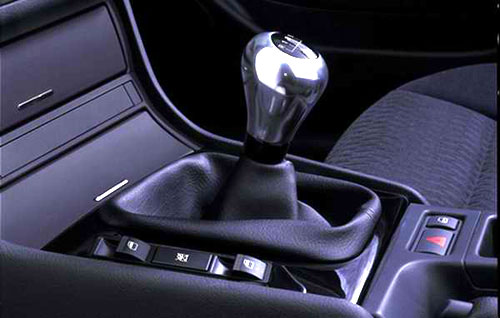
Left Lane News reports MINI is following Car and Driver’s lead in launching a campaign to invigorate sales of manual-transmission-equipped cars in the US:
MINI … is trying to reverse the trend of left-foot lethargy with a $500 price decrease for manual-transmission-equipped models and a new advertising campaign entitled ‘Manualhood.’ The campaign, which touts the increased control of stickshifts, features a range of slogans including ‘get your shift together’ and ‘manual up, America.’
Forget politics for a minute—there’s a cause I get behind, and have; I’m a diehard stickshift proselytizer. To mash up the slogans of two manual transmission stalwarts (Porsche and BMW), there is no substitute for the joy of rowing one’s own gears. It’s involving, focuses the driver on his or her task and thus promotes alertness while driving, allows so much greater control over the car’s actions and it’s just a lot of fun to master the skill. Here’s hoping more American drivers see the light and decide to take up the challenge.