Spannerhead Dot ComSpannerhead.com

Posts filed under ‘Car Industry’

It’s Over: Saab to Liquidate Assets

December 19, 2011 by Matt

Saab Logo Badge Emblem

The long arm of General Motors came back to haunt Saab, even as the company fought for survival, and proved to be the Swedish automaker’s undoing. As I reported back in July:

[O]n the verge of liquidating their assets and shuttering their factories, a pair of buyers emerged, in this case the Chinese firms Youngman and Pang Da.

What looked like the potential for a relatively secure line of credit for Saab has been nixed by GM on the grounds that patents arrangements could be used to further the interests of GM’s competitors in China, an exploding market for the American giant. So although GM no longer owns Saab, technically, a great deal of proprietary technology was shared, giving GM a certain amount of legal, if not financial sway over Saab’s activity.

And so, having been shunned by every major and minor automaker, it seems Saab’s quirkiness will be exiting stage left. The turn of events obviously means the end for Saab’s only current offering, its well-executed and distinctive second-generation 9-5.

What conclusions to draw from Saab’s demise? If I were going to be snarky, after the death of Oldsmobile, Pontiac, Hummer, Saturn, Daewoo and now Saab, I’d strongly advise struggling automakers against hitching their wagon to the General. Especially compared to the success of, say, former Ford partnerships—Jaguar, Volvo, Aston Martin and Mazda immediately come to mind—GM’s track record of putting companies on a successful trajectory looks poor indeed.

Also, the increasingly oppressive regulatory climate, both here and across the pond, is squeezing out smaller, more unique automakers in favor of larger, more financially-stable firms better able to absorb lawmakers’ capriciousness. It’s a sad state of affairs when outfits that bring so much color to the automotive world are sacrificed in order to free up the capital needed to comply with new emissions and safety laws, not to mention the overwhelming amount of gadgetry de rigeur in even a basic mid-level car. Now, of course I can’t prove a direct connection between the two; after all, many companies are done in by good old-fashioned mismanagement and stupidity (see: TVR), but it’s almost always the case that when the list of requirements for a product grows, the chance of companies designing very similar “solutions” grows proportionally. Everything fades to gray, and Saab is the latest color to dim.

2 Comments on It’s Over: Saab to Liquidate Assets

Too Much Help?
The Risks of Electronic Assistance

December 9, 2011 by Matt

Toyota Fun Vii Interior Inside Cockpit Dashboard Screen

Matt Hardigree at Jalopnik writes an excellent article drawing parallels between the technologically-dependent pilot mindset that doomed Air France Flight 447, and the potential for a variation of the same mindset to compromise car drivers’ ability to respond in an emergency situation on the road. The money quote:

I’m not anti-technology. I think technology can enhance and improve safety. Driverless cars and similar tech is designed primarily as safety equipment. Great. But instead of worrying if we’ve designed an autonomous system smart enough to drive without crashing when engaged, we need to worry about whether we’ve designed autonomous systems that are smart enough to not make us dumb when they disengage.

As far as technology’s potential to create the kind of dependency that could allow a driver’s emergency instincts to atrophy, or fail to develop in the first place, adaptive cruise control is Hardigree’s Exhibit A. Auto-drive technology, still immature at present and requiring a degree of road-based infrastructure that won’t be in place for quite some time, is the closest point of comparison to the context that doomed Flight 447, but the essence of the article holds true, even for less-than-fully-automated vehicle control environments. The more control a particular driving convenience assumes on our behalf, the more diligent we as drivers must be to maintain a connection to our cars’ actual dynamics, in the event, however rare, that the system fails and we’re compelled to reassert control.

In fact, I’d go further than that and maintain it’s not only the technology that takes control away from the driver that makes a car potentially less safe; it can also be the gadgets and doodads—some the driver himself brings into the car—that allow him to be distracted more easily from his primary task: Driving. It’s a variation on a very relevant theme as the virtual world envelops us more and more—We must be aware not only of what technology does for us, but also what it does to us. The more we become desensitized to the latter, the more we lose touch with our essential humanity, whatever your worldview. And that we do at our peril, whether in a fiery cataclysm like the one that overtook Flight 447, or in the slow withering of the faculties which connect our real bodies and minds to the real world.

No Comments on Too Much Help?
The Risks of Electronic Assistance

Ferrari’s Two Decades of Excellence

December 7, 2011 by Matt

Ferrari Engine Motor

Don’t get me wrong—they’ve always been good. But a recent Motor Trend interview with Ferrari chairman Luca Montezemolo, whose tenure began in ’91, gives a little insight into the Italian performance firm’s particularly outstanding last 20 years.

The interviewer and Montezemolo compare the remarkable improvement in Ferrari’s output to the qualitative difference between two cars which bookend the 20-year span: The early ’90s, dorky Testarossa-junior 348 and the recently-released, voluptuous, world-beating 458 Italia:

If you want to understand how dramatically Luca Montezemolo has changed Ferrari in his 20 years at the helm of the company, the transformation from 348 to 458 is an apt metaphor. Enzo might have created the Ferrari legend, but it’s Luca, born into an aristocratic family the year the company was founded, who’s made the legend real.

The two cars occupy roughly the same niche in Ferrari’s lineup, that of their “entry-level” mid-engined sports car, so the comparison works—Ferrari has come a long way, and much of their present mastery of the exotic car formula is due to Montezemolo’s steady, visionary hand at the tiller.

I don’t have much to add to the excellent interview summary other than to point out an often-overlooked contributor to Ferrari’s consolidation of its position in the industry: The revolution in their car’s usability starting with the 348’s replacement, the F355.

Prior to the F355—the first car developed on Montezemolo’s watch and a direct response to the threat posed by the Honda/Acura NSX—Ferraris were quick, to be sure, but unpleasant, ergonomically disastrous and evil-handling cars. The driver was expected to endure the car’s vices, more or less, for the privilege of experiencing its virtues. Upon its release, the NSX showed the world that high performance, benign handling traits and everyday usability weren’t mutually exclusive qualities in an exotic car. Ferrari took the lesson to heart, and with the F355, delivered the first in an unbroken series of ever-quicker, but also ever-more-user-friendly sports cars, culminating with the 458. It’s that sea change, more than even their looks or speed, that’s been the driver behind Ferrari’s climb, and we have Montezemolo to thank for the automaker’s enduring emphasis on that aspect of their cars.

7 Comments on Ferrari’s Two Decades of Excellence

Mercedes Gets Its Pistons Back in a Row

October 27, 2011 by Matt

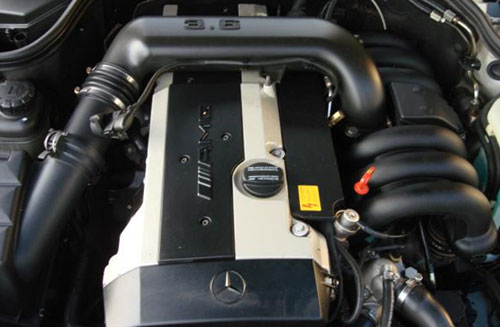
Mercedes Benz Merc M-B C36 AMG Engine Bay

Even as BMW tiptoes in the direction of abandoning their relationship with the straight-6 cylinder configuration, their arch-rivals at Mercedes-Benz seem set to reintroduce an engine featuring 6 cylinders all lined up, a layout they haven’t used for gasoline engines since they went all-V6 in ’99.

It’s yet another engine configuration shakeup as engineers scramble to find the new balance between their brand’s requirements and new efficiency and emissions regulations. The past half-decade has witnessed a remarkable downsizing of displacement and a virtual explosion of turbochargers, which have the promise of boosting the power of the smaller, more miserly engines. Whether or not they’re equipped with a turbo, the new inline-sixes from Mercedes stand a good chance of replacing larger engines at the same time they increase efficiency over the automaker’s outgoing V6s, mainly due to better manifold optimization and lower valvetrain loss (two camshafts vs four, etc). The only question I have concerns what I understand to be another major reason automakers are switching to smaller, shorter engines: The new EU frontal impact crash regulations. How will Mercedes square the additional length of an inline-6 over a V6 with the added crumple zone size required by the regulations?

If nothing else, it’s an interesting turn of events, and ensures that whatever BMW decides to do, the inline-6 won’t go be consigned to the dustbin of obsolete engine configurations (see: straight-8) just yet.

No Comments on Mercedes Gets Its Pistons Back in a Row

Are Hybrids Losing Their Luster?

October 2, 2011 by Matt

Honda Civic Hybrid Engine

A report from Left Lane and a comparo in this month’s issue of Car and Driver take exception to the conventional wisdom that says hybrids are the “next big thing.”

The Left Lane article cites fresh statistics that show hybrid sales as a percentage of all new car sales declined for the third straight year:

[T]he percentage of vehicles sold each year that are gas-electric hybrids is actually on a downward trend, despite the fact that the market has nearly doubled its offering since peaking in 2009 at 2.8 percent of all new cars sold… [I]t appears that buyers in 2011 are heading for a hybrid market share of just over two percent, lower than the 2.4 percent recorded in 2010.

I was surprised to read that, given the massive exposure new hybrid models are accorded on the car show circuit and in automotive publications. It’s a refreshing reminder that as much as a new technology is hyped by the powers-that-be, whether governmental or corporate, people will buy the best option available for their particular situation. Market forces are inexorable, in spite of certain institutions’ best efforts to guide the buying public’s actions in specific directions.

And as evidenced by the Car and Driver comparison test between the Chevy Volt and its stablemate, the Cruze Eco, the automotive press is starting to cut through the fanfare and hold automakers’ feet to the fire for their claims of hybrid efficiency, and examine the real-world wisdom of a hybrid purchase. The Volt has been all but hailed as the savior of the entire American automotive industry, so with such over-saturation it’s inevitable any actual scrutiny of car itself will fail to meet those sky-high expectations. Still, it’s remarkable how thoroughly the conventional-cycle gas engine-powered Cruze Eco trounces the Volt in the comparo—and not just in terms of real-world fuel efficiency, either, but also with respect to driver engagement, standard equipment and options, all at less than half the price of the Volt.

The end of the hybrid tale is yet to be written, of course, but in medias res one automaker that seems very smart is Mazda, having chosen to forego developing a hybrid powerplant in favor of their ultra-high efficiency SkyActiv gas engine technology, to be introduced in Mazda’s upcoming CX-5 mini-ute. If the hybrid downward trend continues, the Japanese automaker in particular stands to look positively visionary.

No Comments on Are Hybrids Losing Their Luster?

Conflicts of Interest

September 29, 2011 by Matt

Ford World Headquarters HQ Corporate Building Office

Whether you’re an individual or a corporation, standing on your own two feet is something to be proud of. Ford, the only one of the Big Three automakers not to receive bailout money during the opening months of the current administration, recently rolled out an ad pitching their relative independence from taxpayers as a selling point.

It’s understood that Ford’s relationship with their unions is just as unhealthily symbiotic as GM’s or Chrysler’s. Also, despite the fact they didn’t require bailout funding, Ford has certainly been on the receiving end of the taxpayer dole many times in the past. So they’re not “blameless” by any means. Still, I regard the company more positively than its rivals for having had the management acumen to navigate the recent downturn without requesting a public lifeline, and a recent survey shows I’m not alone: 50% of those asked said they’d be less likely to buy a GM car because of the bailout.

However, not everyone smiles on Ford’s publicizing of their independence, including some in positions of power. The Detroit News reports:

Ford pulled the ad after individuals inside the White House questioned whether the copy was publicly denigrating the controversial bailout policy CEO Alan Mulally repeatedly supported in the dark days of late 2008, in early ’09 and again when the ad flap arose. And more.

With President Barack Obama tuning his re-election campaign amid dismal economic conditions and simmering antipathy toward his stimulus spending and associated bailouts, the Ford ad carried the makings of a political liability when Team Obama can least afford yet another one. Can’t have that.

The ad, pulled in response to White House questions (and, presumably, carping from rival GM), threatened to rekindle the negative (if accurate) association just when the president wants credit for their positive results (GM and Chrysler are moving forward, making money and selling vehicles) and to distance himself from any public downside of his decision.

Behold an “intended consequence” of government takeover of private industry: The success of a company becomes a political liability, and something to be suppressed. A committee from the House of Representatives is investigating the extent to which the administration pressured Ford to yank the ad, but as they say, the damage is done. The Obama White House has amply demonstrated it has no qualms using taxpayer money to pick winners and losers in the private sector, and won’t hesitate to strongarm companies like Ford who remain proud of their more prudent fiscal decisions, and have every right to crow about it.

No Comments on Conflicts of Interest

The Way Forward for Lincoln

September 27, 2011 by Matt

Old Lincoln Car Ad

Autoblog relays a report that Lincoln is planning to move away from their traditional “waterfall grille” styling cue. It had been something of a nominal addition, tacked on for years without any real context, but lately, with the ’07-present MK-generation of cars, it’s become more integrated into the cars’ overall design themes. I can’t say I’m sad to see it go—it’s the sort of brand-defining design feature that can easily completely overwhelm the front end, and so elaborate that it can make designers feel absolutely cornered aesthetically, with no way to design around the monstrosity that must live on the car’s nose. It’ll be interesting to see which direction the stylists take next.

Of course, the same could be said about the brand in general. Lincoln has been floundering for years, with no clear direction from their parent company Ford, dabbling with a few different approaches but never really committing to any. And now that their sister marque Mercury is dead, all eyes are on Lincoln as the last remaining Ford sub-brand. Will they find their way and survive? Or will they be euthanized as well, leaving Ford standing alone?

Assuming Lincoln is worth saving, let’s consider a few potential paths:

  1. Go Euro. Also known as “the Cadillac path.” Lincoln could decide that American tastes have fundamentally veered away from the traditional American soft, cushy luxoboat, and opt to completely ape their European competitors. They could make all their platforms RWD (with AWD as an option), offer stickshifts and focus on balance, quality and handling. They might even consider adding a wagon and giving it a funky name like “Avant” or “Touring.” At this point, Lincoln would be late to the party, as even the Japanese competition (Lexus, Infiniti) is chasing BMW and Mercedes. Cadillac distinguishes themselves with great whacking American pushrod V8 power and knife-edged design; it’s difficult to envision how Lincoln could make themselves stand out if they chose such a route. Besides, they’ve already dabbed their toe in that product development philosophy with the unloved ’00-’06 LS V6 and V8, so they might be a bit leery of tacking that direction again. Still, in the case of the LS, I maintain the flaw lay not in the concept, but in its lackluster execution and the lack of conviction behind it. So “going Euro” is still a viable option.
  2. Pull an Audi. I have in mind Audi of the early ’80s, when they spearheaded an innovative and promising technology (quattro AWD) and built their cars and brand around it. Audi became, for all intents and purposes, “the AWD automaker” and fastened lesser distinctives, such as beautifully tasteful styling, to that primary brand-defining attribute. By hitching its wagon to some up-and-coming technology, Lincoln could become “the _____ luxury automaker” going forward. It would give the company a characteristic to rally around and help elevate the brand’s profile in an overcrowded market segment.
  3. Double down. With luxury automakers like Cadillac and Buick abandoning the traditional definition of the American luxury car like rats on a sinking ship, Lincoln could wager the ship is still salvageable, and attempt to establish a niche as the last refuge of the American land barge. Granted, they’d have to update the type’s image somewhat for the 21st century (read: more efficiency), but the theoretical potential does exist for the big boulevard cruiser to experience a resurgence in the marketplace. It’s a long shot, but perhaps that’s the way to point Lincoln’s tiller.

No Comments on The Way Forward for Lincoln

Obituaries

September 21, 2011 by Matt

Ford Crown Victoria Honda Element Chevrolet Chevy HHR Tails Rear Taillights

Today, Left Lane compiled a selective list of 13 cars axed for the 2012 model year. From the perspective of tracking trends and shifting automotive preferences over time, it’s almost as interesting as a new cars list. It’s fascinating to consider what caught on, what didn’t, what’s “out” and what’s “in” when it comes to car offerings. Some points of interest:

  • Buick Lucerne, Cadillac DTS and STS, Ford Crown Vic and Lincoln Town Car. Like the American station wagon and “personal car” (large 2-door coupe), the big American luxoboat seems to be going the way of the dodo. The contextual difference between the cars is their manufacturers’ vision of what’s next: Buick and Cadillac are trending smaller and more European (although Buick still clings to dynamically-inferior FWD), Ford is experiencing success with other models and has little incentive to replace the Crown Vic directly, and Lincoln is utterly rudderless and in desperate need of a focused company vision if it’s to survive—something the demise of the Town Car without any “way forward” illustrates.
  • Honda Element. In my mind, this one was a bit underrated. Sure, it wasn’t exactly a looker, but it wasn’t the Quasimodo everyone seems to think it was. Its biggest problem seemed to be lack of definition: The Left Lane article references the Nissan XTerra, a much more purposeful expression of the “utilitian, rugged SUV” idiom. Perhaps if the Element had been more truck-like and rough and tumble like the XTerra, or less SUV-ish like a Subaru Forester, it would have found a more dedicated audience; who knows.
  • Chevrolet HHR. Every time I saw an HHR, I was struck with how shamelessly it ripped off the PT Cruiser. However, most reviews concluded that Chevy had created the clearly superior car, not the most difficult task when you have a specific target to surpass. That said, it’s interesting to see certain companies canning their retro models, while others are updated (VW Beetle) and new ones are introduced (Fiat 500). Looking back, Chevy must have concluded that the need for a response to the PT Cruiser was gone, and that two retro-themed cars (the HHR and the Camaro) in their model line was one too many. Of the two, I’m glad they decided to keep the Camaro.

2 Comments on Obituaries

Teutonic Shifts

September 14, 2011 by Matt

BMW Logo Roundel V6 V-6 Engine Block

Motor Trend relays a bit of sleuthing by Bimmerfest involving recent patent filings by BMW. As it turns out, the Bavarian automaker has just applied for patents on a pair of upcoming engines: Two turbocharged V8s and, more significantly, a couple of twin-turbo V6s.

If you know anything about BMW’s relationship with the inline-6 engine configuration, you’ll know the adoption of a V6 would represent a fairly significant lurch away from their legacy. Virtually every other automaker has abandoned the I6 in favor of the more compact V layout for their 6-cylindered powerplants. Mercedes, Nissan, Toyota—you name it; they’ve ditched the I6. Why, then, has BMW persisted with the configuration for so long? In contrast to the more common V6, arranging the cylinders in a row does have some important advantages: Intake and exhaust plumbing is more simple, the valvetrain is much less complex, and perhaps most significantly: The engine is capable of achieving perfect harmonic balance, meaning it runs very smoothly. This puts less stress on its internals and gives the inline-6 a refined feel, an important quality for the engine of a luxury performance car.

And now BMW may be, at long last, introducing a V6. Somehow I doubt it will entirely replace their iconic I6 across the model range, as it did with the other automakers, but it muddies the waters; it dilutes what was previously an uncompromising devotion to the inherent qualities of a technically elegant engine configuration. That said, as with the introduction of FWD cars branded as BMWs, I don’t know if I can blame this entirely on some cynical quest for profit at the expense of the automaker’s legacy. The new EU regulations for cars include rather draconian specifications for pedestrian safety, regulations the European auto industry is striving to adhere to mainly by integrating larger crumple zones into the noses of their designs. The additional “give” needed by the bodywork means the “hard” engine must be pushed back farther in the chassis, putting the comparatively long inline-6 at a major disadvantage. So an attempt to conform to some arbitrary set of top-down restrictions may bear at least some of the blame for the shift. Whatever the reasons, it’ll be a sad day for classic Bimmer-philes when the first V6-engined BMW rolls off the assembly line.

2 Comments on Teutonic Shifts