Spannerhead Dot ComSpannerhead.com

Posts filed under ‘Mazda’

Mazda to Reintroduce
More Efficient Rotary Engine?

March 14, 2012 by Matt

New Mazda 16X 16-X Rotary Wankel Engine

For all you rotorheads, this has the potential to be very big news.

Left Lane reports:

According to Mitsuo Hitomi, the general manager of Mazda’s powertrain development department, the company is about to put the final touches on an entirely new rotary engine that will easily comply with upcoming fuel economy and emissions standards.

The new engine is likely the long-awaited 16X. According to the report, Mazda engineers altered the shape of the rotor housing, and modified the intake manifold and ignition sequencing in order to dramatically improve the rotary’s efficiency, always and ever its Achilles heel, and more important than ever given the priority placed in recent years on mileage and frugality.

It’s interesting the revelation that a new rotary is so close to completion comes hard on the heels of another recent report of Mazda’s somewhat perilous financial condition. If nothing else, it’s a sign of the engine’s vital importance to Mazda’s brand identity that development continues, even at such a low level, given that there’s likely very little money in the automaker’s coffers for anything else. As enthusiasts, we can only be thankful for Mazda’s devotion to the design, and wait with bated breath to see what makes its way to the auto show circuit, or even better, the showroom floor.

No Comments on Mazda to Reintroduce
More Efficient Rotary Engine?

Why Can Mazda Not Break Through?

March 9, 2012 by Matt

Mazda Logo Miata Shifter

A recent Left Lane report that Mazda will be cutting back its US workforce revived a question that’s been rolling around in my head for some time: Why is Mazda not more successful? Why can they not break into the “upper tier” of Japanese automakers, a plane occupied by companies like Toyota, Nissan and Honda?

Granted, all automakers have to lay off workers from time to time in order to adapt to changing demand, or an underperforming product, or increased competition. But Mazda seems to be a perpetual underachiever, almost always turning our cars that are among the best in their respective class, and well put-together at that, but unable to vault their manufacturer into the upper echelon of Japanese makes. As a result, they seem to experience crises every half dozen years or so where they’re compelled to pare down their workforce or seek a business alliance, never actually entering bankruptcy, but certainly experiencing hard times, with little surplus development money available for the projects they’d actually rather be working on, such a next-generation rotary engine, or putting together a factory race team and adding to their already-enviable racing pedigree.

Mazda MX-5 Miata Roadster Green Silver NC

A quick mental scan of Mazda’s product line over the past decade or so offers some insight into the company’s fortunes. As much as GM would like us to believe otherwise, an automaker’s success or failure is tied pretty directly to the quality of the cars they design, engineer and manufacture, and a glance at Mazda’s output—the 3, 6, RX-8, MX-5, CX-7, CX-9 and Tribute, among others—reveals vehicles that are almost always a joy to drive, but in terms of mass-market appeal, are a little out-of-step with mainstream tastes. They’re not boring transportation appliances, and as much as we enthusiasts would consider that a selling point, the hard truth is that much of the buying public is looking for the anonymous beige box to tote them around, never breaking down and getting 30 mpg and playing their MP3s via Bluetooth. That being the case, consideration of Mazda cars requires a bit more of a “leap of faith” from the consumer than say, an Accord or Camry, vehicles that all their friends have; known quantities. Success, no matter how it’s arrived at, begets success, and as such Toyota, Honda and Nissan occupy enviable positions atop the podium, leaving Mazda and other Japanese makes nibbling around the edges.

Is that the whole story, though? Interesting cars that are lovely to drive but are cursed by the fact that the words “Camry” or “Accord” aren’t affixed to their trunklids? Or is there more to it? Why do you think Mazda isn’t more successful?

4 Comments on Why Can Mazda Not Break Through?

The Joys of a Paid-Off Car

February 15, 2012 by Matt

Mazda MPV 05 2005 LX Grey Gray Gunmetal

We paid off our minivan yesterday. It was our first—and to date only—car to have been financed, and after 2 years and 10 months, I’m proud to say we’re in the clear again, considerably earlier than the term of the loan. The extra money in our pocket will be helpful for a whole host of things, from kid activities to home improvement and assistance in paying off other debts. It’s incredibly liberating and satisfying to know that we now hold our cars’ titles, not the bank.

It also makes me want to take better care of the minivan. It’s an ’05 Mazda MPV LX, powered by a 3.0l, 200 hp V6, and it’s been incredibly faithful. 3,000 more miles to go to hit the big 100K, and our only failures to date have been:

  • A PCV hose around the back of the intake manifold a year ago. $50 worth of parts and tools later, and it was good as new.
  • The door handle cable inside the drivers’ door. Found a gentleman online (I love the internet for sourcing car parts) with a spare and was able to fix it for around $20.

Mazda MPV 05 2005 LX Grey Gray Gunmetal Rear Taillights Back

Other than that, it’s been bulletproof, with a couple of trips to the beach and many, many errands around town under its belt. It does have to sleep outside, unlike its siblings (the 240Z and the BMW get the garage), but it doesn’t seem to mind too much. It does need a good wash and wax and clean-out, though, along with a potential transmission service at 100K. Debating about that last one.

Having the minivan paid off makes me think about the ways in which car acquisition and ownership have changed since my parents’ day. My dad always paid cash, and almost always bought new, even if he had to sell some stocks or dip into his other investments to do so. To my knowledge, my parents have never had a car payment, and I have a feeling it was like that for many more families than just mine. New car prices have increased significantly over the past 30 years, and not just because of inflation—modern cars are packed with electronics and safety features, a dozen airbags, traction and stability control, navigation systems, and so on. It makes me wonder how far the avalanche of features and gadgets can really go, how far the market can really sustain the one-up-manship between automakers.

Mazda MPV 05 2005 LX Grey Gray Gunmetal Interior Inside Cockpit Dashboard Dash Console

If I had to put forth a prediction, I really do see car ownership going in the same direction as home ownership in the sense that 20-30 years out, everyone will finance their cars; they will simply be an investment on the same level as buying a house. Debt coaches will advise their clients on another type of “acceptable debt” besides a home loan: the car loan. Between cars’ rapid increase in sophistication, the growing complacency (the past few years excepted) toward consumer debt and the looming specter of federal regulations that threatens to hike the price of the average car even more, only a very small percentage of buyers will pay entirely out of pocket for a new car. It’s unfortunate, really, symptomatic as it is of the decline in the average consumer’s purchasing power, even as the shift has the potential to be a boon for the used car and auto repair industries. I really don’t think we’d be surrendering a great deal by shifting our buying habits toward smaller, simpler, less expensive cars and simply taking more responsibility for ourselves behind the wheel in terms of driving safely, entertaining ourselves and finding where we need to go.

6 Comments on The Joys of a Paid-Off Car

Underrated Lookers:
The ’86-’91 Mazda RX-7

January 27, 2012 by Matt

Mazda RX-7 RX7 FC 2nd Gen Generation Red Turbo II 2

Overshadowed by Mazda’s later, stunning, 3rd generation rotary-powered sports car, the ’86-’91 2nd gen plays an aspirational role for many owners. Much like its contemporary from Toyota, the ’86-’92 Supra, the 2nd gen RX-7 lives in the shadow of its faster, better-looking and far more potent sequel.

That said, the FC, as it’s known, is quite a handsomely-penned car in its own right. The Porsche 944‘s shape inspired the Japanese designers, and while the 2nd gen might not be quite as baroque and sultry as its counterpart from Stuttgart, the similarities proportion-wise are evident. Notable differences include a lack of an actual quarter light for the Mazda, and its unique headlight treatment that allows flash-to-pass while the high beams are still stowed. The Japanese car features less surface detail than the 944 as well, but it displays a taut and confident—if not overly interesting—profile.

Mazda RX-7 RX7 FC 2nd Gen Generation Red GTU GTUs

Several details in particular stand out to me: The strong “keystone” of a C-pillar, the ever-so-slightly flared wheel arches, and especially the minimal thickness between the top of the front arch and the beginning of the sheet metal’s turn inward toward the hood. That last detail visually lowers the front end and gives the car an especially agile, grippy appearance.

No, even if its lines doesn’t deserve the admiration of the FD’s, the FC is a cohesive, attractive and often overlooked shape, one that I wouldn’t mind in the least to be seen behind the wheel of.

Editor’s note: This post is part of an ongoing series featuring cars whose design I find appealing, in contrast to mainstream opinion. Read the other installments here:

4 Comments on Underrated Lookers:
The ’86-’91 Mazda RX-7

FWD Champions: The ’88-’92 Mazda MX-6

January 2, 2012 by Matt

Mazda MX-6 MX6 GT Turbo Gray Grey Silver

There’s one of these at the house at the end of our road. A white one. I stare at it every time I drive by. Every time I stroll by its house during a walk with the kids, I have half a mind to ask the owner if he’d be interested in selling.

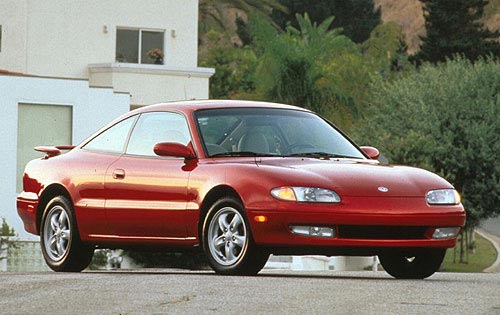
Even with the GT trim line’s 2.2l, 145 hp turbocharged 4-cyl engine, the first-generation Mazda MX-6 was never a screamer. 0-60 time was around 7.5 seconds—respectable for the era, but not necessarily quick. The style, too, was understated almost to the point of anonymity. The fascia in particular has no elements whatsoever that would distinguish it from your average Japanese sedan of the period. And to top it all off, the car was exclusively FWD. So what’s the big deal?

Mazda MX-6 MX6 LX Brown Black

As with many cars I enjoy, what matters are the details, and what’s under the sheet metal. Study the car’s proportions for a minute. Notice the subtle fender flares and shape of the spoiler, among other cues. Remind you of anything? An R32 Skyline, perhaps? The car’s stance radiates a quiet undercurrent of mild aggression I find very appealing.

As nice as the shape is, the core of the first-gen MX-6’s draw are the mechanical bits. As mentioned above, the GT trim line was fitted with a 145 hp turbo’d 4-banger. The horsepower figure may not be much to write home about, but the many owners and enthusiasts feel it may have been underrated, and the torque number stands at a very stout 190 ft-lbs. Not only that, the nucleus of the engine itself served in a number of noteworthy sporting Mazdas, including the 323 GTX cult car and the first-gen Miata, and is well-known to be nearly indestructible, and very responsive to basic mods.

Mazda MX-6 MX6 4WS Four 4 Wheel Steering Diagram Schematic Drawing System

The ’88-’92 MX-6’s real party piece is illustrated above: The 4-wheel steering system. Offered around the world for the majority of the car’s run, but only in North America for the ’89 model year, Mazda’s 4WS system was very close in concept to that of the concurrent Honda Prelude. A computer-controlled steering rack was fitted to the rear wheels with the ability to turn them up to an angle of 5 degrees. The rear wheels turned the opposite direction from the fronts, tightening the turning circle and enhancing maneuverability, up to a vehicle speed of around 22 mph, at which point all four wheels turned the same direction, giving the MX-6 better high-speed stability. A system failure, or routine power down (as in turning the car off) automatically returned the rear wheels to straight ahead. Added weight and complexity, sure, but the car wasn’t that heavy or complex to begin with, it did mitigate some of FWD’s inherent disadvantages, and the cool factor is off the charts. Put all that together, and you have a worthy addition to our parade of notable FWD cars.

Editor’s note: This post is part of an ongoing series highlighting FWD cars I think highly of, in spite of my overwhelming RWD bias. Read the other installments here:

1 Comment on FWD Champions: The ’88-’92 Mazda MX-6

A Fresh Face: The Mazda Takeri Concept

November 30, 2011 by Matt

Mazda Takeri Concept Red

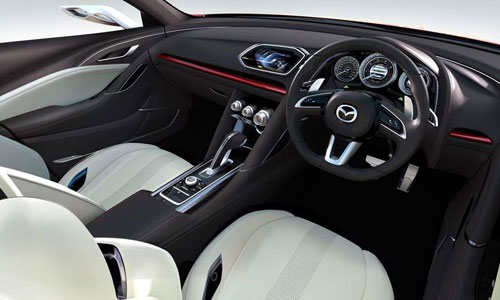
One of the prominent reveals of the first day of the Tokyo Motor Show was the Mazda Takeri concept. The enthusiast-oriented automaker had released photos a month ago but the Japanese show is the first the public has seen the car in the flesh, to rave reviews.

Mazda Takeri Concept Red

The shape is obviously the main draw, one of the first Japanese forays into the new “four-door coupe” territory pioneered by the Mercedes CLS, Volkswagen CC and Audi A7, among others. I have to say, if Mazda builds the car—and it looks surprisingly production-ready—they stand to leapfrog Nissan’s attempts to become Japan’s automotive style leaders, echos of a period in the early-to-mid ’90s when they penned a series of stunners, from the FD RX-7 to the MX-6 and 929.

Beyond the nicely-sculptured proportions, the Takeri serves as further evidence Mazda is ditching the derided “smiley faces” in favor of a positive, versatile grille shape. It’s appeared on the upcoming CX-5 small SUV as well, but on the Takeri the fascia radiates strong overtones of the Jaguar XF‘s front end—not a bad car to use as inspiration. However, in the Mazda’s case, I’d venture to say the pupil has surpassed the master, giving the Takeri more tension and poise than the XF’s comparatively plain grille.

Mazda Takeri Concept Interior Inside Cockpit Dashboard

The mechanicals receive a suite of Mazda’s latest initiatives as well. In addition to featuring their new Skyactiv efficiency program, which encompasses engine, transmission and chassis elements, the Takeri also showcases the automaker’s awkwardly-named i-ELOOP regenerative braking system. From Motor Trend‘s post:

i-ELOOP converts kinetic energy into electrical energy and stores it in capacitors for quick charge and discharge to power the vehicle’s electrical components. The automaker claims the system reduces fuel consumption by as much as 10 percent.

It won’t set the world on fire, and it all sounds very show car-ish, so it’s questionable how much of that would make it to the assembly line, but it does illustrate Mazda’s willingness to think outside the trendy hybrid/electric box. I hope to see the car in a showroom soon.

No Comments on A Fresh Face: The Mazda Takeri Concept

The Ones That Got Away, Part VII

November 11, 2011 by Matt

Mazda RX-7 RX7 GSL-SE GSLSE 13B 1984 1985 84 85 Rotary Wankel Brown Maroon

It’s appropriate, I suppose, that part VII of this series should be about an RX-7. This one was more of a brief flirtation, but it does illustrate the enduring appeal of one’s “first love,” automotively-speaking, and represents a seminal period in my thinking about cars.

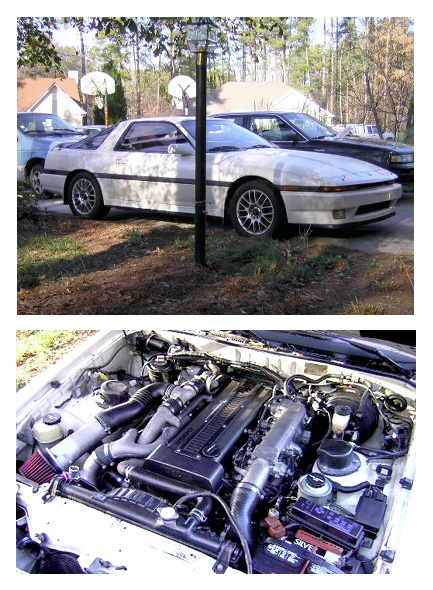
In early 2003, I was underemployed and driving my ’88 Supra Turbo, pre-engine swap. Between working part-time and hunting for a serious, degree-related job, I had a fair amount of time to mull over my car situation. I liked the Supra very much; it had been my companion of sorts during my 6-month adventure in Florida the previous year, so we had some “history.” However, as evidenced by the diversity of topics on this very site, my automotive interests resist confinement to one model, brand or even type of car. The grass is always greener, and even though I did have a bond with the Supra, I was getting bored with it, as dumb a decision as a car switch would have been at that point.

My car philosophy was in flux as well. A vehicle like the Supra is easily upgradeable for big power; modification paths are readily available and well worn. That said, I was in the midst of a kind of existential crisis, coming to the realization that there would always been a car out there with more power than mine, faster than mine. That may seem like a truism, but it was very immediate for me during that period, coming to terms with the fact that the horsepower war is a bottomless money and time pit. Of course, being as broke as I was, I couldn’t have upgraded my car anyway, so it’s likely the “crisis” was, as much as anything else, a subconscious attempt to pin my automotive self-image on something other than raw speed. Convenient, that.

In any case, during my soul searching, instead of going after big power, I resolved to value qualities in a car unrelated to the amount of tire smoke it could generate on command. Self-serving it may have been, I determined to seek out the intangibles, to value the character of a car more than its spec sheet.

Mazda RX-7 RX7 GSL-SE GSLSE 13B 1984 1985 84 85 Rotary Wankel Brown Maroon Interior Inside Cockpit

Naturally, my conclusion led me back to the first car I’d really fallen for, my first project car, the ’79-’85 Mazda RX-7. Even in top-of-the-line 135 hp ’84-’85 GSL-SE trim, it’s no speed demon, with a 0-60 time of around 8 seconds, comparable to that of a modern family sedan, and upgrade paths are considerably steeper than for the Supra. What it did possess was a raw, elemental feel, an eager, curve-hungry personality coupled with a unique, turbine-like rotary engine. Its timeless shape has always appealed, being neither bound to the campiness of ’70s styling conventions nor the harsh angularity of ’80s trends. And I already knew every nook and cranny of its engine bay, having performed an engine swap between a pair of ’85s. The combination of character, uniqueness, design and familiarity was irresistible. I fired up Autotrader and began hunting for one.

Being the product of part-time job daydreaming, I wasn’t completely serious about the endeavor, and even if I had been, I’d have had no idea how to unload my Supra in favor of an RX-7. I indulged my wandering emotions a bit, though, and when an ’84 GSL-SE closely resembling the one feature in this post’s pictures popped up 90 miles away, I roped a car buddy into doing some investigation with me.

We made the trip and found the car in fantastic condition. The paint was lustrous, the engine ran well (and idled properly—a rare quality for the GSL-SE’s 13B Wankel) and the interior, while brown, wasn’t the hideous maroon color many ’80s sports cars seem to have been afflicted with. I could have lived with a chocolatey RX-7 very easily, but in the end I had no real plan to acquire it, and my buddy and I returned home. Having actually kicked the tires, my longing for a first-generation RX-7 was sated just enough to clear the fog of fixation, and I backed off my quixotic quest. I rediscovered character-related attributes I enjoyed about my Supra, and learned, in the end, that even in cars with readily-tapped power potential, there are still a host of other aspects to relish.

Editor’s note: This post is part of an ongoing series relating stories of cars I almost acquired, whether though purchase or trade. Read the other installments here:

No Comments on The Ones That Got Away, Part VII

Rotary Thunderbird: Mazda’s Cosmo/RX-5

November 4, 2011 by Matt

Mazda RX-5 RX5 Cosmo Green Early Old First 1st Gen Generation

Having just finished reading the recent, excellent Ate Up With Motor article on early Mazda rotaries, I feel suitably inspired to discuss an obscure, short-lived but very cool late ’70s Mazda import: The Cosmo, or RX-5.

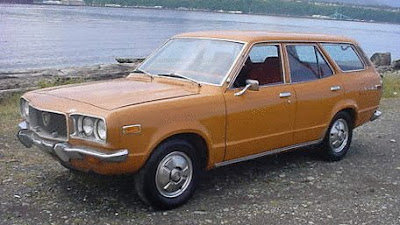
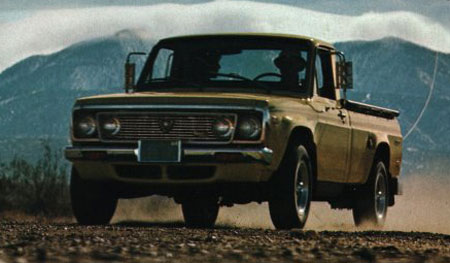
In the beginning of the ’70s, Mazda made an initial ambitious push to standardize the rotary across their model range, with the eventual goal of dropping piston engines altogether. To that end, they installed their Wankel engines in everything from family station wagons to sporty coupes to their pickup trucks. The cars were initially moderately successful, but just as the automaker was hitting its stride, the early ’70s fuel crisis arrived, and the rotary’s mostly undeserved reputation for thirstiness (especially compared to the gargantuan big block V8s of the day) caused buyers to shy away from Mazda’s lineup. The company felt the downturn acutely, and pulled the novel powerplant from all but a few of its cars, even those selling in tiny numbers.

Mazda had totally committed themselves to the Wankel engine, so they couldn’t simply euthanize the venture and revert to conventional engines; they had to find a “home” for the rotary. They needed ideas, and in the years between the engine’s initial fall from grace and the runaway success of the first-generation RX-7 in ’79, where Mazda finally hit on the formula that would make the Wankel financially viable, they tried a few different things.

Mazda RX-5 RX5 Cosmo Red Early Old First 1st Gen Generation

One experiment that sadly never took off is the coupe featured in this post, the Mazda Cosmo, or RX-5 in international markets. The idea was to harness the incredible popularity in the ’70s of the “personal coupe” concept—think Cadillac Eldorado, Ford Thunderbird or Olds Toronado, among a myriad of others. So rather than give the rotary engine a completely distinctive wrapper to reflect the unconventional engine, they decided to “American-ize” the concept and ape current market trends, albeit on a smaller scale (the Cosmo tipped the scales at a welterweight 2,500 lbs).

Mazda RX-5 RX5 Cosmo Early Old First 1st Gen Generation Interior Inside Cockpit Steering Wheel Dash Dashboard

Unfortunately, it didn’t catch on. Mazda dropped the car after the ’78 model year, when it was clear Americans just weren’t buying the recipe, apparently preferring their giant domestic land yachts or dedicated sports cars like the 280ZX to a nicely-styled but smaller personal coupe with a smooth, flexible engine and crisp handling.

I love the Cosmo. It’s incredibly obscure, which is always appealing; I love having the “What is that?” conversation in parking lots and at gas stations. Besides, as much as Mazda tried to emulate the larger American cruisers of the time, what they actually hit upon has a sort of pony car swoop and dynamic to its profile. And details like the side windows, grille and taillights, while still exhibiting some of the fussiness Japanese designs have always been notorious for, are remarkably clean, especially considering the era in which it was produced. Best of all, if you know anything about the family of Mazda rotary engines, you’ll be aware of the fact that it’s a very modular powerplant, and with a little mixing and matching of components produced over the years, it would be relatively simple to assemble a much more powerful rotary to drop right into the Cosmo chassis. So it’s eminently upgradeable. As unloved as it was in its day, to me here and now, those qualities add up to a winner.

Editor’s note: It’s understood there were two Mazda cars that shared the name “Cosmo:” The pioneering 110S and later line of personal coupes that complimented the automaker’s RX-7 sports car line and concluded with the stunning JC Cosmo of the early ’90s.

4 Comments on Rotary Thunderbird: Mazda’s Cosmo/RX-5

Are Hybrids Losing Their Luster?

October 2, 2011 by Matt

Honda Civic Hybrid Engine

A report from Left Lane and a comparo in this month’s issue of Car and Driver take exception to the conventional wisdom that says hybrids are the “next big thing.”

The Left Lane article cites fresh statistics that show hybrid sales as a percentage of all new car sales declined for the third straight year:

[T]he percentage of vehicles sold each year that are gas-electric hybrids is actually on a downward trend, despite the fact that the market has nearly doubled its offering since peaking in 2009 at 2.8 percent of all new cars sold… [I]t appears that buyers in 2011 are heading for a hybrid market share of just over two percent, lower than the 2.4 percent recorded in 2010.

I was surprised to read that, given the massive exposure new hybrid models are accorded on the car show circuit and in automotive publications. It’s a refreshing reminder that as much as a new technology is hyped by the powers-that-be, whether governmental or corporate, people will buy the best option available for their particular situation. Market forces are inexorable, in spite of certain institutions’ best efforts to guide the buying public’s actions in specific directions.

And as evidenced by the Car and Driver comparison test between the Chevy Volt and its stablemate, the Cruze Eco, the automotive press is starting to cut through the fanfare and hold automakers’ feet to the fire for their claims of hybrid efficiency, and examine the real-world wisdom of a hybrid purchase. The Volt has been all but hailed as the savior of the entire American automotive industry, so with such over-saturation it’s inevitable any actual scrutiny of car itself will fail to meet those sky-high expectations. Still, it’s remarkable how thoroughly the conventional-cycle gas engine-powered Cruze Eco trounces the Volt in the comparo—and not just in terms of real-world fuel efficiency, either, but also with respect to driver engagement, standard equipment and options, all at less than half the price of the Volt.

The end of the hybrid tale is yet to be written, of course, but in medias res one automaker that seems very smart is Mazda, having chosen to forego developing a hybrid powerplant in favor of their ultra-high efficiency SkyActiv gas engine technology, to be introduced in Mazda’s upcoming CX-5 mini-ute. If the hybrid downward trend continues, the Japanese automaker in particular stands to look positively visionary.

No Comments on Are Hybrids Losing Their Luster?