Spannerhead Dot ComSpannerhead.com

Posts filed under ‘Mazda’

A Breath of Fresh Air: The Mazda CX-5

August 31, 2011 by Matt

2013 Mazda CX-5

Mazda’s all-new entry in the saturated small SUV class, the CX-5 bows next year as a welcome vanguard of the automaker’s new styling direction. Car and Driver reports:

The previous Nagare (“wind-driven flow”) theme that gave us more ear-to-ear grins than we really needed is heretofore supplanted by Kodo—a less flamboyant, more tasteful “soul of motion” appearance. Where the CX-5 goes stylistically, other Mazdas will follow.

As odd as it seems for a small SUV to be leading its company’s design direction, at this point, those of us battle-weary from the aesthetic jarring of seeing the Mazda 3 schnoz on the commute home will take visual relief any way we can get it. I actually think Mazda went above the call of duty and penned a very shapely and distinctive little car, one that will stand out in a forest of antiseptic Honda Pilots, Kia Sportages and Ford Escapes.

2013 Mazda CX-5 Interior

While the styling is sure to be well-received, as will be the handling (Mazda’s forte), the new powertrain philosophy the automaker is introducing with the CX-5 is a less sure bet. Instead of releasing a fashionable hybrid or turbo-diesel, Mazda has opted to focus on refining their traditional engines to remarkable levels of efficiency, with carefully optimized internals and peripherals that wring maximum mileage out of conventional processes. While it’s an admirable goal, I do wonder whether Mazda is either:

  1. Making the best of a bad situation, not having the resources or capital to develop either a hybrid or diesel powertrain, or
  2. Somehow betting that the current phase of alternative propulsion is just a fad, and hoping to jump on the train at the next station, so to speak, by anticipating whatever will come next.

I’ll be keeping an eye on the response to both Mazda’s styling and propulsion choices. I hope for their sake—and for the prospects of any future rotary-powered Mazda sports car—that their gambles pay off.

Update (3:24 p.m.): Automotive News reports that a diesel engine option will be added to the lineup for the 2014 model year. Still no word of a hybrid, though…
No Comments on A Breath of Fresh Air: The Mazda CX-5

Taking the Measure of the RX-8

August 18, 2011 by Matt

Mazda RX-8

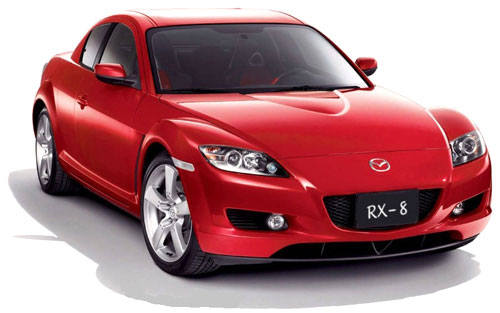
As production of Mazda’s aging RX-8 sports coupe winds down and with it, production of the automaker’s signature rotary engine, I think it’s worthwhile to pause and scrutinize the car’s 8-year model run.

Introduced in 2004 in the US, the RX-8 represented the long-awaited reintroduction of the rotary engine to our market after the too-hasty departure of the 3rd generation RX-7 in 1995. Rumors had been swirling for years about which form the return would take, and after a series of teaser concept cars like the RX-01 and RX-EVOLV, it’s fair to say no one really knew how Mazda would package the engine, if indeed it did return. Would it be a fire-breathing road-eater like the 3rd-gen RX-7? A cheap and tossable sports car like like the 1st-gen? Or something completely different? More than anything, speaking as a Mazda fan and rotary buff, we just hoped Mazda wouldn’t compromise in the fun-to-drive department.

Mazda RX-8

We got something of a mixed bag. Jeremy Clarkson remarked in his review that the car looked like it had been “styled by suggestion box,” and that statement could have held true for the engineering as well. To summarize the pros and cons of the then-new RX-8, the good points:

  • Low weight. Mazda admirably kept the car around 3000 lbs for the entirety of its model run.
  • Excellent handling. Review after review praised the responsiveness of the chassis, and in their recent comparo, Car and Driver ranked the 7-year-old RX-8 an astonishing third, beating out even the M3.
  • Some measure of practicality. Stung by criticism of the late 3rd-gen RX-7’s single-minded focus on performance at the expense of everyday livability, Mazda added a pair of so-called “freestyle doors” to enhance rear seat access. They might well have been added to assuage the bean-counters’ fears, but they’re undeniably practical.

And the negatives:

  • Uneven styling. Compared to its arch-rival Nissan 350Z, released shortly before the RX-8, the Mazda’s design is much less coherent. The concession to a more practical roof line is partly to blame (the 350Z is a pure 2-seater), but no one can claim the added rear seat volume is responsible for the mess of lines called the nose. The smiley face grille (exacerbated with the styling refresh in ’09, shown below) and headlights are cartoonish when they should be sleek and serious, and the profile is bulbous instead of tapered and focused. And the clear taillights and other details represent, yet again, the worst tendency of Japanese designers to chintz up the outside of their cars.
  • Low power. I won’t take Mazda to task for the inherent high-revving nature of the rotary engine. The power’s at the top of the rev range, and you have to spin it—there’s no getting around that (good thing the engine makes the task so effortless). That said, what power was available wasn’t competitive in its class, and Mazda committed the cardinal sin of over-promising and under-delivering just as the car was released: They quoted a power figure of 250 hp; reality was closer to 232, and after independent dyno tests called Mazda’s bluff, they embarrassingly re-rated the car and offered to buy back those of any who were dissatisfied. At least they did damage control, but it happened at the worst possible time and to the ambassador of Mazda’s key technology. Stupid, dumb, unfortunate.

Mazda RX-8

Overall, I was a huge fan of the car’s dynamics, could have lived with the power (I don’t mind winding out my cars’ engines), but had real issues with the styling, especially the ’09 refresh. I don’t think the car hurt Mazda’s or the rotary’s image—public perception is still that it’s a gas-guzzling, oil-burning hamster wheel—but the RX-8 didn’t help matters either. Basically, it dutifully carried the “halo car” torch for Mazda for 8 long years, but didn’t broadcast itself to a wider audience in any capacity other than pleasant placeholder.

Does this mean I wish Mazda had “mainstreamed” the rotary, incorporating it into a more mass-market sedan or GT bodystyle, like the automaker did in the early ’70s? Not necessarily, but the RX-8 at least could certainly have benefited from a larger dose of conviction—the amalgam of roles and compromises bundled into the car spoke of an automaker that may have soldiered on with their signature technology as a matter of duty, but not necessarily as a matter of pride. As good as it was in many ways, the RX-8 simply wasn’t focused or stunning enough. Here’s hoping that whatever form the the next wrapper for the rotary takes, it at least has a strong identity—buyers can relate to that, and respond to it; witness what Mazda itself accomplished with the Miata. As for me, I’ll be eager to see what they come up with next.

No Comments on Taking the Measure of the RX-8

As the Eccentric Shaft Turns

August 6, 2011 by Matt

Mazda 12A Turbo Engine Wankel Rotary

Well, that answers that.

Autoblog reports the Mazda rotary hasn’t been shelved, like I had feared, although it seems to be in a sort of cryogenic suspended animation:

Mazda execs have apparently confirmed that engineers are working on a more efficient and more powerful version of the Wankel. While the project was technically back-burnered during the economic downturn, the research wasn’t canned outright.

The “more efficient and powerful version of the Wankel” is presumably the 16X, the long-awaited longer “stroke” (read: torquier) successor to the prolific 13B, a variant of which has been installed in every top-of-the-line Mazda sports car since 1986.

Unfortunately, the report goes on to point out:

A rotary does pair well with an extended-range electric vehicle platform, however, as the high-revving nature is perfect for turning a generator. While that may be a far cry from the low-slung RX-8, it’s at least reassuring to know that the engine design could have a future.

Again, yes and no. While it would be gratifying on some level to know that Felix Wankel’s internal-combustion epiphany wouldn’t be utterly tossed into the dustbin of history, being relegated to some sort of “prop” for an up-and-coming alternative propulsion technology just seems, well…demeaning to an engine configuration with so much character and untapped potential—in standalone, gasoline-burning form.

In my perfect world, Mazda would build a new front-engine, rear-wheel-drive sports car and a high-end sports sedan around the 16X, their development of the rotary having cracked its fuel consumption and low-end torque issues. The automotive press would hoist the new pair of models on their collective shoulders, rhapsodizing that Mazda had finally found the perfect engine to complement their peerless chassis tuning, and buyers would flock to Mazda showrooms in droves. The unexpected success would at last convince other manufacturers to give the Wankel a fresh look, and Mazda would license the technology to another automaker or two. The engine wouldn’t take over the world, so to speak, but would perform a sort of Apple-in-the-late-’90s-style comeback, slowing gaining legitimacy and a sort of non-conformist cool (more than it already has, that is) on the way to establishing a secure beachhead in the market.

To put it mildly, that’s a bit much to extrapolate from this latest confirmation that the rotary is not, in fact, dead. But I have a feeling my pipe dream is shared by more than a few rotary enthusiasts out there.

3 Comments on As the Eccentric Shaft Turns

Car Heroes: David Lane

July 31, 2011 by Matt

David Lane's Mazda RX-7 GSL-SE CarTech Turbo

It’s cliché, but even in the car world, we’re not islands untethered, but stand on the shoulders of those who have come before and had an impact on us. This post begins a new series paying tribute to those people I consider seminal in my development as a car buff.

When reflecting on the forces that shaped my perspective on cars in general, I look back most often to a gentleman named David Lane. David is Director of Admissions at Peabody Conservatory and a long-time fixture on the first-generation (’79-’85) Mazda RX-7 mailing list. Our car interests occupy different orbits now, but his influence on my early days of tinkering is something of an anchor in my mind.

Our paths crossed in late ’99 on the first-gen RX-7 e-mail list. E-mail lists seem to be an obsolescent species nowadays, as natural selection continues to favor the more accessible medium of online forums. That said, David’s even-keel and avuncular demeanor complemented the e-mail list format perfectly; his talents would be wasted in the bite-size, rapid-fire world of forums. He excelled in online diplomacy, holding the list together through many flame wars and other disagreements. His warm writing style underscored the wisdom he offered to guys like me, often discouraged by speed bumps and setbacks in the course of our first car projects. And when it was all said and done and I had completed my first engine swap in the summer of 2000, David extended the kind of verbal pat on the back that made me feel like I had been initiated into the ranks of the mechanically accomplished, even though there were many pitfalls yet to come.

And then there was his car. You can read the full spec sheet here, but suffice it to say that it remains a legend in the first-gen RX-7 world, the “pinnacle of one path of automotive evolution,” as one fan remarked. It created a sort of template in my mind of the attributes I would aspire to create in whatever project car I took on: Understated style, attention to detail, and well-sorted but brutal performance when the hammer was down.

More than that, though, his words in the following article provided a philosophical foundation for my opinions about the cars and communities I would come into contact with in the ensuing years. It’s written with RX-7s in mind, but the principles it contains are transferable to any model of car owners feel a passion for. It’s worth the read.

Read the article…

1 Comment on Car Heroes: David Lane

A Brace of Blacks

July 26, 2011 by Matt

Mercedes-Benz C63 AMG Coupe Black Series

Three, actually, if you count both Mazdas. Hot on the heels of Mercedes’ recent unveiling of their tectonic C63 AMG Coupe Black Series, Mazda has released a pair of UK-only cosmetic packages for their MX-5 roadster and Mazda 2 hatchback: The Black Sport and Black, respectively. I guess you can’t copyright a color if it’s part of a car’s name.

In keeping with the tradition of earlier Black Series cars, Mercedes has stuffed an earth-moving 6.2l, 509 hp V8 under the hood and outfitted the body with aerodynamic touches and DTM-style boxy fender flares. The peripheral mechanical organs are upgraded as well, the suspension is stiffened and the interior receives race-like buckets, among other details.

I have to admit I’m still at a bit of a loss as to what exactly Mercedes is trying to achieve with the car. Are they going for the hardcore track day enthusiasts? If so, why not strip even more weight out of the car and push the specifications further into racer territory, like BMW did with their (overpriced) M3 GTS? At least the car is equipped with a dual-clutch manual as opposed to a traditional automatic, as in the unloved SLR McLaren. If they’re after the typical Mercedes customer who wants a bit, well, more, surely the idea of trundling along the highway in butt-hugging Recaros, knowing every plebeian in a Mustang GT is eying the garish fender flares is somewhat…beneath them, no? As with previous Black Series powerhouses, this one seems like it suffers from something of an identity crisis. That said, I’m sure it goes like stink.

For Mazda’s part, the changes to the cars in question aren’t nearly as extensive, but it’s still interesting that they’d assign the name “Black” to the option packages, given the German automaker’s prominent use of it for several years now. Perhaps limiting them to the UK market dampens any potential trademark conflict; who knows.

Mazda 2 Black

The MX-5 Black Sport and Mazda 2 Black basically offer a limited exterior and interior palette, special gunmetal-colored wheels and in the case of the Mazda 2 Black, a black vinyl roof. That’s pretty much it. Nice to move some volume, but I wouldn’t run around bragging to all my friends and relatives that I had purchased a limited-edition Mazda Black! Just not really worth it, you know?

Exit question: With the “claiming” of random letters of the alphabet by the in-house tuning divisions of various automakers (Cadillac has V, BMW claims M, Lexus nabbed F and Audi has spoken for S and possibly R as well), are colors the next logical step in staking out a brand’s special-edition territory? Might we see, say, an Acura “Blue Line” or a Dodge “Orange Blast” some time in the near future?

6 Comments on A Brace of Blacks

What Might Have Been: The Eunos Cosmo

July 20, 2011 by Matt

Mazda JC Cosmo

How might the automotive landscape been different had an automaker made a critical decision differently? Decided to see a particular concept through to production? Persisted with the production of a flawed model a little longer? Kept developing a promising technology? Changed a key part of a model whose sales were flagging?

It’s hard to play revisionist historian, what with the infinite number of variables that swirl around us on a daily basis. That said, there are definitely cars, ideas and technologies that deserved a lot more success than they actually achieved. This is the first installment of a new series examining “What Might Have Been,” key decisions by various automakers that, frankly, I wish they had made differently.

Today we discuss the Eunos Cosmo, a RWD luxury coupe built by Mazda between 1990 and 1995 for their upmarket Japan-only Eunos division. Never heard of it, you say? Good reason: It was never exported outside Japan, and remained a right-hand-drive domestic-market-only vehicle.

It was a technological tour de force. The first mass production car to feature sequential twin turbochargers, it remains also the only production car equipped with a 3-rotor, 300 hp version of Mazda’s signature rotary engine, the 20B-REW:

Mazda 20B

The innovations continued inside the car, with the world’s first built-in GPS navigation system as well as a color touchscreen. Sadly, no manual transmission option was offered on a production car, though a few enterprising owners have adapted the later third-generation RX-7’s manual to their Cosmos.

The late ’80s saw an explosion of luxury sub-brands associated with Japanese automakers: Honda launched Acura, Nissan debuted Infinti and Toyota unveiled Lexus. Mazda was set to follow suit, building momentum for their upcoming Amati luxury marque. The Cosmo, along with a car which later became the Mazda Millenia, were pegged as the two Amati “launch vehicles.” But for reasons unknown, Mazda decided to change course and shelve plans for the new sub-brand. As a result, the Cosmo never crossed the Pacific, and remained a vision from afar for American enthusiasts.

It didn’t help us, either, that the development of the Cosmo occurred during a period of great aesthetic success for Mazda, when they released some their best-ever looking models, and some of the most beautiful cars to arise from Japan, ever. The lines of the stunning third-generation RX-7, Mazda’s final 929 and MX-6 were penned by their then-brilliant design department, but the Cosmo’s sinuous curves arguably topped them all. Had it been released here, between its technological prowess and overwhelming styling grace, I’ve no doubt it would have been a credible rival to the successful Lexus SC coupe. If only, Mazda, if only.

Editor’s note: This post is part of an ongoing series highlighting key decisions I wish automakers had made differently, for divers reasons. Read the other installments here:

7 Comments on What Might Have Been: The Eunos Cosmo

Wankel’s End?

July 8, 2011 by Matt

Wankel Engine

I really hope I’m reading this wrong.

In their August issue, Car and Driver reports (emphasis mine):

Only 1134 Mazda RX-8s were purchased here in 2010. The lack of interest means that Mazda will probably shelve its rotary engine later this year. But weep not, rotorheads, because salvation is at hand. […]

The Audi A1 E-Tron, a concept car revealed at last year’s Geneva auto salon, is a showcase of rotary possibilities. Like practically every future-think demonstration vehicle, the E-Tron is electrically propelled, in this case by a 101-hp AC motor driving the front wheels. To forestall range anxiety when the 12-kWh lithium-ion battery pack peters out after 30 or so miles of city driving, there’s an onboard alternator located between the rear wheels. Enter the rotary: A 254-cc, single-rotor Wankel engine provides the power to generate up to 15kW of electrical energy, stretching total range to 155 miles on one battery charge and one 3.2-gallon tank of gasoline.

Except…it’s not really the same. Nothing against the Audi per se, but as any rotary enthusiast will tell you, relegating the engine to secondary duty providing power for an electric motor may make some sense from an efficiency standpoint, but it’s a gross waste of the engine’s potential, character, and just seems, well, undignified. Better to go out in a blaze of glory like the manner in which the FD RX-7 departed our shores in ’95 rather than carry on in some kind of nursing-home existence as the “backup” to the method of propulsion du jour.

I don’t know. A first-generation RX-7 was my first project car, so I’ve been a rotorhead from way back, and I’ve been simultaneously saddened by the fact that the engine never caught on, and heartened by Mazda’s dogged devotion to it. The wording of the Car and Driver article is a bit ambiguous, and leads me to believe that they have some kind of inside tip that Mazda has decided to cancel their long-awaited overhaul of the rotary concept, the 16X (shown below).

Mazda 16X Engine

There are a number of reasons (of varying degrees of validity) the rotary never really caught on. Many of them are misconceptions borne out of ignorance, or the negative reputation, somewhat unfair at this point, the engine developed in its infancy, when the kinks were still being worked out. A few of them are more difficult to dispel, though, among them criticisms of the engine’s poor fuel economy and lack of low-end torque. Mazda’s 16X was specifically designed to address both of those issues with the first-ever clean sheet redesign of their Wankel engine. The larger rotor diameter effectively increases the engine’s “stroke,” greatly improving torque, and changes to the port design and engine management, coupled with the aforementioned rotor optimization, cut fuel consumption considerably.

I just hope I’m misinterpreting the Car and Driver article’s wording, and that Mazda is in fact continuing to inch the engine closer to production. I know it’s not as fashionable as, say, a hybrid or pure electric system, but the engine is Mazda’s heart and soul, their primary claim to uniqueness, and is one of the few really different pieces of core automotive technology out there.

1 Comment on Wankel’s End?

The Mazda 2: It’s the Little Things

July 4, 2011 by Matt

Mazda 2

If you had to choose one small car currently on the market, which would it be? Say you wrecked your current ride and the bottom fell out financially, and used cars were off limits for some reason, which small, economical car would you pick?

A perennial Mazda fan, I would choose a Mazda 2. From all I’ve heard and seen, there’s something admirably quasi-European about its melding of economy and personality. Having lived in Europe for a number of years, I had a chance to experience firsthand the prevailing carbuilding philosophy on the other side of the pond, a philosophy that doesn’t treat good handling as the exclusive province of more upscale cars. Indeed, given the attention required just to survive a daily commute in most European urban environments, good handling is more of a need than a nice-to-have. The net result is that even economy cars possess a tautness and response factor absent from the beige, slushbox-equipped transportation appliances that occupy the lower end of the auto market here in the US of A.

Mazda2

And Mazda’s fixation on their cars’ handling—and by extension, fun-to-drive factor—regardless of which market segment any particular car may be positioned in, is really admirable. In other words, they don’t “dumb down” their cars’ handling; they give them that responsiveness and well-nigh challenge their customers to recognize and value it. Sure, some American Mazda owners will overlook their cars dynamic qualities and esteem other aspects of their cars more highly (if they even think about their cars in general as more than point-A-to-B devices), but for most folks, it’s difficult to live with a good car for any length of time and not think, “Gee, I really love the way this car feels to drive.” Some cars can sneak up on you like that.

Mazda 2 Interior

From what I’ve seen, I have the feeling the Mazda 2 could surprise a lot of owners—and potential owners—that way. The meaty three-spoke steering wheel, the shifter positioned high on the console, close at hand… Even a first glance at the interior seems to communicate the car’s priorities. Car and Driver comments:

The Mazda 2 hustles through corners with Miata-like athleticism and plenty of steering feel. We like the manual shifter—the way it snicks through the gears…

That’s a car after my own heart. Perhaps I’ll test drive one and report on my experience. For now, though, just knowing Mazda, and their historical focus as a company, I feel pretty confident in saying that if push came to shove and we had to buy a new economy car, the 2 would be the one.

5 Comments on The Mazda 2: It’s the Little Things