Spannerhead Dot ComSpannerhead.com

Posts filed under ‘Miscellaneous’

Ribbon-Cutting: The Spannerhead Store

January 26, 2012 by Matt

Spannerhead Store

Announcing the grand opening of the brand-new Spannerhead Store! I’ve only made a handful of products so far, but look for more as I create more designs. Pick up a stylish t-shirt or bumper sticker and help spread the word!

3 Comments on Ribbon-Cutting: The Spannerhead Store

3 Cars That Should Not Have Been Convertibles

January 9, 2012 by Matt

Nissan 350Z Convertible Vert Cabrio Droptop Ragtop Blue

Not everyone should drop their top, and this adage applies equally well to cars. After a full weekend of continuing to prep my garage for the forthcoming Z restoration project, and extending the sort-of Z theme from the previous post, let’s kick this off with an entry from the Z world:

Nissan 350Z. Shown at top. For a car with proportion “issues,” probably the worst thing Nissan could have done would have been to remove the only element giving it even a hint of interest in profile—the roof—and make it a ragtop. Sadly, they did. The transformation dramatically multiplied the number of “bad angles” possessed by the car. The 350Z’s side view morphed from a quasi-pyramid-like center-cab shape to an amorphous soap bar. And no convertible truly looks good with the top up; but the 350Z deserves special mention for its awfulness, looking for all the world like a symmetrical lozenge with a speed bump amidships. Truly terrible.

PT Cruiser Convertible Vert Cabrio Droptop Ragtop Silver Gray Grey

Chrysler PT Cruiser. Where do I start? The picnic-basket-like “roll bar?” The bathtub-ish styling? The fact that the once kind-of-plucky retro shape had jumped the shark, past its prime, exhausted its 15 minutes of fame and finally become a complete cartoon with the ragtop iteration? Male, female, young, old, car buff or not; I don’t care what your party affiliation is, driving one of these is a utter affront to human dignity. They should have offered them from the dealer with brown paper bags for the new owners to wear over their heads.

3000GT VR-4 VR4 Spyder Convertible Vert Cabrio Droptop Ragtop Black

Mitsubishi 3000GT. Take one overwrought, overweight, over-complex Japanese sports coupe. Add a dose of fading public interest. Throw in a poorly-executed, trunk-killing folding hardtop. And garnish with a dash of nearly double the car’s price. Recipe for success? I think not. Over the 3000GT Spyder’s 2-year (’95-’96) model run, its automaker sold a whopping 1618 here in the States. Granted, the folding hardtop was a good idea (the Mercedes SLK would later execute it correctly, sparking an industry trend); Mitsubishi just couldn’t pull it off, and overall it did more harm than good to the car’s reputation.

3 Comments on 3 Cars That Should Not Have Been Convertibles

How To Photograph Your Car

January 5, 2012 by Matt

BMW E34 525i M50 1995 95

Let’s get a few disclaimers out of the way:

  1. I am not even remotely a professional photographer.
  2. These are my general rules of thumb for descriptive (but not necessarily dynamic) car photography. In other words, if you want to communicate the most about your car on an online forum or in a for sale ad, these guidelines should be useful. If you’re gunning for the cover of Super Street, move along.
  3. I have broken each of these rules many, many times over the years of photographing cars.

That said, in no particular order, here are a few procedural steps and goals I bear in mind when wielding my DSLR:

  • Get the whole car in the frame. This seems obvious, but I’ve seen so many Craigslist ads and eBay listings with half the car in the image I feel obligated to include it.
  • Avoid midday sun. Light shade is best. Bright overhead light tends to shade the wheel wells and deemphasize the wheels. If you must shoot in bright light, position the car so the sun is at your back so the shadows fall away from the car.
  • Contrast with the background. Don’t shoot a white car against a snowdrift, a green car in a grassy field or a black car at night. Be aware of the background and how its busy-ness or simplicity interact with the shape of the car in the foreground.
  • Telephoto lens is best. Avoid the “fisheye” look. To communicate accurately the car’s proportions, you’ll want to back away and zoom in as far as you can. This can make getting a steady shot more difficult, especially if lighting isn’t optimal, so consider using a tripod.

BMW E34 525i M50 1995 95

  • Front and rear 3/4 shots convey the most about the car in a single image. You get the front or rear impression, the car’s profile, proportions and stance all in one photograph.
  • Turn the wheels perpendicular to the line of the shot. This is a subjective preference, but I feel strongly turning the wheels 45° or so away from the camera give the car a more dynamic presence that it would otherwise have, and can also help mask (though not eliminate) unsightly wheel-to-fender gap.
  • Wash and clean out the car. Again, a rule of thumb that should be obvious, but I can’t remember how many dirty, filthy interiors I’ve seen on Craiglist and eBay. It’s basic, really.

BMW E34 525i M50 1995 95 Interior Inside Cockpit Dashboard

  • Use wide angles for interior shots. Wide angles match the natural tendencies of our eyes when in enclosed spaces like a car’s interior. I like to include at least one shot of the steering wheel, dashboard and console area front the exact spot my head would be if I were driving.
  • For post-processing in Photoshop or Photoshop Elements, three dialogs are going to be key: Levels, Photo Filter and Shadows/Highlights. Here’s what I do when I get an image file into Photoshop: Resize as necessary. Open up the Levels dialog and move the sliders inward to eliminate any flat spots at the ends of the histogram. That done, I fire up the Photo Filter panel and “neutralize” the image, cooling it if it looks too warm and vice versa. Lastly, I play with the sliders in the Shadows/Highlights dialog to optimize the exposure. Most of the time, after all that’s done, I’ll have a very presentable image.

No Comments on How To Photograph Your Car

How to Define Handling:
Two Contrasting Approaches

December 28, 2011 by Matt

Wheel Suspension Forces Loads Drawing Schematic Diagram

I know that more than anything else, Motor Trend‘s post is kind of an end-of-year throwaway stat compilation. And the editorial staff certainly has enough sense to grasp that qualifying a car’s handling is more than about just the raw numbers. Still, the contrast in criteria between MT‘s “10 Best Handling Cars of 2011” and Car and Driver‘s recent duo of “Best Handling Car in America for Less than $100K” and then “…Less than $40K” is instructive.

In generating their respective assessments, MT relied solely on raw skidpad and track numbers, while C&D, although they used track time as a “tool” in their comparo, treated the numbers as a smaller part of a bigger picture, with additional metrics like steering response, body control and chassis composure factored into their evaluation. In contrast to MT‘s quick-and-dirty establishment of a benchmark for internet racers to bicker over, C&D set themselves the more ambitious goal of trying to qualify the un-quantifiable, of trying to methodically communicate something that’s primarily sensed by the driver, and oftentimes can have far more of an impact on how a car handles than raw capability. Case in point: Anyone who’s ever attended a track day or HPDE will tell you stories of many cars that were slower on paper actually driven faster around the track than more high-caliber racers, simply because the slower cars were more communicative and benign in their subjective feedback to the driver.

The finishing positions of the Corvette Z06 in both the MT and C&D articles provide an extreme example of the exclusivity of objective and subjective handling. According to the numbers, the car is supremely capable, ranking first in MT‘s assessment, but in terms of driver feedback and response, it leaves a lot to be desired, and it comes in sixth out of seventh in the C&D article.

The takeaway from all this is something forum junkies and car buffs in general need to bear in mind when flaunting track times, 1/4 mile trap speeds and braking numbers in online discussions: Your automotive hero may be the performance be-all end-all under the right circumstances, but figures alone don’t seal the deal. No one can prove one car is better than another by simply matching up the data—it’s how a car feels, how it responds, if it makes you smile and feel confident behind the wheel whether it has 90 or 573 hp. As far as I’m concerned, it’s the ability of the car to connect with its driver that separates the truly great from the pretenders, and ensures those that excel in that capacity a loyal following.

2 Comments on How to Define Handling:
Two Contrasting Approaches

Half a Year of Automotive Blogging:
A Retrospective

December 24, 2011 by Matt

Spannerhead Santa Hat

Since most automotive journalists are likely hunkered down in their beds, visions of F10 BMW M5s and 2013 GT500s dancing in their heads, it’s been an exceptionally slow news day. What better time, then, to pen a little self-serving look back at the six months I’ve been blogging?

It’s been an adjustment, to say the least. Depending on a number of factors—how excited I am about a particular subject, how familiar I am with said subject, how much time I spend conjuring a topic, how quickly I’m able to find and format images, etc—writing a post can take anywhere from 30 minutes to a couple of hours, and shoehorning that time into often-hectic family life can be difficult. Fortunately, I’ve been able to generate a steady stream of content beyond the initial pent-up backlog of automotive opinions built up over the years prior to the blog. The various series I’ve started help, as does the odd good news day here and there. It may be 10:30 in the evening, and I may have had no clue what to write about up until then, but somehow, inspiration comes, even if I just phone it in for that day (and you all have been privy to many of those posts).

I’m incredibly grateful for my readership, as limited as it is. I have to admit the bulk of the site’s hits come from search engine results, and so much hit-and-run browsing makes me thankful for the returning visits the site records. Suffice it to say that so far, you’re, um, an exclusive club. I’ve been toying with the idea of starting a forum, but without a compelling “angle” that would differentiate it from the hordes of automotive forums out there, I don’t want to put in the time to set that up, as much traffic as that would have the potential to generate.

Preemptively, and because I would like to focus on automotive topics through the next holiday, I do have a few goals for Spannerhead for the new year:

  • Complete my “About” page. The site feels a bit bare without it.
  • Finish stocking my merchandise site. Soon you’ll be able to buy a Spannerhead t-shirt (among other things), but I need a few more designs before that goes live.
  • Add a “like” or “share” button to each post to enable more specific networking.
  • Integrate some kind of navigation into the header to make it easier for people to browse the site by topic. As the number of articles grows, I’d like folks to be able to see, for instance, a whole series at a glance.

That should keep me busy for quite a while. Again, thanks to all my faithful readers, and a very merry Christmas to all. May your daily commutes be safe, your heel-and-toe downshifts seamless, and the bases of each of your trees festooned with wonderful car-related gifts.

No Comments on Half a Year of Automotive Blogging:
A Retrospective

If They Mated: Internet Gaming and Cars

December 16, 2011 by Matt

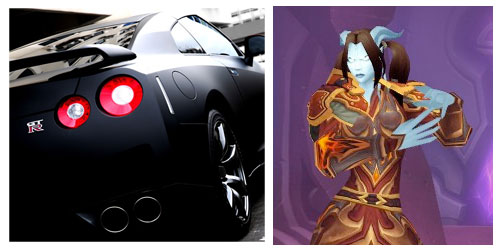
Nissan GT-R Black WoW Draenei

Riffing on the classic Conan sketch, here’s an example of a train wreck caused by the collision of MMORPG geekery and car enthusiast posturing:

Apparently you can make enough money selling WoWBots to buy a tuned, carbon-fiber-laden Nissan GT-R for $150,000. That’s what one 18-year-old Zilvia.net forum denizen says he did, and now he’s selling the car on the board. Naturally, everyone else thinks he’s trolling.

As the husband of an avid World of Warcraft player (and the owner of a level 85 Draenei mage, no less), the Jalopnik post held particular relevance for me. Needless to say, I immediately sent the link to my wife and asked her if there was any possible way for her to get into this apparently lucrative “WoWBots” programming scene and earn me enough money to score a GT-R as well. Still waiting for a response on that one, but it may be just as well—the thread in question apparently descended into the usual claims, lies and YouTube “proof” which the alleged owner of the GT-R later admitted was all a scam. Yet another “get car quick” scheme goes up in smoke. Oh well.

2 Comments on If They Mated: Internet Gaming and Cars

Too Much Help?
The Risks of Electronic Assistance

December 9, 2011 by Matt

Toyota Fun Vii Interior Inside Cockpit Dashboard Screen

Matt Hardigree at Jalopnik writes an excellent article drawing parallels between the technologically-dependent pilot mindset that doomed Air France Flight 447, and the potential for a variation of the same mindset to compromise car drivers’ ability to respond in an emergency situation on the road. The money quote:

I’m not anti-technology. I think technology can enhance and improve safety. Driverless cars and similar tech is designed primarily as safety equipment. Great. But instead of worrying if we’ve designed an autonomous system smart enough to drive without crashing when engaged, we need to worry about whether we’ve designed autonomous systems that are smart enough to not make us dumb when they disengage.

As far as technology’s potential to create the kind of dependency that could allow a driver’s emergency instincts to atrophy, or fail to develop in the first place, adaptive cruise control is Hardigree’s Exhibit A. Auto-drive technology, still immature at present and requiring a degree of road-based infrastructure that won’t be in place for quite some time, is the closest point of comparison to the context that doomed Flight 447, but the essence of the article holds true, even for less-than-fully-automated vehicle control environments. The more control a particular driving convenience assumes on our behalf, the more diligent we as drivers must be to maintain a connection to our cars’ actual dynamics, in the event, however rare, that the system fails and we’re compelled to reassert control.

In fact, I’d go further than that and maintain it’s not only the technology that takes control away from the driver that makes a car potentially less safe; it can also be the gadgets and doodads—some the driver himself brings into the car—that allow him to be distracted more easily from his primary task: Driving. It’s a variation on a very relevant theme as the virtual world envelops us more and more—We must be aware not only of what technology does for us, but also what it does to us. The more we become desensitized to the latter, the more we lose touch with our essential humanity, whatever your worldview. And that we do at our peril, whether in a fiery cataclysm like the one that overtook Flight 447, or in the slow withering of the faculties which connect our real bodies and minds to the real world.

No Comments on Too Much Help?
The Risks of Electronic Assistance

A Stunning Homage: The Eagle Speedster

November 25, 2011 by Matt

Eagle Speedster Jaguar E-Type XKE Roadster Red

Coincidence or not, the release of the Eagle Speedster in the year of the 50th anniversary of the legendary Jaguar E-Type’s debut is entirely appropriate. A car buff’s fantasy of an E-Type with modern running gear, the Speedster takes the classic shape unaltered, tidies up the details of the styling, adds modern power and suspension and prices it into the stratosphere, in the process creating nearly the sensation in the automotive world the original did.

Eagle Speedster Jaguar E-Type XKE Roadster Red

Offered at an eye-watering $780,000 apiece, each Speedster is handbuilt and utterly flawless, qualities which at least partially justify the price. Performance is on par with modern sports cars as well, thanks to the car’s light 2,200 lb weight and torquey, 4.7l, 330 hp straight six. The claimed 0-60 time is around 5 seconds, but then, driving the Speedster isn’t really about raw numbers; it’s about the experience. It’s a delicate balancing act—How to keep enough of the classic car without making it feel old and fragile, and introduce enough modernity without completely bulldozing the classic patina that gives the car its character? If Jeremy Clarkson, in the review after the jump, is to be taken at his word (and there’s no reason not to), it would appear Eagle has pulled it off in spades:

Watch the clip!

2 Comments on A Stunning Homage: The Eagle Speedster

The New SSC Tuatara and
Top Speed One-Upmanship

November 14, 2011 by Matt

SSC Tuatara White Supercar

Inspired by the recent reveal of the SSC Tuatara‘s wacky/awesome (take your pick) interior, and the car’s stated intent to reclaim for SSC the title of “World’s Fastest Street-Legal Production Car” from the Bugatti Veyron Super Sport, I decided to revisit the evolution of that title over the past 60 years or so.

Here’s the progression since 1949:

And here are some observations about the list:

  • The three longest record holders were the Mercedes Gullwing at 6 years, the McLaren F1 at 12, and the Ferrari Daytona at a whopping 16 years. The ’70s truly were “the lost decade” for speed.
  • The Lamborghini Diablo, emerging in 1990, had a quoted top speed of 202 mph, which beat the Ferrari F40’s listed 201 mph; however, the F40 could hit 203 in practice. Beastly car.
  • Although the F1’s record of 231 mph has long been surpassed, it remains the fastest naturally-aspirated car on the list, a testament to the enduring excellence of McLaren’s chassis and BMW’s engine development.
  • The Koenigsegg CCR held the record for the shortest amount of time: a month and a half between late February and mid-April ’05, when it was surpassed by the Veyron.
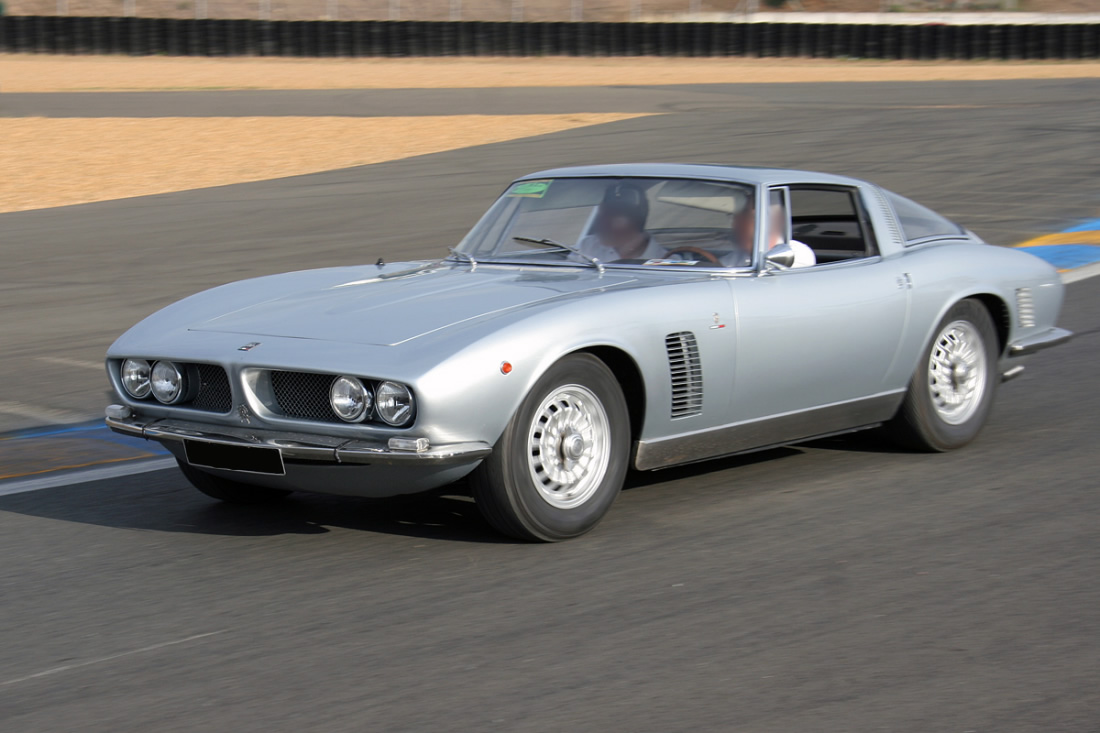
  • I’m embarrassed to say I hadn’t even heard of the Iso Grifo before compiling the list. It’s a shame, really, since it’s a stunning car. Hmm…future article fodder?
  • Driving any of the listed cars at top speed (with the possible exception of the F1 or 959) is probably a truly terrifying experience, but from all I’ve heard, 171 mph in the Miura would take the cake as the most hair-raising ride of all. The groundbreaking Lambo is little more than a pretty shell with a transverse V12 shoehorned in amidships—little to no chassis tuning or finesse, negative downforce. Yeesh.
  • The upcoming Tuatara’s quoted top speed is 276 mph, an increase of 8 mph over the Veyron. I remember when 200 mph was the “barrier;” how much longer until we’re topping 300??

No Comments on The New SSC Tuatara and
Top Speed One-Upmanship