Spannerhead Dot ComSpannerhead.com

Posts filed under ‘Miscellaneous’

The Driveshaft Dyno:
The Tuner’s New Best Friend?

November 5, 2011 by Matt

AEM Dyno-Shaft Dynoshaft Driveshaft Dyno Yoke Slip Ring SEMA

As noted on the Edmunds Best New Product overview of the annual Specialty Equipment Market Association (SEMA) show, among a host of other tuner-related websites, one of the coolest and longest-overdue innovations on display was the AEM Dyno-Shaft on-car dynamometer.

A two-part device basically consisting of sensors installed at opposite ends of a RWD car’s driveshaft, the Dyno-Shaft measures driveshaft load to accurately determine engine horsepower and torque in any given situation. In contrast to the “ideal laboratory” environment of a conventional, external dynamometer, AEM’s product can calculate real world power output during highway pulls, dragstrip launches—anywhere. It stands to really allow the tuner to optimize his vehicle for the entire operational envelope. The Dyno-Shaft won’t work for FWD or AWD cars, isn’t cheap—around a grand—and requires some custom fabrication to fit, but anyone who’s worked out the kinks of an engine swap or massive upgrade will tell you dyno time adds up quickly, and can be only marginally profitable if all your ducks aren’t in a row before you roll onto the rig. If I had a build I was really serious about, I’d strongly consider it.
3 Comments on The Driveshaft Dyno:
The Tuner’s New Best Friend?

Ridiculously Awesome:
’80s Tuner & Specialty Cars

October 26, 2011 by Matt

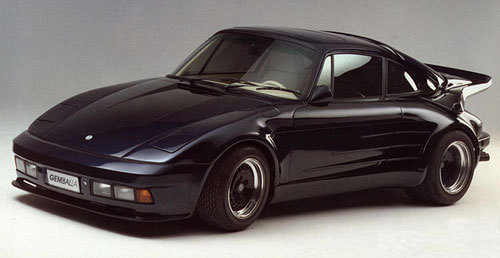
Gemballa Avalanche 911 Tuner Car 80s Black

I absolutely guarantee you that if I had known about any of these cars in the ’80s, a poster of one would have been immediately fixed to my bedroom wall. Forget that white Lamborghini Countach garbage; the customized German and Italian beauties featured on this site are where it’s at.

Or was at. The site is fascinating as a time capsule of ’80s car fashion as much as it is a showcase of the customizers’ talents. Tire and wheel technology being far less advanced than it is today, relatively small-diameter but massively wide tires steamroll underneath grotesquely swollen wide-body conversions. Most colors have a pastel or day-glo quality, and any additional electronics look like they were lifted from a Radio Shack catalog circa 1985.

300E W124 Mercedes Benz Merc M-B Hammer Red AMG

That said, the highlights of the site’s “collection” are too numerous to list in a concise manner, so I’ll just call out a few. The AMG 300E “Hammer” shown above is noteworthy for the “period” model selected to pose with the car. The Koenig and Gemballa Testarossas arguably improve on the stock car’s lines by getting rid of the side vents’ strakes. The Porsche 930-based Gemballa Avalanche (shown at top) and Mirage are awesome to behold, and the rainbow-pattern on the Buchmann 928 Targa’s seats is a nice touch, as are the location of the stereo controls (!).

BMW ABC Exclusive E24 635 635CSi Convertible Vert Cabriolet Cabrio Droptop

As a former BMW E24 6-series owner, I was particularly drawn to the ABC Exclusive E24 convertible. It’s so well done and the car looks so sleek it makes me wonder why BMW didn’t contemplate a factory version.

1 Comment on Ridiculously Awesome:
’80s Tuner & Specialty Cars

Touristenfahrten

October 14, 2011 by Aaron

Nurburgring Ring Track Circuit Map

Dubbed the green hell by Sir Jackie Stewart, the Nurburgring is an automotive Mecca (and well worth a pilgrimage). Unlike any other race track in the world, the Nurburgring’s north loop (Nordschleife) is imposing, demanding, dangerous, and oddly available.

The track persists as the yardstick for sports cars the world over (seen the Cadillac CTS-V commercial lately?) but most summer evenings anonymous sightseers have the option to take a self-guided “tour” for about $35 per 12.9 mile lap. As one of those undistinguished tourists, I can attest that 12.9 miles on the ‘ring is allthe thrill that you can handle and probably then some. Aside from major car rental companies who anecdotally monitor the ‘ring to discourage tourists from abusing their fleet vehicles, the track is run what you, um brung…just don’t pass on the right.   The accessibility (and with it, the responsibility for vehicular efficiency) is Teutonic – we all know that this wouldn’t work stateside. The ‘ring is and will always be singular.

I hear that there is an amusement park and macho gift shop in the works at the GP course on the south side of the track. Time will tell, but I’m hoping that this net-induced fame doesn’t sully its austere appeal.

Editor’s note: During my two-day fall camping trip, enjoy this guest contribution by my friend and sometime car-adventure-partner-in-crime Aaron!

4 Comments on Touristenfahrten

Shuffling Cylinders

October 6, 2011 by Matt

Engine Blocks Motor V8 V6

Inspired by the recent hullabaloo over the possible phase-out of BMW’s longstanding “no V6s” philosophy, I thought it might be interesting to ponder which marques have been most closely associated with various engine configurations throughout automotive history. Enjoy:

  • Inline 6: A number of automakers have had great success with this configuration, notably Mercedes, Nissan (with their L- and RB-series) and Jaguar (XK engine), but the cylinder layout has to be most closely linked with BMW, not only for the various sizes of the engine they produced over the years, but also for their persistence with the configuration long after their competitors abandoned it in favor of V6s and V8s.
  • Inline 5: Less than 6, but more than 4? Who comes to mind when a fellow car geek says “inline 5-cylinder?” Acura and Volvo have used this layout, and Mercedes has made 5-cylinder diesels, but undoubtedly the company joined at the hip with the straight 5 is Audi after their fire-breathing quattro-equipped monsters dominated Group B rally racing during the mid-’80s. After ditching the inline 5 in the mid-’90s, I’m pleased to see it’s been making a bit of a comeback Ingolstadt-way, fitted in transverse form to the ridiculously quick TT RS.
  • Inline 4: Even more than the inline 6, the straight 4 has been developed to a very high level by a myriad of car companies. That said, the manufacturer that springs most quickly to mind when pondering the 4-cylinder engine is Honda. They’ve created some truly great 4-bangers over the years, including the Prelude’s H22A and the S2000’s F20C. Unfortunately, the association with Honda is further cemented by the legions of high schoolers who throw fart-can mufflers on their moms’ Accords and drone down the main drag any given Friday night. It’s sad, but noise of an uncorked Civic 4-cylinder is something any car buff can immediately conjure to mind. Sorry, Honda.
  • V8: This one’s a bit tricky, as essentially the entire American automotive industry is connected to the layout. The classic small-block Chevy engine will always be the prototypical V8, though, still in production after more than 50 years. Chevrolet wins this one.
  • V6: Again, another engine configuration associated with a number of automakers. Alfa Romeo pioneered the layout in the early ’70s, and Buick developed a great V6 in the latter part of that decade, but Nissan was the first manufacturer to roll out a modern version with their ’83 VG engine, a variation of which they subsequently installed in just about every vehicle they made, from pickups to family sedans to sports cars. Give the nod to the Japanese automaker.
  • V12: Here’s an easy one, for a change. Which manufacturer is world-famous for their legendary and unbroken line of V12-engined sports cars? Ferrari, of course. Of all other automakers, Lamborghini comes closest to displacing its rival as the “champion of the V12,” but is still a significant ways back with respect to the association.

On a related note, allow me to plug an article which I’ve greatly enjoyed and learned a lot from: The Autozine Technical School discussion of engine layouts and the impact cylinder arrangement has on engine smoothness.

2 Comments on Shuffling Cylinders

Collecting Superlatives

September 23, 2011 by Matt

Ferrari World Outside Building Exterior

It was inevitable, really.

Given the predilection of those flush with oil wealth for fast, expensive cars and over-the-top resorts, it was only a matter of time before someone thought “Hey, let’s mash ’em up!” and the relentless lure of capital beckoned arguably the world’s most famous performance brand to the Middle East.

Ferrari World, the largest indoor theme park in existence, opened for business in Abu Dhabi, UAE, late last year. It’s a marvel of excess echoing the marque’s own sensibilities, with the world’s fastest roller coaster and 19 other rides. And really, it could have only been Ferrari. “Porsche World,” “McLaren World” or even “Bugatti World” wouldn’t have worked—their brand image doesn’t inspire nearly the same amount of exo-automotive enthusiasm. In other words, see a fast car in Ferrari red with the prancing horse on the hood, and your heart skips a beat, even if you’re not a car buff. So aside from the fact that an aerial view of the establishment uncomfortably recalls the shape of a malevolent alien from more than one TV show and movie, it’s a brilliant concept for a theme park.

No Comments on Collecting Superlatives

Blurring the Connection

September 4, 2011 by Matt

Dual Clutch Transmission DSG PDK SMG

The line between automatic and manual transmissions is losing definition. Whereas before a car buyer had exactly two choices—three-pedal manual or torque-converter automatic (perhaps with a manumatic shift mode, but still a slushbox)—in the past 10 years “flappy paddle gearboxes” of the single- and dual-clutch variety have arrived to complicate the issue. This raises the question: Are they manual or automatic? Yes, in most cases, their purpose is to replace a manual transmission, but set to fully automatic mode, the seamlessness of their shifts (dual-clutch especially) can rival the best slushboxes on the market. And they lack a traditional third pedal. So what are they?

In a their March issue, Car and Driver took a stand, switching from calling dual-clutch transmissions (e.g. VW/Audi’s DSG, shown above) “dual-clutch manuals” to “dual-clutch automatics.” They wrote:

Our conclusion is that we need to update our definition and classification of both types to reflect how they perform, instead of trying to distinguish them by the hardware they employ. Automatics and dual-clutch gearboxes both have the ability to send power to the wheels during upshifts, something no manual gearbox can do. For this reason, dual-clutch transmissions will now be known as dual-clutch automatics in Car and Driver.

Do you buy it? Should “how they perform” be the pivot point of the terminology in dispute? Or should we rather classify transmissions as belonging to one camp or the other based on how they’re predominantly used by the driver? In other words, for better or worse, to an enthusiast, the words “manual” or “automatic” do more than convey mechanical functionality—they communicate intent, and it just doesn’t sound right to call, for example, the fire-breathing BMW M3 GTS‘s gearbox an automatic, dual-clutch or no. What say you?

3 Comments on Blurring the Connection

Technical Treasure Troves

August 25, 2011 by Matt

V12 Engine Block

For some reading on the more esoteric aspects of cars and what makes them go, check out the following links, all of which I’ve learned from and greatly enjoyed:

  • The Autozine Technical School. Covers a huge array of topics and seems to be kept fairly current. I’m particularly fond of their discussion of engine balance and the differences between engine configurations (I4, V6, H6, V8, etc) with respect to engine smoothness.
  • AnimatedEngines.com. Features cheeky little animations of various types of engines, and not just internal combustion ones at that. In fact, I’d say the non-IC engines are the more fascinating for their complexity and ingenuity.
  • RotaryEngineIllustrated.com. Co-founded by the late Blake Qualley, something of a hero in the rotary community, this site’s animations are pretty polished, and showcase the operation of the Wankel engine from many different perspectives.

Hope you enjoy and benefit from the sites as much as I have. From that last one, click on the jump below to view a particularly noteworthy animation of the recently-axed RX-8’s RENESIS rotary engine:

Watch the clip!

No Comments on Technical Treasure Troves

Heart Transplants

August 14, 2011 by Matt

SBC Engine and 1st-Gen Miata

Let’s clear the air. After ages participating in car communities of many different makes and models, online and otherwise, I’ve come to the conclusion that there’s no more contentious issue than the idea of doing a cross-make engine swap; in other words, of swapping into a particular car an engine from a different make.

Examples abound and usually, but not always, involve dropping some flavor of American V8 into a lightweight or otherwise desirable import body:

  • Small-block Chevy V8 into RX-7
  • Ford V8 into Mazda Miata
  • SBC into Jaguar XJ6 or XJS
  • Toyota 1JZ into Datsun Z-car

For what it’s worth, it’s not a new phenomenon—professional tuning outfits and even OEMs have been splicing disparate powerplants and chassis for donkey’s years. The AC Cobra, De Tomaso Pantera and Ultima GTR have rightly become the stuff of legend; the cars may have had their flaws, but without the easy availability and modularity of the engines (and the ingenuity of the designers), the aforementioned cars wouldn’t have seen the light of day. More than that—the engine and body each supplied something the other lacked and created cars that were more than the sum of their parts.

So what say you? Is a cross-make engine swap acceptable, and if so, under what circumstances? Is the union between factory engine and chassis sacrosanct; that character inviolable? And if you would never, ever, desecrate a car by shoehorning an engine of a different persuasion under the hood, what about another engine of the same make—say, a BMW V8 into an E24 6-series, or a Nissan RB26DETT into a 240Z? Do you take a stand for a car’s purity, or simply choose the best tool for the job?

No Comments on Heart Transplants

Crusading for Stickshifts

August 4, 2011 by Matt

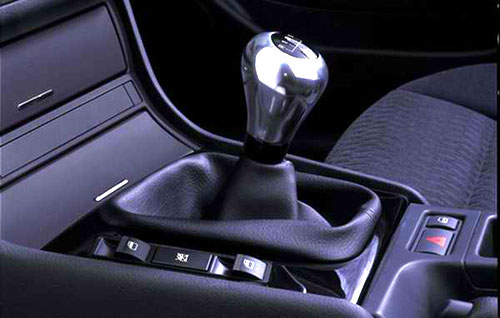
BMW Polished Manual Shifter

Left Lane News reports MINI is following Car and Driver’s lead in launching a campaign to invigorate sales of manual-transmission-equipped cars in the US:

MINI … is trying to reverse the trend of left-foot lethargy with a $500 price decrease for manual-transmission-equipped models and a new advertising campaign entitled ‘Manualhood.’ The campaign, which touts the increased control of stickshifts, features a range of slogans including ‘get your shift together’ and ‘manual up, America.’

Forget politics for a minute—there’s a cause I get behind, and have; I’m a diehard stickshift proselytizer. To mash up the slogans of two manual transmission stalwarts (Porsche and BMW), there is no substitute for the joy of rowing one’s own gears. It’s involving, focuses the driver on his or her task and thus promotes alertness while driving, allows so much greater control over the car’s actions and it’s just a lot of fun to master the skill. Here’s hoping more American drivers see the light and decide to take up the challenge.

No Comments on Crusading for Stickshifts