Spannerhead Dot ComSpannerhead.com

Posts filed under ‘News’

Burger Dots (12/21)

December 21, 2011 by Matt

Burger

  • Italian boutique automaker F&M recently debuted their Evantra supercar, ingloriously bestowing it with a name that sounds like it originated in the Kia marketing department. Also, I’d hate to see one of those doors pop open accidentally on the autostrada. Oh, and it weighs under 2,700 lbs and its 3.5l twin-turbo flat six pumps out 603 hp. Yawn.
  • AOL Autos recently decided to do what every automotive publication does when it’s a slow news day: Compile a list of the 50 worst cars of all time. The only variation on a very common endeavor was the fact that AOL opted to include one car per automaker. Agree with most, disagree with a handful of selections, including the Alfetta (there have been uglier Alfas), Audi 5000 (indicting it for faults entirely unrelated to the car itself) and 2012 Honda Civic (first-gen Insight, anyone?).
  • In a case that has car buffs fantasizing about Italy turning into some kind of automotive paradise (more than it already is, natch), Ferrari president Luca Montezemolo is reportedly considering running for Italian Prime Minister. His “a chicken in every pot and a Ferrari in every garage” campaign promise should go over particularly well with the Tifosi.
  • Edmunds today features a fantastic photoshoot of four classic ’80s supercars: The Ferrari 288 GTO, Porsche 959, Ferrari F40 and Lamborghini Countach. All red, naturally, and overexposed so you can really see the crackle finish on the aluminum manifolds and cam covers, and the pucker on the leather interiors. Perfect.
  • Continuing the “ridiculously cool pictures” theme, Jalopnik highlights a stunning photo featuring the groundbreaking Citroën DS and a prototype Concorde. Both vehicles share a kinship in that they were assumed to be the wave of the future in many ways, but technological progress decided to take a left turn just as they were set to really catch on. Ghosts of old future tech.

4 Comments on Burger Dots (12/21)

Alfa Romeo 4C: The Return

December 20, 2011 by Matt

Alfa Romeo 4C New Red

I love writing about Alfa Romeo. In any capacity, really. News, treatises on older models, discussions of the company’s up and downs—I’ll take anything. The reason? Without descending too far into cliché, there are few automakers that evoke quite the same sense of implausible romance as Alfa does. Even a stereotypically “passionate” automaker like Jaguar was taken over by Ford and forced to attend to boring things like quality, and is the better for it nowadays, but in my mind, Alfa has always remained unencumbered by such concerns as how their cars actually go together. For ages, they’ve been free to focus on the qualities that really matter to enthusiasts—soul, emotion, feedback, sensation—without fretting over details like whether their automotive objets d’art would start every morning. Car buffs have long felt a connection to that fundamentally irrational mindset; after all, a sports car is almost by definition an irrational acquisition. Boring, reliable transportation appliances are cheap and plentiful, and there’s simply no real way to justify the purchase of something as impractical as a sports car, of any make. I know; I’ve tried—and how. But that’s where Alfa meets us; they seem to understand the struggle, and somehow make it easier for us by completely eliminating any delusions of sensibility creating conflict in our minds. For that, the automaker will always have a place in the enthusiast pantheon.

Alfa Romeo 4C New Red Back Rear Tail

The good news today is a reconfirmation of Alfa’s intention to return to the US market for the first time since their departure in ’94, and return with a bang: Their 4C sports car will be the first model to hit showrooms. True to form, it’s a completely impractical, tiny, 2-seat, mid-engined, turbocharged road-hugger, and it looks beautiful, like a three-fifths size 458 Italia. Even more impressive than its 230 hp, 1.8l direct-injection 4-cylinder engine is its Lotus-like sub-2000 lb curb weight. That kind of power-to-weight ratio ensures lively responses in any direction, not the least of which is a mid-4-second 0-60 sprint. Priced around $60K, it should undercut the Porsche Cayman by $10K or so while offering 911-like levels of performance. If Alfa can pull it off—and there’s no reason to think they won’t be able to, given the financial muscle of parent Fiat—I’d say they have a winner on their hands. I look forward to reading magazine and online comparos chronicling the impractical Italian’s attempts to one-up its more sensible German, Japanese and American rivals.

No Comments on Alfa Romeo 4C: The Return

It’s Over: Saab to Liquidate Assets

December 19, 2011 by Matt

Saab Logo Badge Emblem

The long arm of General Motors came back to haunt Saab, even as the company fought for survival, and proved to be the Swedish automaker’s undoing. As I reported back in July:

[O]n the verge of liquidating their assets and shuttering their factories, a pair of buyers emerged, in this case the Chinese firms Youngman and Pang Da.

What looked like the potential for a relatively secure line of credit for Saab has been nixed by GM on the grounds that patents arrangements could be used to further the interests of GM’s competitors in China, an exploding market for the American giant. So although GM no longer owns Saab, technically, a great deal of proprietary technology was shared, giving GM a certain amount of legal, if not financial sway over Saab’s activity.

And so, having been shunned by every major and minor automaker, it seems Saab’s quirkiness will be exiting stage left. The turn of events obviously means the end for Saab’s only current offering, its well-executed and distinctive second-generation 9-5.

What conclusions to draw from Saab’s demise? If I were going to be snarky, after the death of Oldsmobile, Pontiac, Hummer, Saturn, Daewoo and now Saab, I’d strongly advise struggling automakers against hitching their wagon to the General. Especially compared to the success of, say, former Ford partnerships—Jaguar, Volvo, Aston Martin and Mazda immediately come to mind—GM’s track record of putting companies on a successful trajectory looks poor indeed.

Also, the increasingly oppressive regulatory climate, both here and across the pond, is squeezing out smaller, more unique automakers in favor of larger, more financially-stable firms better able to absorb lawmakers’ capriciousness. It’s a sad state of affairs when outfits that bring so much color to the automotive world are sacrificed in order to free up the capital needed to comply with new emissions and safety laws, not to mention the overwhelming amount of gadgetry de rigeur in even a basic mid-level car. Now, of course I can’t prove a direct connection between the two; after all, many companies are done in by good old-fashioned mismanagement and stupidity (see: TVR), but it’s almost always the case that when the list of requirements for a product grows, the chance of companies designing very similar “solutions” grows proportionally. Everything fades to gray, and Saab is the latest color to dim.

2 Comments on It’s Over: Saab to Liquidate Assets

If They Mated: Internet Gaming and Cars

December 16, 2011 by Matt

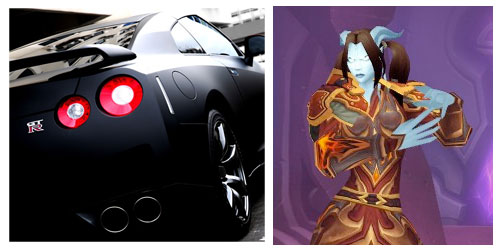
Nissan GT-R Black WoW Draenei

Riffing on the classic Conan sketch, here’s an example of a train wreck caused by the collision of MMORPG geekery and car enthusiast posturing:

Apparently you can make enough money selling WoWBots to buy a tuned, carbon-fiber-laden Nissan GT-R for $150,000. That’s what one 18-year-old Zilvia.net forum denizen says he did, and now he’s selling the car on the board. Naturally, everyone else thinks he’s trolling.

As the husband of an avid World of Warcraft player (and the owner of a level 85 Draenei mage, no less), the Jalopnik post held particular relevance for me. Needless to say, I immediately sent the link to my wife and asked her if there was any possible way for her to get into this apparently lucrative “WoWBots” programming scene and earn me enough money to score a GT-R as well. Still waiting for a response on that one, but it may be just as well—the thread in question apparently descended into the usual claims, lies and YouTube “proof” which the alleged owner of the GT-R later admitted was all a scam. Yet another “get car quick” scheme goes up in smoke. Oh well.

2 Comments on If They Mated: Internet Gaming and Cars

New Lotus Esprit Details Trickle Out

December 14, 2011 by Matt

2014 Lotus Esprit Top View Green British Racing BRG

Automobile links to the latest tantalizing morsel from Lotus concerning their upcoming Esprit reboot, shown above. The tidbit in question is a glimpse at the 2013 Esprit’s all-new V8 engine, which was originally adapted from the Lexus IS F‘s mill before Lotus decided to start fresh. Given the British niche automaker’s engine-building experience (they developed the original Corvette ZR1’s world-beating LT5 powerplant, among many others), I’ve no doubt they’ll do it right.

Lotus Esprit V8 Red

As much of an issue as I have with Lotus’ plans for diversification of their product line, there will always be a place for the Esprit. In many ways, the ’77-’04 original was the quintessentially British supercar, a fascinating and compelling amalgam of cutting-edge and long-obsolete technology, a unique intersection between differing performance philosophies. Before the Esprit, Lotus cars embodied a characteristic devotion to light weight, but the Esprit was arguably the first Lotus to add power to the equation. Beginning with the 210 hp Essex Turbo in ’80, through the factory turbo cars of the ’80s, culminating in 300 hp out of the 2.2l 4-cylinder S4s in ’95, and progressing onto the ultimate 350 hp twin-turbo V8 of the late ’90s / early ’00s (shown above), the Esprit story has been one of continual evolution over a 27-year span. Truthfully, Lotus’ commitment to the Esprit is surpassed only by Porsche’s dogged and ongoing refinement of their 40+ year old 911, though in the British firm’s case, the attachment was driven largely by an perennial lack of capital to develop anything new, rather than by a more pure affection for the car’s legacy, as in the case of the German concern.

I love the way the Esprit took on the best from Porsche, Ferrari and Lamborghini during the supercar wars of the ’80s. It was the 4-cylinder turbocharged underdog from the UK, and had the glamor and pedigree to match its rivals step for step. And it looked more like a pure supercar than any of them, lacking the Countach’s over-the-top flamboyance, the bloated Testarossa’s Miami Vice cheese graters and the 911’s pumped-up bulges. No, the Esprit was just a simple, low, elemental wedge shape, the two-seat, mid-engined core of a supercar with every non-essential geegaw absent. And quirky as it may have been, it remained largely true to that philosophy throughout its evolution. For that, I remain an ardent fan.

No Comments on New Lotus Esprit Details Trickle Out

Upcoming Supra and NSX?
The New Sports Car Landscape

December 13, 2011 by Matt

Toyota FT-HS Supra White

Of all Japanese automakers, Nissan and Lexus, with their GT-R and LFA, respectively, get it.

No electric motors, please. No fuel cells, giant capacitors or kinetic energy recovery systems. Just plain old gasoline-generated horsepower, and lots of it, for our sports cars.

And yet, Honda and Lexus’ parent company Toyota, seem to want to mimic their eco-crazy European counterparts in developing hybrid sports cars. As if that weren’t bad enough, it seems likely both companies will revive storied model names to give their new creations a measure of “legitimacy” out of the starting blocks.

In Toyota’s case, the rumors aren’t anything new—the automaker has been coy about the development of a “Mark 5” Supra for ages now—but the recent introduction of the clean-sheet, RWD GT 86/Scion FR-S has freshly stoked the fires of speculation. And with the FT-HS concept car, shown at top, all that’s left to wonder is what Toyota’s waiting for to pull the trigger. It’s understandable the collapse of the Japanese sports car market during the late ’90 would leave that country’s automakers wary of introducing any new top-of-the-line road eaters, and Toyota is a cautious company in general. That said, the automaker is the poster child for hybrid success with the runaway popularity (relatively speaking) of their Prius, so it wouldn’t be too far of a stretch for them to adapt some well-proven hybrid technology to a range-topping sports car. And Toyota’s never made a dynamically bad car, so its driving characteristics will undoubtedly be above reproach. The only question left, then, is what enthusiasts would make of a new Hybrid Supra. Would they enthusiastically embrace it? Or recoil in horror that the legacy of the canonized Mark 4 Supra would be tarnished by association with technology primarily geared toward economy?

Acura Honda NSX Purple Iron Man Tony Stark

For its part, Honda has more or less committed to introduce an NSX successor, if you can call it that. The Jalopnik report states:

Sources inside a Las Vegas dealer meeting earlier this month exclusively told us the new Acura NSX Concept would look like the vehicle from the upcoming Avengers movie (albeit in hardtop form) and feature an AWD hybrid drivetrain. If true, this would mean a radical departure from the car’s previous life as a pure, light-weight, RWD sports car.

I share the site’s sense of disappointment at Honda’s divergence from the formula that made the original so distinctive. In a way, if the automaker does decide to attach the NSX nameplate to the trunklid, they stand to lose more than Toyota would in naming an upcoming hybrid sports car Supra. Although comparable performance-wise, the NSX was an altogether more pure sports car than the Supra, offered at a higher price point, and basically unchanged (or unsullied, depending on your point of view) from its introduction through the end of its model run. The game-changing nature of the original NSX‘s arrival means a new AWD, hybrid version of the car would more radically redefine the car’s image and purpose compared to a similar situation with the Supra. For the record, I hope both Honda and Toyota come around and offer genuine GT500/Corvette/M3/911 competitors, but given industry trends toward more complex, “eco-friendly” vehicles, I’m doubtful a refreshingly conventional successor to the NSX or Supra will see the light of day.

No Comments on Upcoming Supra and NSX?
The New Sports Car Landscape

BMW 6 Series Gran Coupe:
New Frontiers in Redefinition

December 12, 2011 by Matt

BMW 6-series Gran Grand Coupe 650i 640i

It’s not a coupe. It just isn’t.

The American Heritage Dictionary defines the word coupe thusly: “A closed two-door automobile.” The picture above certainly shows a two-door non-convertible, but I’m pretty sure there are two more doors on the other side, and if my math is correct, that would make for a total of four. Logic is an unyielding discipline, and if we’re to apply its principles, it would seem to dictate that in spite of its name, the new BMW 6 series Gran Coupe cannot, axiomatically, be a coupe.

And neither can any of the other entrants in the so-called “4-door coupe” market segment, a niche which has exploded since the introduction of the first-generation Mercedes CLS in ’04. In addition to the CLS, the Volkswagen CC, Tesla Model S, Aston Martin Rapide, Porsche Panamera and Audi A7 have all preceded the BMW Gran Coupe, making the Bavarian entry a little late to the party, but no less incorrect in its claims of coupe-ness.

Now, it should be noted that, other than the Panamera, I have absolutely no problem with the cars listed above. They inject a healthy dose of style into a market segment that threatens to be very dull indeed. In a way, it’s understandable—part of the traditional purpose of the sports sedan has always been to allow middle-aged family men to have a little fun on the long way home from work and impress prospective clients with discreet, understated style during the work day. Lately, though, it seems otherwise staid businessmen have decided they want a bit more frosting with their cake—forget all that “sleeper” stuff—hence the exponential growth of the segment. And that’s fine. All the cars (exception noted above), and especially the Rapide and A7, are absolutely stunning, and sparkling performers as well. Even the Gran Coupe actually looks better than its two-door counterpart, what with the 4-door’s more pleasing proportions and assertive front valence. Looks and speed: Win-win.

BMW 6-series Gran Grand Coupe 650i 640i

So…what makes me take issue with this trend now? Simply put, BMW is the first automaker to blatantly thumb their nose at accepted vehicle vocabulary and explicitly include the word coupe in a 4-door car’s name. It’s one thing if you market your car as a “four-door coupe” in glossy brochure descriptions and press releases; automakers always wax flowery when pitching their wares. But a line is crossed from enthusiasm to arrogance when a manufacturer attempts to actively impose a kind of redefinition by including an accepted term in the name of a car that clearly falls outside the boundaries of that term. Bad form, BMW.

3 Comments on BMW 6 Series Gran Coupe:
New Frontiers in Redefinition

Ferrari’s Two Decades of Excellence

December 7, 2011 by Matt

Ferrari Engine Motor

Don’t get me wrong—they’ve always been good. But a recent Motor Trend interview with Ferrari chairman Luca Montezemolo, whose tenure began in ’91, gives a little insight into the Italian performance firm’s particularly outstanding last 20 years.

The interviewer and Montezemolo compare the remarkable improvement in Ferrari’s output to the qualitative difference between two cars which bookend the 20-year span: The early ’90s, dorky Testarossa-junior 348 and the recently-released, voluptuous, world-beating 458 Italia:

If you want to understand how dramatically Luca Montezemolo has changed Ferrari in his 20 years at the helm of the company, the transformation from 348 to 458 is an apt metaphor. Enzo might have created the Ferrari legend, but it’s Luca, born into an aristocratic family the year the company was founded, who’s made the legend real.

The two cars occupy roughly the same niche in Ferrari’s lineup, that of their “entry-level” mid-engined sports car, so the comparison works—Ferrari has come a long way, and much of their present mastery of the exotic car formula is due to Montezemolo’s steady, visionary hand at the tiller.

I don’t have much to add to the excellent interview summary other than to point out an often-overlooked contributor to Ferrari’s consolidation of its position in the industry: The revolution in their car’s usability starting with the 348’s replacement, the F355.

Prior to the F355—the first car developed on Montezemolo’s watch and a direct response to the threat posed by the Honda/Acura NSX—Ferraris were quick, to be sure, but unpleasant, ergonomically disastrous and evil-handling cars. The driver was expected to endure the car’s vices, more or less, for the privilege of experiencing its virtues. Upon its release, the NSX showed the world that high performance, benign handling traits and everyday usability weren’t mutually exclusive qualities in an exotic car. Ferrari took the lesson to heart, and with the F355, delivered the first in an unbroken series of ever-quicker, but also ever-more-user-friendly sports cars, culminating with the 458. It’s that sea change, more than even their looks or speed, that’s been the driver behind Ferrari’s climb, and we have Montezemolo to thank for the automaker’s enduring emphasis on that aspect of their cars.

7 Comments on Ferrari’s Two Decades of Excellence

New Frontiers in Combustion:
The OPOC Engine

December 2, 2011 by Matt

EcoMotors OPOC Engine Motor Opposed Piston Opposed Cylinder

Call me a pessimist, but as much promise as this engine shows, I just don’t see it going anywhere.

It’s not for lack of technical merit. The EcoMotors Opposed-Piston Opposed-Cylinder (OPOC) 2-stroke diesel engine exhibits a thermal efficiency of close to 50%, meaning that around half the energy delivered to it is converted into work, compared with 20-30% for the average gasoline engine. It’s compact, smooth, efficient, powerful and arguably less complex than the typical conventional engine, what with its lack of valvetrain or ignition system.

EcoMotors OPOC Engine Motor Opposed Piston Opposed Cylinder

Essentially a two-stroke horizontally-opposed diesel engine with an extra pair of pistons where the cylinder heads would otherwise be, linked to the crankshaft via long connecting rods, the OPOC engine employs an exhaust-driven turbocharger to deliver positive pressure to fill the cylinder volume and push out the exhaust. The engine avoids the typical two-stroke disadvantage of losing much of the intake charge out the exhaust by staggering the port openings relative to the piston positions—impossible on a conventional single-piston reciprocating engine. All the moving parts are carefully synchronized in a kind of mechanical ballet, keeping bearing loads to an absolute minimum and permitting a relatively lightweight engine block.

So why the pessimism about its potential for success? History. There have been no shortage of alternatives to the conventional reciprocating engine over the years, and none of them have caught on. The closest to parity, of course, has been the Wankel engine, but even it was relegated to a far, far distant second place, and ceased production entirely this past year. So in spite of its fear-dissuading superficial resemblance to normal boxer engine, the OPOC engine’s extra dose of unfamiliarity will be its undoing in the marketplace. I suppose, if all else fails, the engine may turn out to have a fruitful career in non-commercial applications such as military vehicles and the like, but I just don’t see it catching on beyond that sphere of use.

Click on the jump below to view a pair of clips, the first an animation of the engine in action, and the second representatives of the development team explaining the engine’s intricacies.

Watch the clips!

1 Comment on New Frontiers in Combustion:
The OPOC Engine