Spannerhead Dot ComSpannerhead.com

Posts filed under ‘News’

Scion FR-S Returns Toyota to the Driver’s Seat

December 1, 2011 by Matt

Scion FR-S FRS Toyota GT-86 GT86 Subaru BRZ Red

Another bit of large-ish news from the 2011 Tokyo Motor Show: After months of photos and tentative specs, Toyota and Subaru officially unveiled their jointly-developed trifecta of badge-engineered RWD coupes.

Scion FR-S FRS Toyota GT-86 GT86 Subaru BRZ Interior Inside Cockpit Dashboard Gauges

As reported previously, the common ground between the Subaru BRZ, US-only Scion FR-S and rest-of-world Toyota GT-86 is their 2.0l, 200 hp flat-four engine, overall shape, light-ish 2800 lb weight and RWD architecture. The brand- or sub-brand-specific fine-tuning is up to the individual automakers, and so far it looks like Subaru’s going to give their BRZ a harder performance edge in contrast to Toyota’s selection of a more docile feel for their coupes. Either way, expect a myriad of further trim lines and variations on the basic theme, both from the automakers and from the legion of aftermarket tuning outfits chomping at the bit to get their hands on the cars.

I can hardly blame them; we’ve been waiting since ’05, when the Toyota MR2 Spyder left our shores, for a real enthusiast-oriented car from the Japanese automaker. For a time, they redirected their efforts toward dominating the market for hybrid cars with their Prius, neglecting the performance legacy established by the aforementioned MR2, Celica, AE86 Corolla and almighty Supra. I think I speak for many enthusiasts out there when I say, “Welcome home, Toyota.”

Scion FR-S FRS Toyota GT-86 GT86 Subaru BRZ Engine Bay Motor

A quick glance at the engine bay reveals some positive and some disappointing features for those of us in the do-it-yourself set, professional or otherwise. It seems the shock towers are already braced to the firewall, eliminating, or at least rendering irrelevant, the presence of an aftermarket shock tower brace, a favorite engine bay ornament of the Fast & Furious crowd. Speaking of the shock towers, I guarantee you their location relative to the wide, flat engine is going to make changing spark plugs a complete nightmare. Fortunately, most cars having a 100K mile tuneup interval, that’s probably not a procedure that will have to be attempted often. The airbox is situated prominently, right up front in the bay, providing a nice location for the inevitable aftermarket cone filter to draw warm air from under the hood, giving the supposedly performance-minded owner a couple horsepower debit over the OEM piece, which is an actual cold-air intake.

At the very least, the FR-S and its cousins may give wannabe racers a showroom-fresh, balanced, RWD alternative to their aging Nissan 240SXs, FC RX-7s and brawny Mustangs. I’ll drink to that.

9 Comments on Scion FR-S Returns Toyota to the Driver’s Seat

A Fresh Face: The Mazda Takeri Concept

November 30, 2011 by Matt

Mazda Takeri Concept Red

One of the prominent reveals of the first day of the Tokyo Motor Show was the Mazda Takeri concept. The enthusiast-oriented automaker had released photos a month ago but the Japanese show is the first the public has seen the car in the flesh, to rave reviews.

Mazda Takeri Concept Red

The shape is obviously the main draw, one of the first Japanese forays into the new “four-door coupe” territory pioneered by the Mercedes CLS, Volkswagen CC and Audi A7, among others. I have to say, if Mazda builds the car—and it looks surprisingly production-ready—they stand to leapfrog Nissan’s attempts to become Japan’s automotive style leaders, echos of a period in the early-to-mid ’90s when they penned a series of stunners, from the FD RX-7 to the MX-6 and 929.

Beyond the nicely-sculptured proportions, the Takeri serves as further evidence Mazda is ditching the derided “smiley faces” in favor of a positive, versatile grille shape. It’s appeared on the upcoming CX-5 small SUV as well, but on the Takeri the fascia radiates strong overtones of the Jaguar XF‘s front end—not a bad car to use as inspiration. However, in the Mazda’s case, I’d venture to say the pupil has surpassed the master, giving the Takeri more tension and poise than the XF’s comparatively plain grille.

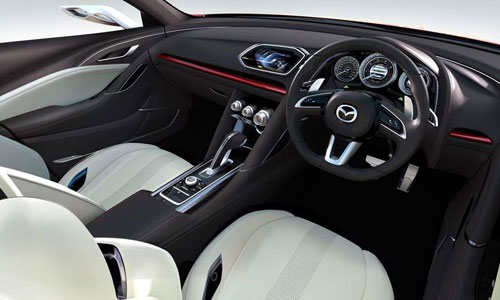
Mazda Takeri Concept Interior Inside Cockpit Dashboard

The mechanicals receive a suite of Mazda’s latest initiatives as well. In addition to featuring their new Skyactiv efficiency program, which encompasses engine, transmission and chassis elements, the Takeri also showcases the automaker’s awkwardly-named i-ELOOP regenerative braking system. From Motor Trend‘s post:

i-ELOOP converts kinetic energy into electrical energy and stores it in capacitors for quick charge and discharge to power the vehicle’s electrical components. The automaker claims the system reduces fuel consumption by as much as 10 percent.

It won’t set the world on fire, and it all sounds very show car-ish, so it’s questionable how much of that would make it to the assembly line, but it does illustrate Mazda’s willingness to think outside the trendy hybrid/electric box. I hope to see the car in a showroom soon.

No Comments on A Fresh Face: The Mazda Takeri Concept

Bauhaus Bolide: A New Audi TT?

November 28, 2011 by Matt

Audi TT RS TTRS White

No, that’s not the new Audi TT; it’s the top gun of the outgoing model, the brutally fast TT RS. Able to launch from a standstill to 60 mph in a cornea-flattening 3.6 seconds (when equipped with the DSG dual-clutch gearbox), the TT RS is evidence Audi has managed to wring every last drop of performance out of the current TT platform. It’s not unexpected, then, that Motor Authority reports Audi may unveil a redesigned TT at the upcoming Tokyo Motor Show.

Stylistically, Audi had a tough act to follow when they decided to update the groundbreaking first-generation TT. One of the few niche cars with slight retro overtones to justify a sequel, the original TT made the transition from show car to production vehicle almost unchanged, and its looks exemplified Audi’s beautiful, Apple-like attention to detail while giving a nod to the automaker’s stylistic heritage. On a personal note, I have a great deal of respect for the car’s design in that (among other highlights) it’s one of the most prominent vehicles to use the wheel arches as a design element. Rather than arbitrarily punching holes in the bodywork—as it seems happens with far too many designs—Audi’s stylists curved the TT’s fascia and rump to echo the arc of the wheel surrounds, giving the wheels a strong context and producing an exceptionally integrated and tidy package.

In any case, as they did with the second generation car, I hope Audi has the good sense to offer us a cleanly-penned, sleekly-tasteful update on the qualities that made the first two TTs a success. And for heaven’s sake, I hope Audi retains the masterstroke of reintroducing their awesome 5-cylinder turbo engine. I’ll be keeping tabs on the Tokyo show as it unfolds starting Wednesday.

No Comments on Bauhaus Bolide: A New Audi TT?

Endgame: The 2011 Brazilian GP

November 27, 2011 by Matt

Brazil Bresil Brezil Brazilian GP Grand Prix Formula 1 One Track Circuit Map Layout Interlagos

Closing out the 2011 Formula 1 season, the 2011 Brazilian Grand Prix saw Mark Webber’s long-awaited first win of the season, some technical difficulties for the now-crowned 2011 champion Sebastian Vettel, and good drives by the supporting cast.

After last race’s rear suspension failure that sidelined Vettel’s Red Bull on the first lap, today’s gearbox troubles at Interlagos weren’t terminal, but did keep the German prodigy from notching his 12th win of the year, relegating him to second place behind his teammate Webber. The Australian qualified second, and had an excellent drive, with Vettel keeping the pair of Red Bulls comfortably ahead of the rest of the pack.

I was especially disappointed for Fernando Alonso in his Ferrari, after undertaking a brilliant passing maneuver to take third place from Jenson Button’s McLaren early in the race, only to see the British driver retake third in the closing laps and secure the final podium spot. Not only was Alonso unable to participate in the trophy-hoisting post-race, the three additional points tallied by a third- over a fourth-plate finish would have pushed the Spanish double world champion past Webber for third in the season-ending points standings.

In the spirit of the newly-descended Christmas season, here’s a brief wish-list for F1 next year:

  • After the dominance of the “Big Three” of Red Bull, McLaren, Ferrari, it would be nice to see another team make a comeback (Williams?) or stake a new claim on the sport (Mercedes? Sauber?)
  • The jury is still out on the merits of DRS after its first season in F1. It undoubtedly allows for more overtaking, but adds another layer of regulation to an already over-regulated sport. Still, I’d like to see what, if any, new strategies emerge in the offseason to exploit its full potential. Here’s hoping for its return.
  • I sincerely hope the US Grand Prix returns to the calendar. Its status is somewhat in limbo at the moment, but if everything is ironed out to the satisfaction of all parties involved, it will be great to have F1 return to the States, putting more race distance between the present and the infamous 2005 US GP, the bitter memories of which still linger.

Stay tuned for 2012!

No Comments on Endgame: The 2011 Brazilian GP

A Rube Goldberg Car?
BMW’s New Tri-Turbo Diesel

November 24, 2011 by Matt

Electric Turbo Patent Drawing

Turns out rumors of a new triple-turbo engine under development for the next BMW M3 may not have been entirely accurate. As it happens, the turbocharger arrangement may be destined instead for their new all-wheel-drive, diesel-powered 550dX. Adding a first-ever-for-a-production-car third turbo to the mix is ambitious enough, but then to fasten the resulting assembly to a diesel engine? And offer the resulting car only with AWD? Isn’t that level of initial complexity just asking for trouble on BMW’s part?

Autoweek elaborates a bit on the details:

The radical new engine, which is rumored to use two traditional exhaust-blown turbochargers in combination with an electrically driven turbocharger to add low-end response, is planned to be offered exclusively with an eight-speed automatic gearbox and four-wheel drive.

Being the ostensibly rational, sensibly German company they are, it’s virtually beyond question BMW have a sound engineering justification for cramming so much mechanism into one car beyond just headline-grabbing “shock value.” That being the case, I’m eager to hear them explain themselves. The piping diagram between the manifolds, intercooler(s) and turbo is going to be rival a map of the London Underground, I’ve no doubt. For this exercise, in the interest of science, I’ll shelve my longstanding bone to pick with BMW’s new engineering direction. I’m genuinely curious to hear the whys and wherefores.

2 Comments on A Rube Goldberg Car?
BMW’s New Tri-Turbo Diesel

Shakeup in the Desert: The 2011 Abu Dhabi GP

November 13, 2011 by Matt

Abu Dhabi Yas Marina F1 Formula One Circuit Track Map

Cozied up to the enormous complex that is Ferrari World, the 2011 Abu Dhabi Grand Prix was a spectacle of new money splendor kicked off by a surprising turn of events for the world champion.

Yes folks, much as I don’t wish misfortune on anyone, I’m pleased to be able to report that Sebastian Vettel did not win the event and clinch his 12th win of the season. No, the world champion-elect’s Red Bull RB7 suffered a right rear suspension and tire failure three corners into the race, spun out and limped back to the pits, where it was determined the car was too damaged to continue. Lewis Hamilton in his McLaren seized the opportunity afforded by Vettel’s first retirement of the season to go into full-attack mode, building a substantial—dare I say, Vettel-like—lead, leaving the rest of the field slogging it out for silver. Fernando Alonso in his Ferrari maintained a solid pace behind Hamilton, racking up a few fastest laps himself, while Jenson Button, Felipe Massa, and Mark Webber in the other McLaren, Ferrari and Red Bull, respectively, leapfrogged each other multiple times before Button eventually crossed the line in third to claim the final podium spot. If there’s any doubt about which three constructors have completely dominated this season, races like today’s provide ample confirmation of the Austrian, British and Italian teams’ mastery of the 2011 formula.

The venue was a kind of mash-up of the urban, lifeless Singapore race and the organic-yet-technical Indian GP two weeks ago. The race was held at dusk and bridged the transition between day and night with powerful circuit-illuminating floodlights. And strangely, as much as the whole F1 circus is a larger-than-life affair, completely taking over the atmosphere of a host city during a race weekend, in Abu Dhabi, surrounded by so much oil wealth-fueled grandeur, the F1 race seemed like a sideshow. More than any venue I’ve seen so far, the cars looked almost like toys in some unimaginably wealthy oil sheik’s playground. I got the sense that with a word, any of the race’s high-dollar patrons could have bought the whole multimillion dollar sport outright several times over, had they wanted to. For a competition that takes itself far too seriously at times (most of the time?), it was an interesting effect.

No Comments on Shakeup in the Desert: The 2011 Abu Dhabi GP

The Resurrection of TVR?

November 12, 2011 by Matt

TVR Tuscan Black

Autoblog reports preliminary signs of what could be the next phoenix-like rebirth of TVR. After several decades of ups and downs and the “final” shuttering of the Blackpool factory in 2006 after a few years of mismanagement by its new 20-something Russian trust fund baby owner, is a resurgence in the works? Who knows, but as the article points out, the company’s website has been updated for the first time in ages, and rumors have been circulating of a possible sourcing of the GM LS3 V8 engine for new models.

TVR Tuscan Interior

I sincerely hope the company can get its act together and stage a comeback. The whole TVR story, dating back to the company’s inception in 1954, is something of a soap opera, with multiple owners, legendary quality control problems, a complete lack of focus and direction, but the cars… In a strangely appropriate way, the automaker’s gung-ho ethos was echoed in the utter craziness of their vehicles, always lightweight fiberglass with great whacking V8s, V6s or I6s, knife-in-the-back handling and, especially following the release of the Griffith in ’91, styling that defiantly marched to the beat of its own drum.

My pick for the quintessential modern TVR is the Tuscan, featured in this post’s images. The fit and finish may be terrible, the electrics marginal, the handling diabolical, but it looks like absolutely nothing else, and if mastered, is capable of great speed. I love the way it exemplifies its automaker, a firm which, if truly still dead, will leave the automotive landscape with a distinctive void.

No Comments on The Resurrection of TVR?

Hideous Excellence:
The Porsche Panamera

November 8, 2011 by Matt

Porsche Panamera Turbo S Blue

Porsche recently released an upgraded “S” variant of their Panamera Turbo 4-door super sedan, and I don’t even care.

I have yet to find an angle, in pictures or in person, where the car looks even remotely acceptable. I find it hard to believe it was signed off on by all the responsible parties, since if you know Porsche’s car development philosophy, you know they rarely introduce new models, and those they do the company is completely committed to. So they knew the shape would be with them for a while; it wasn’t a case of “Oh, let’s try this; if people don’t dig it we’ll reel it back in a few years later.” And they can’t defend it, as BMW did with their Chris Bangle creations of the past 10 years, on the grounds that it’s an avant garde, envelope-pushing design; no, the details of the styling are resolutely conventional. It’s not a coherent yet unique vision of a 4-door Porsche like a Bangle take on the concept might be; the Panamera is really nothing more than a 911 stretched in odd places to accommodate two extra doors on its haunches. End of story.

That said, the car’s dynamic prowess and performance chops were a foregone conclusion—its manufacturer knows how to build an Autobahn dominator like no one else. With the Panamera Turbo S, the 0-60 drops to a truly epic 3.4 seconds, and the braking and roadholding are standard Porsche issue. But again, none of this really matters to me or, I’d wager, many of the car’s would-be buyers. If I’m going to fork over almost $200 grand for a car, I don’t want to have to apologize for my purchase by changing the subject to its performance every time its looks are brought up in conversation. I’m not saying the car has to be a complete stunner (though some are), but it should exceed a certain “threshold of appeal.” Sadly, the Panamera misses the mark.

No Comments on Hideous Excellence:
The Porsche Panamera

The Driveshaft Dyno:
The Tuner’s New Best Friend?

November 5, 2011 by Matt

AEM Dyno-Shaft Dynoshaft Driveshaft Dyno Yoke Slip Ring SEMA

As noted on the Edmunds Best New Product overview of the annual Specialty Equipment Market Association (SEMA) show, among a host of other tuner-related websites, one of the coolest and longest-overdue innovations on display was the AEM Dyno-Shaft on-car dynamometer.

A two-part device basically consisting of sensors installed at opposite ends of a RWD car’s driveshaft, the Dyno-Shaft measures driveshaft load to accurately determine engine horsepower and torque in any given situation. In contrast to the “ideal laboratory” environment of a conventional, external dynamometer, AEM’s product can calculate real world power output during highway pulls, dragstrip launches—anywhere. It stands to really allow the tuner to optimize his vehicle for the entire operational envelope. The Dyno-Shaft won’t work for FWD or AWD cars, isn’t cheap—around a grand—and requires some custom fabrication to fit, but anyone who’s worked out the kinks of an engine swap or massive upgrade will tell you dyno time adds up quickly, and can be only marginally profitable if all your ducks aren’t in a row before you roll onto the rig. If I had a build I was really serious about, I’d strongly consider it.

3 Comments on The Driveshaft Dyno:
The Tuner’s New Best Friend?