Spannerhead Dot ComSpannerhead.com

Posts filed under ‘Technical’

Datsun 240Z Restoration:
Fuel System, Part I

April 12, 2012 by Matt

Nissan Datsun 240Z Fuel Tank Gas HLS30 S30

Made a bit of progress last night. After draining 2-3 gallons of 8-year-old gasoline-turned-varnish (below), I removed the fuel tank (above) without too much drama. All three of the evaporative emissions system hoses that intersected the tank were completely shot, so they were snipped (along with a fuel line), but I’ll be replacing all the rubber anyway, so it wasn’t critical. Other than that, all the bolts and screws turned remarkably readily for the first time in 40 years, even exposed as they’d been at the rear of the car. A little shot of PB and everything was peachy.

Bad Gas Gasoline Old Evaporated Fuel Petrol

Needless to say, the garage reeks of old gas now. I’ll probably mix this in with 2-3 gallons of fresh gas and feed it to my lawnmower. The consensus seems to be that it’ll be fine.

Nissan Datsun 240Z Inside Rear Quarter Panel

The really great news was on the inside of the rear quarter panel, shown above. Yes folks, it’s all solid metal. There’s a bit of superficial rust here and there, but based on my cursory inspection, no actual rot. If the car’s structural rust is confined to the passenger side floor pan and rocker panel, I’ll be a happy (relatively-speaking) man.

Given the good condition of the inside of the tank, the question at this point becomes: Should I use the POR-15 Fuel Tank Repair Kit, or just clean and seal the outside of the tank and call it a day? I’ve used the POR-15 kit before (on my old Audi 4000’s tank) with good success, so that’s charted territory. But I’d rather not do more work than I really have to. Hmm.

Editor’s note: This post is Part 13 of an ongoing series chronicling my efforts toward the restoration of my 1972 Datsun 240Z, originally my father’s. Read the other installments here:

9 Comments on Datsun 240Z Restoration:
Fuel System, Part I

Datsun 240Z Restoration:
Meat on the Wheels

April 1, 2012 by Matt

Datsun Nissan 240Z 260Z 280Z Z-Car Tires Wheels Slotted Mag BF Goodrich Radial Comp T/A

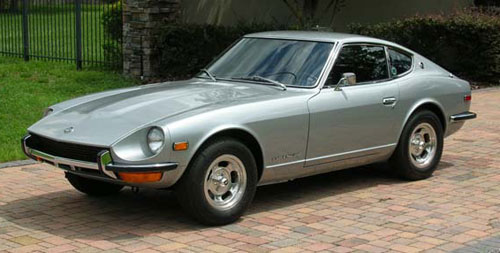
Finally got the Z’s new shoes on. Vintage-looking BF Goodrich Radial T/As in size 225/60-14. My dream tire for the car.

The slotted mags cleaned up pretty well. The lug nuts still have a good deal of brake dust on them, but those are relatively cheap to replace outright. I also need to get a set of center caps for the wheels.

Datsun Nissan 240Z 260Z 280Z Z-Car Tires Wheels Slotted Mag BF Goodrich Radial Comp T/A

225-width tires are a lot of meat for a 2350-lb car. They’re about as much tire as can be stuffed on a 7-inch-wide wheel. From what I gather, the tires are made equally with looks and performance in mind (maybe a bit more in the looks department), so they should perform well, if not spectacularly. The picture above illustrates the need for an air dam as well. The front of the car simply looks too light with just the valence.

Datsun Nissan 240Z 260Z 280Z Z-Car Tires Wheels Slotted Mag BF Goodrich Radial Comp T/A

The car most likely needs a drop as well. In fairness, there are no fluids in the engine bay at the moment, nor are there carbs. So that lack of weight accounts for some of the front fender gap. The side rub strips are coming off, too; a gentleman in the local Z club is interested in them.

Datsun Nissan 240Z 260Z 280Z Z-Car Interior Inside Cockpit Console Dashboard Dash Red Auburn Burgundy

Snapping pictures this afternoon, I realized I hadn’t taken a good clear one of the interior recently. Some issues that need to be addressed include the missing horn pad, cracked dash, cracked center console, tarnished plastic bits, shredded shift boot and ripped driver’s seat bottom. I’ve got a replacement for the latter, but the rest of the stuff will have to be sourced.

Next up: Dropping the fuel tank! What joy is mine… Stay tuned.

Editor’s note: This post is Part 12 of an ongoing series chronicling my efforts toward the restoration of my 1972 Datsun 240Z, originally my father’s. Read the other installments here:

12 Comments on Datsun 240Z Restoration:
Meat on the Wheels

Aaron’s FD RX-7: Bringing It Back

March 31, 2012 by Matt

Mazda RX-7 RX7 FD 3rd Gen Generation Montego Blue Touring Repair Restoration

Took a little detour today to pay a visit to my friend Aaron and his labor of love: A neglected/abused ’93 Mazda RX-7 Touring.

Aaron and I have both been rotary engine enthusiasts for ages, but he goes back even farther than me—his first car was an ’86 RX-7 GXL. His uncle was the car’s original owner, and he had replaced it with a 3rd generation car, giving his nephew rides and creating a strong sense of “someday…”

And after years of pining, Aaron finally picked up his erstwhile dream car a little less than a year ago. We’ll charitably call the seller a younger individual from backwoods West Virginia. He had festooned the car with diametrical opposite of everything that really fits the car’s character; a giant subwoofer box, huge rear wing, ugly body kit, heavy aftermarket wheels and a nitrous system pretty much kill all an FD RX-7’s innate “driver’s car” appeal, no mean feat. On top of all that, the car had sat immobile outside for several years before the seller decide to unload it. So Aaron got a deal, but had his work cut out for him in restoring the car’s luster.

Click here for more pictures!

4 Comments on Aaron’s FD RX-7: Bringing It Back

Datsun 240Z Restoration:
Inspiration (Sort Of)

March 21, 2012 by Matt

Triad Z Club Lineup Datsun Nissan 240Z 260Z 280Z Greensboro Winston Salem High Point

Well, I had good intentions.

Last night, I brought my good camera to my second monthly Triad Z Club meet, and even arrived a bit early, hoping to snap some nice pictures of Z-cars for inclusion here, but…on the way to the meet, the sky decided to fall down.

Absolutely torrential spring rains pelted my car on the highway, and cleared up abruptly a few miles before my exit, only to start again once I reached the meet location. Several brave souls had actually driven their Zs, but I had to rush inside when I arrvied, and it was dark and still drizzling when we left. So none of the pictures I did take are of display quality, to say the least.

Triad Z Club Lineup Datsun Nissan 240Z 260Z 280Z Greensboro Winston Salem High Point

In their place, then, I present a few photos of previous year Triad Z Club meets, generously forwarded to me by the club’s president. There are many more; I just picked out several of the better ones. Hopefully they convey a sense of how significant membership in a local group can be when it comes to maintaining motivation during a long restoration project. I attend the meetings as much for the camaraderie as for the chance to see “my car, done” in the flesh at least once a month.

Triad Z Club Lineup Datsun Nissan 240Z 260Z 280Z Greensboro Winston Salem High Point

The silver lining to the whole rainy evening (besides the conversation) was the fact that I’m tentatively slated to take over some, if not all, of the club website-related responsibilities, including putting together an e-mail list or online forum. I’m excited to be able to contribute to the group in such a way.

Editor’s note: This post is Part 11 of an ongoing series chronicling my efforts toward the restoration of my 1972 Datsun 240Z, originally my father’s. Read the other installments here:

1 Comment on Datsun 240Z Restoration:
Inspiration (Sort Of)

Technical Curiosities: The Turbine Car

March 13, 2012 by Matt

Chrysler Turbine Car Jet Engine Gas Burnt Orange Red Concept

Forget that “nibbling around the edges” school of technological innovation; here’s an example of a car that went all the way, as it were, and adopted a completely different powerplant.

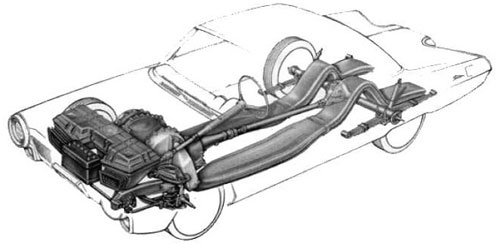
Built in ’63 to the tune of 55 examples, Chrysler’s Turbine Cars were never mass-produced, but did log an impressive number of miles as a demonstrator fleet. Essentially a completely normal car that happened to be powered, via the wheels, by a jet engine, the Turbine Car was a promising innovation dogged by politics all during its long gestation.

Chrysler Turbine Car Jet Engine Gas Engine Motor Powerplant Cutaway Diagram Schematic Drawing

How did it work? Quite simply. The turbine, which spun at up to 44,500 rpm, was connected to an ordinary torque converter and automatic transmission via a gear reduction unit. From there the power was transmitted to the back wheels by means of a basic Hotchkiss axle. The turbine required no liquid cooling system, and the bearings were sealed, so it needed no oil changes. A single spark plug provided the ignition source upon startup; after that the combustion flame was self-sustaining, much like the pilot light in a home furnace. Power output? A respectable 130 hp, and a startling 425 lb-ft of torque available just off idle, a characteristic of the turbine engine not unlike modern electric motors, and one that enabled the Turbine Car to hustle from a standstill to 60 mph in around 12 seconds, decent for the day.

What were some other upsides of the engine, besides the ones mentioned above? The engine could run on just about any combustible hydrocarbon (gasoline, diesel, kerosene, etc), and the operation of the turbine was exceedingly smooth. In addition the simplicity of the peripherals, the engine itself was blessed with only 60 or so moving parts, in contrast to the many hundreds of a typical piston engine. The reliability of the 55 demonstrators affirmed the turbine’s quality: They were an order of magnitude more durable than contemporary reciprocating engines, and that from a powerplant with a miniscule fraction of the development time undergone by its rivals.

Chrysler Turbine Car Jet Engine Gas Concept Cutaway Diagram Schematic Drawing

Disadvantages? In an era used to big, throbbing pushrod V8s, the vacuum cleaner-like sound of the turbine was off-putting. The engine did produce an excessive amount of exhaust heat—being, as it was, an actual jet engine—and Chrysler fitted an oversized and flattened exhaust system to absorb and diffuse as much of the heat as possible. Also, because of the temperatures inside the turbine, some exotic materials were used in its construction, raising the price tag a bit—though mass production and economies of scale would have certainly lessened the blow. One of the biggest downsides to the engine, and one Chrysler worked tirelessly to correct, was persistent throttle lag, caused by the time it took for the turbine to spool up and deliver power to the wheels. Drivers in the muscle car era of the ’60s expected instant power when they punched the gas pedal, and throttle lag cooled considerably whatever enthusiasm they might have felt for the new technology.

It’s a shame the Turbine Car wasn’t picked up for production, killed by politics and a general lack of public enthusiasm in the early ’70s. Perhaps if the red tape hadn’t been present, and the engine had had a company whose devotion to the engine was as strong as, say, Mazda’s for the rotary, we might see a handful of gas turbine-powered models for sale today. Who knows.

Editor’s note: This post is part of an ongoing series spotlighting obscure automotive engineering solutions. Read the other installments here:

5 Comments on Technical Curiosities: The Turbine Car

Datsun 240Z Restoration: Carbs’ Return

March 12, 2012 by Matt

Datsun 240Z SU Carbs Carburetors Carburettors Hitachi S30 Refurbished Rebuilt ZTherapy

The Z’s SU carbs returned from their visit to ZTherapy today, and I couldn’t be more pleased with them.

They’re clean as a whistle, and the action of every shaft and linkage is buttery smooth. The founder of ZTherapy had rebuilt them in the late ’90s, fitting them with the company’s signature ball-bearing throttle shafts in an effort to cure tune-distorting vacuum leaks; however, the seals failed and the founder’s remanufacturing process removed too much material from the aluminum bodies of the carbs for them to be refitted with new bearings. ZTherapy’s current owner was forced to use new cores during this latest rebuild, and he cleaned them, replacing all gaskets and rubber in the process too.

Datsun 240Z SU Carbs Carburetors Carburettors Hitachi S30 Refurbished Rebuilt ZTherapy

The icing on the cake was the presence of the mid-production-style knurled mixture adjustment knobs, shown above. Early Z SUs were fitted with knob without knurls, making it difficult to count turns when tuning, and late-model SUs had thin, notched discs, hard to grasp when rooting around under the carb bodies. I requested the knurled knobs, but ZTherapy declined to fit them, as they (understandably) like to keep the cores together and avoid mixing and matching parts. But then they did it anyway, a fact that really made my evening.

Datsun 240Z SU Carbs Carburetors Carburettors Hitachi S30 Refurbished Rebuilt ZTherapy

A view of the sealed (outer) end of the throttle shaft. A ball bearing resides under here. The new owner’s machining process removes much less material from the carb body, making for a much tighter fit around the throttle shaft, greatly reducing the chance the dust shields or retaining clips will work their way loose.

In other Z news, the wheels have been cleaned and fitted with the BF Goodrich Radial T/As, sized 225/60-14. Pictures forthcoming.

Editor’s note: This post is Part 10 of an ongoing series chronicling my efforts toward the restoration of my 1972 Datsun 240Z, originally my father’s. Read the other installments here:

7 Comments on Datsun 240Z Restoration: Carbs’ Return

Technical Curiosities: The Sleeve Valve

February 27, 2012 by Matt

Knight Sleeve Valve Engine Motor

This technical curiosity is a personal favorite of mine. Used a few high-end pre-WW2 cars, the sleeve valve was far better known for its exploits during the war inside a number of renowned aero engines developed by the British firms Napier and Bristol.

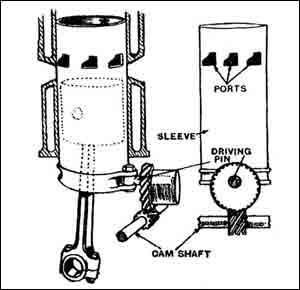
A different method of controlling intake and expulsion of the air/fuel mixture, the sleeve valve system dispenses with conventional valvetrain, including poppet valves, spring, rocker arms and pushrods. Instead, a cylindrical sleeve nestles between the piston itself and the wall of the engine block. The sleeve rotates and moves vertically, its motion controlled by a shaft driven off the crankshaft further down in the block. Ports in the side of the sleeve admit the mixture and allow exhaust gases to be expelled in sync with the movement of the piston, and a conventional spark plug in the roof of the combustion chamber provides the ignition source.

The sleeve valve was a solution to the difficulties posed by conventional poppet valves of the pre-WW2 era. Metallurgy being in a more primitive state then than now, the internal sealing of most engines was less than ideal, and virtually all engines burned a degree of oil as a matter of course, whether they used poppet or sleeve valves. Before advances in sealing that would later vault poppets past sleeve valves in engineers’ consideration, sleeves presented a number of important advantages over their counterparts.

Sleeve Valve Engine Motor Schematic Diagram Drawing Operation How It Works

Without the inertial restrictions of spring-actuated valves, the engine can spin much faster without worrying about valve float and piston-to-valve contact. Also, with careful shaping of the ports, intake and exhaust timing can be precisely controlled, and port area can be much greater than with poppets, unrestricted by the size of the combustion chamber ceiling. Without 2-4 valves per cylinder, the valvetrain is greatly simplified, and the spark plug can be located in the optimum location in the combustion chamber, unencumbered by valves.

Given these major advantages, why aren’t we all driving cars with sleeve valve engines? Sealing. As with the rotary engine, sealing is and will always be the major difficulty of the sleeve valve engine. Not only do the piston rings have to fit tightly against the inside of the sleeve, the outside of the sleeve itself must press up against the block wall. And given that all these parts move relative to each other, they must be lubricated, and some oil leakage into the combustion chamber is virtually guaranteed. As mentioned, during the engine’s heyday, poppet engines were just as bad, so there were virtually no downsides to the sleeve valve engine, but after the war, great strides in materials and processes allowed poppet valves to trump sleeves, sealing-wise, and the sleeve valve engine faded away. It’s a shame, really; given consistent development time, the engine might have overcome its issues, and blossomed into the superior configuration, since it is a fundamentally more efficient design than engines on the road today.

Editor’s note: This post is part of an ongoing series spotlighting obscure automotive engineering solutions. Read the other installments here:

1 Comment on Technical Curiosities: The Sleeve Valve

Datsun 240Z Restoration:
First Triad Z Club Meet

February 21, 2012 by Matt

Triad Z Club Logo Datsun Nissan 240Z 260Z 280Z 280ZX 300ZX 350Z 370Z

Attended my first monthly meet of the Triad Z Club earlier this evening. Paid my annual dues, my laminated (!) membership card will soon be in my sweaty palms.

I had a great time. I printed out a big stack of pictures of my 240Z to discuss, and I think the guys appreciated having the visual reference. 7-8 guys showed, mostly older, and from what I could tell all with their heads on straight as far as restoring and modifying their Z-cars; in other words, no preoccupations with “stance,” sound systems or 19-inch wheels. They, like me, were refreshingly focused on retaining the classic look and feel of their cars even as they upgraded them, and that more for the simple enjoyment of driving rather than all-conquering speed. Their priorities tracked with mine.

Perhaps more than that, I was struck with how friendly everyone was. More often than not, when I go to a car meet I’ll be the only one talking, sharing stories, asking questions and so on; most of the guys who show seem to think standing mute posturing next to their “ride” amounts to participation, but the Triad Z guys were gregarious to a fault. I thoroughly enjoyed talking to everyone.

I didn’t think anyone would actually venture out in their Z, so I didn’t take my camera, but when I arrived, I kicked myself for not having brought it just in case. One of the members drove his restored ’74 260Z with tucked bumpers, in 901 Silver (same color mine will be) with BF Goodrich Radial T/As (same tires mine will have). It wore an air dam, headlight bucket covers and a fresh coat of foot-deep paint. It was beautiful. Interestingly, the car was running de-emission-ed Hitachi “flattop” carbs as fitted to the later 240Zs and early 260Zs, which most will dismiss as particularly poor carbs; however, the car ran perfectly fine with them.

I received a deluge of advice and contacts concerning all aspects of the upcoming restoration effort, which, along with the social aspect of the meet, was exactly what I wanted. I have a mind to invite some of the guys over when I try to start my Z for the first time; it would be great to have an experienced set of eyes and ears trained on the car during that effort. Great group.

Editor’s note: This post is Part 9 of an ongoing series chronicling my efforts toward the restoration of my 1972 Datsun 240Z, originally my father’s. Read the other installments here:

No Comments on Datsun 240Z Restoration:
First Triad Z Club Meet

Koenigsegg’s New Cam-Less Engine

February 13, 2012 by Matt

Camless Valves No Camshaft Cam Pneumatic Valve Springs Koenigsegg

Jalopnik reports on an upcoming supercar from Swedish boutique automaker Koenigsegg that will feature a twin-turbo V8 engine whole valves are actuated without camshafts.

Partnering with Swedish engineering firm Cargine, Koenigsegg plans to develop a valvetrain system whereby the valves are operated using pneumatic pressure alone. F1 car engines have used pneumatic valve springs since the Renault turbo engines of the mid-’80s, but always in conjunction with a camshaft. The Swedish performance car concern intends to do away with the camshaft altogether, actuating the valves directly via servos. The breakthrough has the potential to eliminate a great deal of complexity (the entire valvetrain, cam gears and tensioners) and offer benefits including infinitely variable valve timing and cylinder deactivation, among others. The challenges include reliability (how to make sure the valves remain closed in case of servo failure, to eliminate the potential for valve-to-piston contact) and noise (servos have exactly two states—open or closed—as opposed to the more gradual, less noisy opening and closing profile offered by a cam lobe).

This is a smart move for Koenigsegg. Publicity drives supercar sales, and without the resources to sustain an indefinite top speed pissing contest against Bugatti and SSC, the Swedish automaker has sidestepped that key issue and instead focused on innovation and efficiency. But rather than cooking up yet another oh-so-trendy hybrid supercar, they’ve decided to “borrow from the top,” as it were, and incorporate racing technology in their new engine. Instead of merely “going green” for the sake of going green, shoehorning in hybrid technology well aware of the weight and complexity drawbacks, as with a whole host of recent supercar concepts (New Acura NSX, Jaguar C-X75, Porsche 918, etc), Koenigsegg plans to boost efficiency in the pursuit of power and speed. It’s a win-win.

4 Comments on Koenigsegg’s New Cam-Less Engine