Spannerhead Dot ComSpannerhead.com

Posts filed under ‘Technical’

New Frontiers in Combustion:
The OPOC Engine

December 2, 2011 by Matt

EcoMotors OPOC Engine Motor Opposed Piston Opposed Cylinder

Call me a pessimist, but as much promise as this engine shows, I just don’t see it going anywhere.

It’s not for lack of technical merit. The EcoMotors Opposed-Piston Opposed-Cylinder (OPOC) 2-stroke diesel engine exhibits a thermal efficiency of close to 50%, meaning that around half the energy delivered to it is converted into work, compared with 20-30% for the average gasoline engine. It’s compact, smooth, efficient, powerful and arguably less complex than the typical conventional engine, what with its lack of valvetrain or ignition system.

EcoMotors OPOC Engine Motor Opposed Piston Opposed Cylinder

Essentially a two-stroke horizontally-opposed diesel engine with an extra pair of pistons where the cylinder heads would otherwise be, linked to the crankshaft via long connecting rods, the OPOC engine employs an exhaust-driven turbocharger to deliver positive pressure to fill the cylinder volume and push out the exhaust. The engine avoids the typical two-stroke disadvantage of losing much of the intake charge out the exhaust by staggering the port openings relative to the piston positions—impossible on a conventional single-piston reciprocating engine. All the moving parts are carefully synchronized in a kind of mechanical ballet, keeping bearing loads to an absolute minimum and permitting a relatively lightweight engine block.

So why the pessimism about its potential for success? History. There have been no shortage of alternatives to the conventional reciprocating engine over the years, and none of them have caught on. The closest to parity, of course, has been the Wankel engine, but even it was relegated to a far, far distant second place, and ceased production entirely this past year. So in spite of its fear-dissuading superficial resemblance to normal boxer engine, the OPOC engine’s extra dose of unfamiliarity will be its undoing in the marketplace. I suppose, if all else fails, the engine may turn out to have a fruitful career in non-commercial applications such as military vehicles and the like, but I just don’t see it catching on beyond that sphere of use.

Click on the jump below to view a pair of clips, the first an animation of the engine in action, and the second representatives of the development team explaining the engine’s intricacies.

Watch the clips!

1 Comment on New Frontiers in Combustion:
The OPOC Engine

Datsun 240Z Restoration: The Rollout

November 26, 2011 by Matt

1972 Datsun 240Z Blue

Took advantage of the opportunity afforded by being at my parents’ place for Thanksgiving to discuss the situation with my dad, and to roll the car out of the garage for a bit. It’s the first time the car’s been moved in several years, and I was shocked the rear drums weren’t rusted solid, having left the parking brake engaged. We did have to put some air in a couple of the tires, and we couldn’t find the key, so the steering locked, preventing the car from being rolled out farther. But it was still nice to get a gander at the whole thing.

1972 Datsun 240Z Blue

As mentioned, I did have a chance to “unburden” myself to my dad regarding the hopelessness of being able to give the car a thorough restoration on our family budget, and was genuinely surprised when he half-floated the idea of “sponsoring” a restoration provided I do all the grunt work—which I’m more than willing and able to do—and manage the project in general. The extent of his involvement will be clarified going forward, but knowing my dad and his connection to the car, I’m fairly certain he’ll want to be involved in some capacity.

The upshot is that the Z is going to be taking up residence in its new home here within the next two or three weeks, at which point I’ll carefully develop a game plan and start tearing into it. One of the slight deviations from my “full restoration fantasy” is that certain wish-list items, like a 5-speed, disc brakes or a 2.8l bore-out (if even possible) are going to have to wait. The focus will be the body and interior, along with restoring the engine, suspension and driveline to fully-operational condition. I would, however, like to add two things in the process of bringing the car back from its current state: Headers and a full exhaust, and an air dam. Everything else can wait, and be added later. At this point, after having owned the car for 10 years, I’m just eager to see the process move forward. Wish us luck!

Editor’s note: This post is Part 4 of an ongoing series chronicling my efforts toward the restoration of my 1972 Datsun 240Z, originally my father’s. Read the other installments here:

2 Comments on Datsun 240Z Restoration: The Rollout

A Rube Goldberg Car?
BMW’s New Tri-Turbo Diesel

November 24, 2011 by Matt

Electric Turbo Patent Drawing

Turns out rumors of a new triple-turbo engine under development for the next BMW M3 may not have been entirely accurate. As it happens, the turbocharger arrangement may be destined instead for their new all-wheel-drive, diesel-powered 550dX. Adding a first-ever-for-a-production-car third turbo to the mix is ambitious enough, but then to fasten the resulting assembly to a diesel engine? And offer the resulting car only with AWD? Isn’t that level of initial complexity just asking for trouble on BMW’s part?

Autoweek elaborates a bit on the details:

The radical new engine, which is rumored to use two traditional exhaust-blown turbochargers in combination with an electrically driven turbocharger to add low-end response, is planned to be offered exclusively with an eight-speed automatic gearbox and four-wheel drive.

Being the ostensibly rational, sensibly German company they are, it’s virtually beyond question BMW have a sound engineering justification for cramming so much mechanism into one car beyond just headline-grabbing “shock value.” That being the case, I’m eager to hear them explain themselves. The piping diagram between the manifolds, intercooler(s) and turbo is going to be rival a map of the London Underground, I’ve no doubt. For this exercise, in the interest of science, I’ll shelve my longstanding bone to pick with BMW’s new engineering direction. I’m genuinely curious to hear the whys and wherefores.

2 Comments on A Rube Goldberg Car?
BMW’s New Tri-Turbo Diesel

Datsun 240Z Restoration:
Confessions of a Poor Car Enthusiast

November 23, 2011 by Matt

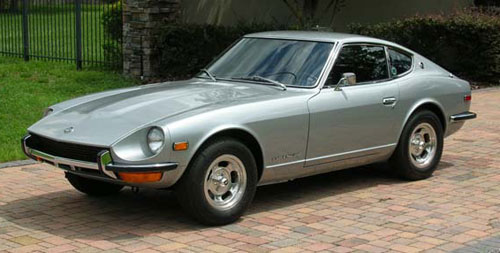
901 Silver Datsun 240Z 240-Z HLS30 S30 Nissan

I finally figured it out. After two and a half years—maybe longer—I discovered the missing piece of the existential puzzle that is my “car promiscuity.”

Since acquiring my driver’s license in ’95, I’ve been through a lot of cars. But more recently, since mid-’09, I’ve made a series of car swaps I couldn’t really justify. Obviously, my automotive flexibility as a husband, dad and homeowner is radically more constrained than it was when I was single, child-less and renting. That said, ever since my car interest “reopened” in mid-’09, I’ve felt this sort of restlessness, discontent, some kind of inexorable force pulling me from one car to the next, searching for what I knew not.

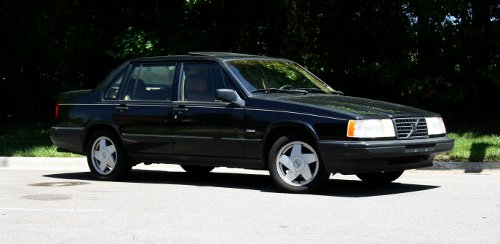
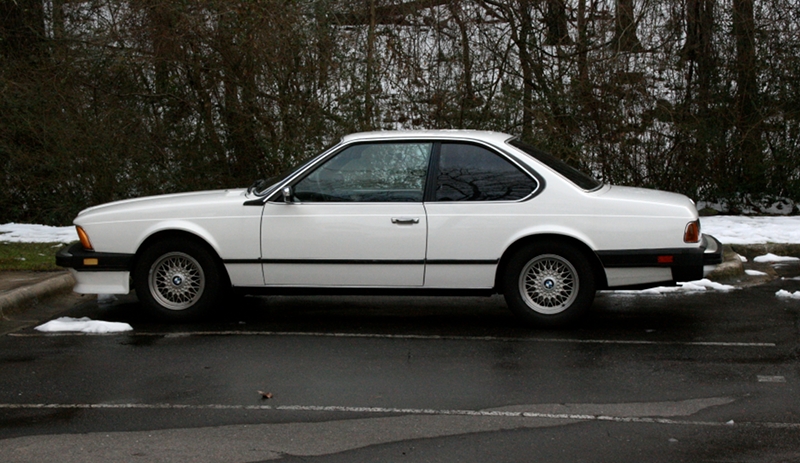
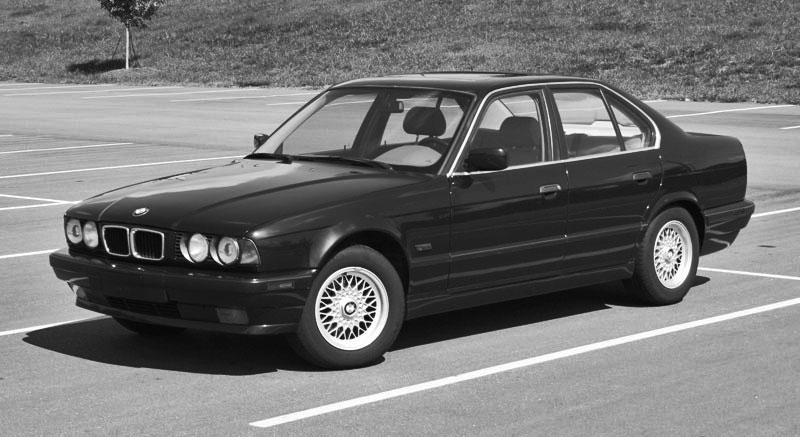
Let me explain our family’s car arrangement. We had established a while ago that there were three “slots” for cars to fill: The family hauler, the daily driver and the project car. The minivan has filled the first slot; no real drama there. The project car slot has been occupied, since late ’01, by my Datsun 240Z. The daily driver slot, in contrast, has seen a remarkable amount of turmoil and turnover. Starting in mid-’09, I’ve been through a ’93 Volvo 940 Turbo, an ’01 VW Jetta TDI, an ’86 BMW 635CSi, a ’95 BMW 525i and I had been searching for its successor. There were a veneer of practical reasons justifying the move from one to the next, but the undercurrent was the aforementioned, irrational restlessness. And it drove me up a wall. It upset my parents. It upset my wife. Why did lose interest in my current daily driver so readily and feel compelled to jump ship? What was I looking for?

The key lay with the third slot, the project car. As a car buff, I love to tinker with cars; there’s little I’d rather do than be working on them. My 240Z is in need of a full down-to-the-metal restoration, and I finally have the space in my new garage to begin the project. So what’s the problem? It’s the realization I came to earlier tonight, and it ties everything together: I will never have enough money to restore the 240Z.

I just won’t. Not the right way, at least, the way it needs to be. Between two young kids, the demands of the house and my line of work, without going into exhaustive detail, the money simply won’t be available for at least another 15 years, if ever. The realization should have been obvious, and I’m sure it was present subconsciously, but tonight was the first time it bubbled to the conscious surface and I “let myself” say it.

And knowing that, deep down, was what drove me (pun intended) from one daily driver to the next. Bereft of a long-term car project I could realistically hope to complete, I gravitated toward short-term “easy power” from my daily drivers. I wanted something that could satisfy my need to get grease under my fingernails, start for me every morning, and haul the family around if the need arose. I didn’t want to admit to myself that the 240Z project was an albatross, but the emotional needs of my hobby would not be denied, and redirected themselves toward my daily driver, creating overlap, cognitive dissonance and great frustration.

It’s difficult to overstate the magnitude of this realization. I feel like a weight has been lifted. It brings so much of my automotive angst over the past two years into focus. My mindset vis-a-vis my car interests going forward is so much more clear.

Editor’s note: This post is Part 3 of an ongoing series chronicling my efforts toward the restoration of my 1972 Datsun 240Z, originally my father’s. Read the other installments here:

3 Comments on Datsun 240Z Restoration:
Confessions of a Poor Car Enthusiast

Vorsprung Durch Technik:
Audi’s Greatest Hits

November 22, 2011 by Matt

Audi quattro System Diagram Cutaway Line Art Schematic

No, not cars—engineering innovations. Granted, they weren’t first with all of these, but more than any other company, Audi put them on the map.

  • Full-time passenger car AWD (1980). Undoubtedly the advance they’re best known for, Audi’s quattro AWD system has been their cars’ key point of distinction since the introduction of the original Audi Quattro. The Jensen FF may have been the first “mainstream” car to use AWD, but Audi pioneered a compact, durable, efficient layout and extended it throughout their model range. In so doing, they established themselves as an innovative automaker.
  • Aerodynamic styling (1982). The first-generation Ford Taurus gets all the credit for introducing wind-cheating, rounded styling to family sedans, but the C3 Audi 5000 preceded it by several years. In a time when most bread and butter cars were chromed-up boxes, the 5000 was a bolt from the blue.
  • Reintroduction of twin-turbo technology (1997). Previously reserved for gadget-laden, high-end Japanese sports cars, Audi’s B5 S4 bought dual turbochargers to sports sedans with its 2.7l, 261 hp “biturbo” V6. At the time, twin turbos were seen as a bit of a fad on the wane, but Audi ignored the trends and made a practical decision in order to compete with the BMW M3. In so doing, they created a wonderfully compelling rocket sled. BMW would introduce its own twin-turbo N54 engine a few years later.
  • Direct injection (2000). Mitsubishi, Toyota and Renault preceded the Ingolstadt automaker by a few years, but Audi was the first to introduce direct injection on our shores with their FSI 2.0l turbo engine. Additionally, with their Volkswagen connections, Audi was able to popularize the efficiency-enhancing technology very rapidly, fitting several of its sister marque’s cars with the engine. Today, a large percentage of performance (and non-performance) engines use direct injection.
  • Dual-clutch transmissions (2003). Developed by Porsche and Audi together in the ’80s for their race cars, the DSG dual-clutch gearbox was rolled out simultaneously in two passenger cars: The Audi TT and VW Golf R32, both using the VR6 engine. The transmission revolutionized “flappy paddle gearboxes” and has even began to replace automatics in many cases.
  • LED driving lights and headlights (2008). First seen on the 2008 Audi A6 refresh, distinctively-shaped LED driving lights are now a must-have for any luxury nameplate to be taken seriously. They exemplify Audi’s leadership in terms of style as well as engineering, and represent a wonderful convergence of the two. With their new R8 models, Audi has began to use LEDs for primary headlights as well, improving longevity and power consumption over traditional bulbs. Of course, as with everything else on this list, it’s only a matter of time before other automakers imitate another of the automaker’s breakthroughs.

Full disclosure: I am an Audi fan. The list featured in this post substantiates my fandom, though; it’s not a blind allegiance. I’m a nut for creative, forward-thinking technology, but I’m even more impressed when that technology sticks, and compels other automakers to follow. From my vantage point, in the past 30 years, when it comes to innovation, Audi has a win/loss record that’s second to none.

No Comments on Vorsprung Durch Technik:
Audi’s Greatest Hits

Atomizing Fuel: Single-Point Injection

November 18, 2011 by Matt

Holley Throttle Body Injection Pro-Jection

This may come as a bit of a surprise to those of you used to seeing fuel injectors neatly arrayed under a fuel rail, or at least poking out of individual runners, but that arrangement certainly wasn’t the first fuel injection design. No, it was arrived at after years of development of much more rudimentary systems, such as the one featured today: Single-point injection (SPI), also known as throttle body or central fuel injection.

In the period from the early ’70s to the late ’80s, when carburetors were on the wane, done in by draconian emissions regulations as well as the relentless march of technology, engineers came up with a dozen different ways of injecting fuel into the cylinders. SPI is arguably the simplest method that emerged from that time frame—essentially nothing more than a gutted two-barrel carb body, the innards replaced with a pair of injectors. The electronics were analog more often than not, controlling the fuel rate in a very crude manner in response to demand from the engine.

The advantages are obvious: The switch from carburetor to fuel injection was made with the absolute minimum amount of disruption to the engine peripherals. Elements such as the air cleaner, fuel lines, intake manifold and even the fuel pump could remain unchanged. Engineers got a slightly simpler and more flexible—albeit unfamiliar—fuel delivery method to hone in pursuit of fuel economy, clean emissions and ultimately power. The marketing guys, for their part, got to brag that their new models were fuel injected, and the accounting department was pleased at the minimal development cost.

To anyone familiar with modern multi-point fuel injection, the downsides of SPI are plain: The manifold design was compromised in the sense that all the runners had to converge in one location, fuel metering could not be timed to meet the intake strokes of individual cylinders, and atomization, owing to the low fuel pressure, was poor, hampering economy.

In the end, SPI was just a stopgap. Multi-point fuel injection was the next wave of progress, and would replace SPI entirely by the early-mid ’90s.

Editor’s note: This post is part of an ongoing series highlighting various obsolescent methods of fuel delivery. Read the other installments here:

No Comments on Atomizing Fuel: Single-Point Injection

The Engine Swap Hall of Fame:
Hilly’s Audi V8 Lotus Esprit

November 10, 2011 by Matt

Hilly Lotus Esprit S3 Audi ABZ V8 Engine Motor Swap Motorgeek

For anyone interested in wild and wacky engine-and-chassis pairings, visit the Motorgeek community Projects subforum. On any given week, there are at least two dozen projects underway involving major engine relocation (a mid-engined V8 Golf, for example), completely custom sheetmetal fabrication and insane power builds. It’s mostly Audi- and VW-related, but some non-VAG stuff does pop in from time to time.

One of my all-time favorite project threads on Motorgeek is dedicated to Hilly’s Audi 4.2l V8 and 6-speed transaxle swap into an S3 Lotus Esprit. Ditching the anemic and temperamental stock 4-cylinder engine, Hilly went for Audi’s all-aluminum unit, in the process creating a sort of proto-twin-turbo V8 Esprit, a homemade version of what the automaker would later do themselves. You can browse the whole build thread here (it’s worth the read); I’ve grabbed a few highlights:

Click here for pictures and video!

2 Comments on The Engine Swap Hall of Fame:
Hilly’s Audi V8 Lotus Esprit

Technical Curiosities:
The Hydraulic Cooling Fan

November 7, 2011 by Matt

Hydro Hydraulic Drive Fan Motor Cooling Radiator

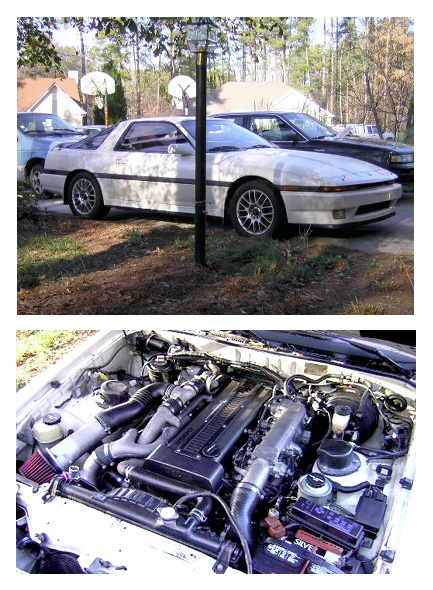
I first ran across this one when I was doing the 7M-to-1JZ engine swap in my old Supra Turbo. Before the thought of a swap had even entered my mind, I remember puzzling over pictures of Japanese-market-only Supra engine bays fitted with the 1JZ-GTE from the factory, wondering why they seemed to have not one, but two power steering fluid reservoirs (yes, I sit and ponder things like that). I couldn’t figure it out, but when I finally had my hands on one and was lining up my ducks for the swap, I quickly discovered the reason for the extra container of hydraulic fluid: The car was fitted with a hydraulically-powered cooling fan.

In almost every instance, car engine cooling fans are powered one of two ways: Either directly by the engine off the front of the water pump pulley, or electrically using a large-ish motor. Typically, longitudinal (front-to-back) engines feature direct-drive, whereas engines mounted in a transverse (sideways) fashion, with their accessory belts rotating perpendicular to the ideal orientation for a direct-drive cooling fan, receive electric units. However, in a handful of cars, the engineers decided to grant the cooling fan its own, dedicated hydraulic circuit for motive purposes. In addition to the 1JZ-GTE in my ’89-’92 Supra application (the 1JZ was directly-driven in other Toyotas), the ’92-’96 Toyota Camry V6, Lincoln LS and ’99-’04 Jeep Grand Cherokee all featured hydro fans.

The disadvantages are obvious, but not outright deal-breakers for sensible and careful engineers: The setup adds another layer of complexity to the engine, with more parts to fail, and another fluid level for the owner/mechanic to check and service. As with Audi’s UFO brakes, the rarity of the solution means added expense for parts.

Hydro Hydraulic Drive Fan Motor Cooling Radiator 1JZ 1JZ-GTE 1JZGTE 1JZGTTE 1JZ-GTTE Parts Diagram Schematic Pump

There are some distinct advantages, though: The decoupling, as it were, of the fan from the engine gives the developers some leeway in term of radiator and accessory placement. The hydraulic drive can draw more power from the engine than an electric fan, and thus move more air through the radiator for more effective cooling. And compared to a directly-driven unit, the hydro fan’s speed isn’t dependent on engine speed—the solenoid that controls the flow of hydraulic fluid through the fan motor can opt to run the fan on high speed as the engine idles, for example, or completely freewheel the fan on the highway.

In the final analysis, if you can accept a little added complexity under the hood, the hydro fan combines the best qualities of both directly-driven and electric cooling fans: high power and flexibility, respectively. It’s a wonder to me that it hasn’t been more widely adopted.

Editor’s note: This post is part of an ongoing series spotlighting obscure automotive engineering solutions. Read the other installments here:

14 Comments on Technical Curiosities:
The Hydraulic Cooling Fan

The Driveshaft Dyno:
The Tuner’s New Best Friend?

November 5, 2011 by Matt

AEM Dyno-Shaft Dynoshaft Driveshaft Dyno Yoke Slip Ring SEMA

As noted on the Edmunds Best New Product overview of the annual Specialty Equipment Market Association (SEMA) show, among a host of other tuner-related websites, one of the coolest and longest-overdue innovations on display was the AEM Dyno-Shaft on-car dynamometer.

A two-part device basically consisting of sensors installed at opposite ends of a RWD car’s driveshaft, the Dyno-Shaft measures driveshaft load to accurately determine engine horsepower and torque in any given situation. In contrast to the “ideal laboratory” environment of a conventional, external dynamometer, AEM’s product can calculate real world power output during highway pulls, dragstrip launches—anywhere. It stands to really allow the tuner to optimize his vehicle for the entire operational envelope. The Dyno-Shaft won’t work for FWD or AWD cars, isn’t cheap—around a grand—and requires some custom fabrication to fit, but anyone who’s worked out the kinks of an engine swap or massive upgrade will tell you dyno time adds up quickly, and can be only marginally profitable if all your ducks aren’t in a row before you roll onto the rig. If I had a build I was really serious about, I’d strongly consider it.

3 Comments on The Driveshaft Dyno:
The Tuner’s New Best Friend?