Spannerhead Dot ComSpannerhead.com

Driving the Only Left-Hand Drive
Mazda RX-7 Spirit R in the World

December 16, 2012 by Matt

As soon as I think I’m over my obsession with the 3rd generation Mazda RX-7, or FD, a clip like this pops up and reminds me of all the reasons I fell in love with the elemental sports car as a 15-year-old.

It does get talky in parts, and the host makes much the same point articulated more astutely by Chris Harris—pining for a lower-power, full-engagement sports car instead of the mega-horsepower digital “robots” de rigeur nowadays—but the shots of the Spirit R blasting along the California coast are worth the occasional superfluous foray into familiar automotive history.

To state the obvious, it’s an achingly beautiful car. I honestly can’t think of a lovelier vehicle to emerge from Japan, and the knowledge of its (considerable) capability only strengthens the pull of its lines. As much as I wish the FD had been offered in the US for longer than three model years, I wonder sometimes if the shortness of its production run coupled with the powder-keg nature of its twin-turbocharged rotary don’t actually enhance its appeal. It’s so ephemeral, so uncompromising, both in its looks and in its accoutrements vis-a-vis the driver, so utterly irrational… We need cars like this; cars that don’t make a lick of sense “in the real world.” As much as I appreciate what Mazda attempted to do with the RX-8, with its suicide doors and livable back seat, those very concessions to practicality turn me off to it. I would “use” the RX-8’s compromises exactly once: As talking points to convince my wife that the car wasn’t a completely frivolous expenditure, and then bemoan their presence for the rest of my ownership experience. No, even if I had to sleep on the couch for a couple of weeks, give me the FD RX-7. Its purity is worth the pain.

2 Comments on Driving the Only Left-Hand Drive
Mazda RX-7 Spirit R in the World

Technical Curiosities:
An Automotive AWD System Primer

December 14, 2012 by Matt

AWD 4WD All Wheel Drive Systems Badges Emblems Audi Quattro Mercedes Benz 4matic Subaru BMW 325ix

Prompted by a recent online forum discussion wherein I explained the difference between BMW’s and Audi’s AWD powertrain layouts, I thought I’d put together a short rundown of front-engined AWD solutions.

I’m sure I’ve overlooked a configuration or two. If you think of one I haven’t covered, post a comment and I’ll add it to this primer!

Car All Wheel Drive AWD 4WD Layout Drawing Diagram Schematic

Standard layout – The illustration above depicts what I’ll call the standard layout—basically a RWD setup with a transfer case attached to the rear of the transmission, sending power to the front wheels via a secondary driveshaft, front differential and axles. All four wheels must be able to turn at different speeds for dry pavement use, so the standard layout incorporates a center differential within the transfer case.

Advantages of this layout include the ability to position the engine further rearward for better weight distribution within the chassis, and the fact that it’s a relatively simple affair to convert a RWD car to AWD using a few extra parts. Among the downsides are additional complexity compared to the other methods described below, as well as a higher center of gravity since the front differential and axles must fit under the engine, and the transfer case and secondary driveshaft run beneath the car as well.

Automakers that use this layout: BMW, Mercedes, Nissan, Infiniti, Cadillac, etc.

Car All Wheel Drive AWD 4WD Layout Drawing Diagram Schematic

Standard transverse layout – Similar to the first configuration, the standard transverse layout is a conversion of a “regular” 2WD (in this case FWD) powertrain setup to AWD. A transfer case, including a center diff, is attached to the rear of the transmission and sends power to the rear wheels through a (long) driveshaft and conventional rear diff and axles.

It’s a relatively compact setup, and commonly added to FWD cars. That said, the engine placement is still limited and the fact that so many components are concentrated near the front of the car means weight distribution is very often less than ideal. Also, the front-rear torque split is almost invariably biased toward the front wheels, only sending power to the rears when the front start to slip, making the car for all intents and purposes FWD, except in certain select circumstances.

Automakers that use this layout: Volkswagen, Mitsubishi, Mazda, etc.
Car All Wheel Drive AWD 4WD Layout Drawing Diagram Schematic

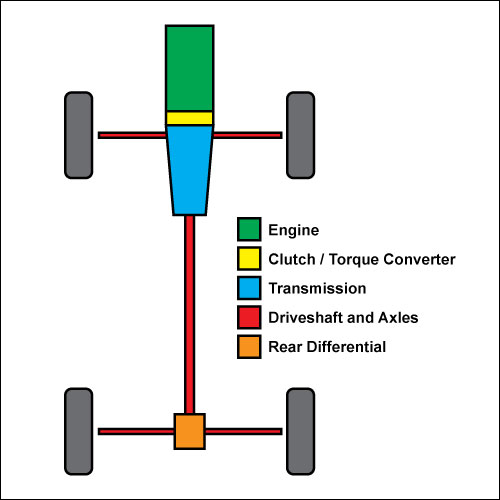
All-in-trans layout – Subaru and Audi pioneered this layout in the ’70s and ’80s, respectively. Everything, including the front diff, is contained inside the transmission casing, and the front axles simply sprout from the sides of the bellhousing.

Both the upsides and disadvantages of the all-in-trans layout are significant. Its configuration is simpler and more compact than any other, and comparatively very robust. Also, having all the mechanicals “on the same plane” allows the car’s CG to be relatively low. All that said, a quick glance at the schematic above reveals the layout’s major downside: The engine must sit fully in front of the transmission and front axle line, utterly destroying any hope of reasonable weight distribution. To Audi’s credit, in the past 5 years or so, they’ve managed to rearrange components inside the transmission such that the front axle line can now move in front of the clutch, improving weight distribution slightly. Better—but they’re still a long way from a 50-50 front-rear balance.

Automakers that use this layout: Audi, Subaru, some Volkswagens (those built on platforms shared with higher-end Audis).
Car All Wheel Drive AWD 4WD Layout Drawing Diagram Schematic

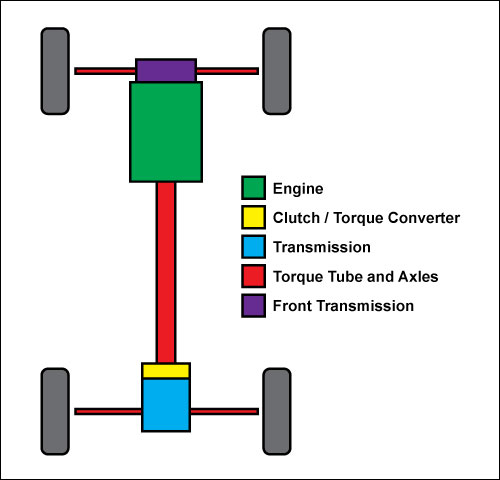
Both-ends layout – This one’s rather creative. It represents Ferrari’s solution to the “AWD problem” and was first introduced with their 2011 FF top-of-the-line shooting brake. Instead of siphoning power from the back of the engine to send forward, the FF’s V12 has a second transmission mounted to the front of the engine, without a differential, sending power to the front wheels via a pair of clutches. For its part, the actual transmission is mounted at the rear of the car in a classic performance car transaxle layout.

The boon to weight distribution from the both-ends layout is clear: The entire engine can, and indeed must, be pushed behind the front axle line. It’s relatively simple, mechanically. But the car’s wheelbase and styling proportions have to follow the layout, and can look rather stretched, as any consideration of the FF’s profile will attest to. Also, the lack of a front differential limits the power sent forward to only 20% of the engine’s output, not a great help in many situations.

Automakers that use this layout: Ferrari.

Editor’s note: This post is part of an ongoing series spotlighting obscure automotive engineering solutions. Read the other installments here:

6 Comments on Technical Curiosities:
An Automotive AWD System Primer

Movie Stars: The Maserati Biturbo 425i

December 11, 2012 by Matt

Maserati Biturbo 4-door 425i Silver Blue

So I watched Licence to Kill over the weekend. The 1989 film is the second of the two James Bond productions featuring Timothy Dalton as the iconic British superspy, and although it has a reputation as one of the less worthwhile Bond films, I enjoyed it. The movie’s tone is considerably darker than the relatively lighthearted Roger Moore outings, and although the script and Dalton’s personality mean there isn’t much “Bond” in the film in the sense of memorable interactions or one-liners, it functions rather well as a lean-and-mean “generic” spy thriller. And some of the explosions are absolutely epic.

Maserati Biturbo 4-door 425i Silver Blue

Unfortunately, one of the definite downsides of Licence to Kill is that there isn’t really a Bond car as such. No Aston DB5, no Lotus Esprit, nothing—Bond’s conveyance during the main action setpiece is an 18-wheel tanker truck, of all things. Really the only car in the film that has any semblance of appeal for the enthusiast is the one driven by the antagonist’s henchmen, the 1987-1990 Maserati Biturbo 425i.

Maserati Biturbo 4-door 425i Engine Motor

As with its already-esblished 2-door stablemate, beneath its rakish Italian skin, the Maserati is powered by a 2.5l SOHC V6 with a pair of turbochargers hanging off the cylinder heads. And as you might expect, the Italians didn’t engineer the car to a level of quality commensurate with its potential on paper. Put another way, in spite of its looks, the Biturbo was a turd of a car, catastrophically unreliable and with a power output of only 188 hp, far below what you would anticipate from the displacement figure and presence of the turbos.

Maserati Biturbo Interior Inside Cockpit Console Dash Dashboard

It is beautiful, though—in a wedge-y, boxy, ’80s sort of way, an aesthetic I’m particularly drawn to. The lines are strong and consistent inside and out, a 5-speed manual transmission option was offered and power was sent to the rear wheels. The raw elements were there, but Maserati’s quality at the time was appalling, rivaling British Leyland at its worst. The ingredients of greatness were present, and when everything worked perfectly… Jeremy Clarkson once said about Alfa Romeo, “They build a car to be as great as a car can be—briefly.” The same might be said of the unsung hero of Licence to Kill, the 4-door Biturbo.

Editor’s note: This post is part of an ongoing series discussing cars which featured prominently on film or television. Read the other installments here:

12 Comments on Movie Stars: The Maserati Biturbo 425i

Stunning BMW E24 “Intro” Video

December 9, 2012 by Matt

This was recently posted by a new member of an online forum for BMW E24 owners and enthusiasts. Needless to say, if every forum inductee could make a clip of this quality, the internet car enthusiast community would be a very nice place indeed.

The cinematography, the music, the editing… It’s breathtaking—and descriptive. My major beef with most amateur (or even professional) car videos is that they tend to be so obsessed with over-the-top “kinetic” camera movement that you barely have time to glimpse the actual car or linger over its lines, but the video above draws out the proportions and feel of the 6er in massive fashion. Full-screen it and turn up the volume. Well done.

4 Comments on Stunning BMW E24 “Intro” Video

On The Psychology of Car Desire

December 7, 2012 by Matt

A funny thing happened as I was poring over a glossy brochure of an Audi A5 acquired from a chance visit to the dealership a few weeks ago. I felt something I hadn’t experienced in quite some time: The desire for a completely unattainable car.

That used to be all I felt as I flipped through car magazines and road tests. Being young, without (or with marginal) employment and without a driver’s license meant that every car was out of reach. But as I got older, more cars entered the realm of possible purchases, not simply because my bottom line was a bit healthier, but also because many of the cars I fantasized about in my early years had depreciated to the point where they were in reach financially. Add to that a penchant for older, boxier, non- or less-electronically-infested cars and the used car market had become my oyster, so to speak.

My experience flipping through the A5 brochure brought those two different mindsets into sharper focus. Naturally, there’s quite a bit of overlap between the two, but basically, we can distinguish between:

Mazda RX-7 RX7 FD Silver

  • The idea of a car. This is all I had in the beginning. Leafing through coffee table books on vintage Lamborghinis and pictorials of the Porsche factory museum, and reading road tests in Car and Driver and my grandmother’s issues of Consumer Reports shaped my views on automotive matters—but it remained an abstract subject. In a way, it was like “car astronomy;” the vehicles I formed opinions about were as remote to me as stars or planets. I gathered data about them from a distance, but any chance of experiencing them was absent.

    This doesn’t mean, by any stretch, that I was dissatisfied with my situation, any more than an 8-year-old is unhappy reading about dinosaurs or learning about fighter jets. Cars were confined to the realm of theory, and just the activity of organizing the various brands and their offerings in my mind and stacking them up against each other was deeply satisfying. However, as I grew older, a new form of automotive enjoyment came alongside:

    Mazda RX-7 RX7 FB SA22C Light Sky Blue

  • The idea of owning a car. This is where the rubber met the road. This is where I began visualizing myself behind the wheel of a little sports car I could actually endeavor to purchase if I were disciplined enough to save for a few months. All of a sudden, worthwhile cars were within reach, and the emotional thrust of my car interest morphed from simple fascination with cars from a distance to “How can I acquire the car I want?” So much time and energy was spent marshaling resources here and there, pondering trade scenarios, working out potential monthly payments on personal loans… I was still enthralled by theory—more than ever, in fact, now that I could dive under the hood of my latest project and familiarize myself with its intricacies—but the additional hemming and hawing over whether a purchase or trade would be the right decision came into play. I agonized over these things. There was, and continues to be, a restlessness absent the gentle succession of internal spotlights on the unattainable magazine car du jour.

That kind of anxiety-free excitement over a particular car model came rushing back to me as I perused the A5’s brochure, and the twinge of forgotten familiarity pleased me, like a comforting smell I hadn’t experienced in years. I want more of the perspective from my younger days; I need to endeavor keep the fingers of potential acquisition from reflexively closing around whatever car I may be fascinated with next. It’s just more healthy that way.

No Comments on On The Psychology of Car Desire

Legends and LeBarons:
The Best and Worst Car Names

December 5, 2012 by Matt

Car Nameplates Emblems Badges

This certainly isn’t an exhaustive list, but I wanted to underscore some of the better and worse car naming efforts over the past 50 years.

Highlights include:

  • Jaguar E-Type – There’s nothing quite so British sounding as a “-Type” suffix on a car’s name, and the ’60s icon exuded British-ness from every sheetmetal gap. The name also drew a connection to Jaguar’s then-recent endurance racing triumphs with the C- and D-Type.
  • Acura Legend – What better way to spearhead Japan’s first foray into the American luxury market than calling your car, with a touch of hubris, the Legend? (It’s legendary! Already?) In spite of Acura’s slight naming overreach, the car was a success, and it will be said “Acura Legend” rolls off the tongue particularly well. It was a shame when the automaker decided to “de-name” its cars and adopt a alphanumeric-only nomenclature scheme.
  • Audi RS4 – Okay, “RS4” just sounds like a cruise missile designation: “Captain, we’re approaching the fleet of aircraft carriers under their radar cover.” “Roger that; launch the RS4s and let’s head back to base!” Perfect.
  • Plymouth Barracuda – In perhaps the best decade for American car names—the ’60s—when automakers were a bit more brave with their names and didn’t subject a sanitized list to dozens of focus groups, the ‘Cuda stands out, sounding for all the world like the cammy idle coming from the Hemi V8 rumbling under the shaker hood.
  • Ford Mustang – Ford captured the “horse theme” and drew a connection to the P-51 Mustang of WW2 renown, an aircraft then only 20 years old and thus fresh in the memories of many at the time of the car’s release.
  • Toyota Avalon – Succinct, easy to pronounce, and perfectly conveys the car’s key attribute: A heavenly, cloud-like driving atmosphere. Spot-on.
  • Audi Nuvolari quattro – Audi has had a string of beautifully-named (and achingly gorgeous) concept cars, with monikers borrowed from icons of the firm’s pre-war racing history, such as Avus quattro and Rosemeyer.
  • TVR Griffith – Props to TVR to mining the “mythological beast theme” with cars like the Griffith, the Chimaera and the Cerbera. The theme is chock full of fearsome creatures whose character seems to transfer particularly well to the late Blackpool automaker’s fast but flawed supercars.

And there have certainly been names that left much to be desired:

  • Triumph Dolomite – It sounds like a vitamin drink. Or something a geologist would be fascinated by. One saving grace, I suppose, was the fact that the name was able to be easily morphed into a nickname: “Dolly.”
  • Chrysler LeBaron – Afflicted with the curse of the “Le-” prefix, much like the Buick LeSabre. Quite apart from the cars themselves, the prefix reeks of an American car company attempting to tart-up an otherwise unremarkable effort by giving it (what they thought was) a foreign-sounding name. Pathetic.
  • Oldsmobile Cutlass Supreme – A pirate’s dessert confection. Awkward and contrived. No thanks.
  • Oldsmobile Achieva – The absolute worst offender in the category I’ll call “Taking Normal Words and Adding an “A” to the End of Them.” Other members of this category include the Toyota Supra, Nissan Maxima and Altima, Acura Integra and Hyundai Elantra. You really can’t try a little harder to come up with something original?
  • Volkswagen Touareg – For your car to be a success, it helps for the buying public to be able to pronounce your car’s name without a lesson from the dealer, and without fear of embarrassment (“You got a what?”) on subsequent tries. The Touareg and to a lesser degree its later stablemate the Tiguan fail this test.
  • McLaren MP4-12C – It sounds like they actually never got around to naming the car, but simply went with the internal prototype code. The combination of numbers and letter seems so arbitrary that it actually detracts from the “special-ness” of the car—an important quality in a supercar. Furthermore, a car like the Ferrari 365 GTB/4 was able to get away with it because its nickname, the Daytona, superseded all else. But the MP4-12C has no such nickname. McLaren has recently decided to truncate the name to “12C.” Better, but again, hardly special.

What am I missing? Post a comment with a car name (or two or three) you think is particularly apt or inept.

7 Comments on Legends and LeBarons:
The Best and Worst Car Names

Carrera GT: The Ferrari of Porsches

December 3, 2012 by Matt

Porsche Carrera GT Silver

Jeremy Clarkson called it “a supercar unplugged.” No AWD, no semiautomatic gearbox, no turbos—no roof, even.

3,000 lbs. A mid-mounted, 5.7l, dry-sump V10 producing 612 hp, propelling the car from 0-60 mph in a recorded time of 3.5 seconds, with a top speed of over 200 mph. A traditional 6-speed, single-clutch, three-pedal manual transmission sending power to the rear wheels alone. Taut, seductive bodywork. And…that’s about it.

List those attributes and it’s likely the first company that pops into a typical car enthusiast’s mind is Ferrari. The Italian automaker has created dozens of supercars over the years that fit that template, most notably in the 1980s with their legendary, elemental F40. Described as little more than a go-kart powered by a beastly twin-turbo, 471-hp V8, the F40 was fitted with only the barest amenities, but delivered a thrill ride like no other. It mesmerized the imagination of supercar purists, including Clarkson, who proclaimed it the one to have.

Porsche Carrera GT Silver

And that, of course, is the supreme irony of the 2004-2007 Porsche Carrera GT, the car actually featured in this post. The F40’s archrival during the supercar wars of the ’80s was the über-sophisticated Porsche 959, a 444-hp missile that combined breathtaking speed with civility and practicality, bandwidth made possible by the unprecedented amount of technology crammed under the 959’s sheetmetal. The F40 was the purist’s rocket sled; the 959 was the supercar for the techno-geeks, folks (like me) who derived as much enjoyment from poring over the car’s spec sheet as fantasizing about actually being behind the wheel.

Fast forward to the early 2000s, and while the performance philosophies of Ferrari and Porsche hadn’t been completely reversed, Ferrari had, by that point, embraced the potential of electronic aids like semiautomatic gearboxes and multiple driving modes to augment the driving experience. For its part, Porsche stayed the course and built on the foundation laid by the 959, continually refining their mastery of the driver-computer-car connection… But then, out popped the Carrera GT.

Porsche Carrera GT Interior Inside Cockpit Console Dash Dashboard

It wasn’t a total ripoff of the F40 stripped-down supercar philosophy; after all, being a German car, it was polished to “basic” (read: still high) standards of tractability and utility, but compared to every other Porsche offering since the 959, the Carrera GT seemed utterly…analog. And yet—it exuded a grace, a presence, an almost un-German passion, and above all, it radiated a kind of supreme focus completely absent lesser supercars like the BMW Z8. The Carrera GT knew exactly what it was: A lightning-fast, beautifully styled, relatively basic thrill ride, full stop. Unlike its German peers, it didn’t seem obsessed with posting a record-beating Nürburgring lap time. It wasn’t “the supercar for all seasons.” It wasn’t even some kind technological testbed. No—it burst onto the supercar scene quite suddenly, and seemed for all the world like a spontaneous expression of carmaking joy on the part of the designers and engineers who developed it. Italian passion + German know-how = The ultimate, essential supercar?

4 Comments on Carrera GT: The Ferrari of Porsches

Which Would You Buy?
The Awful-Driving Looker vs.
the Great-Driving Box

November 30, 2012 by Matt

De Tomaso Mangusta Gray Grey Silver Gunmetal

B13 Nissan Sentra SE-R SER Red

Let’s try something a bit more abstract this time.

Our first car—let’s call it “Car 1″—is a stone-cold stunner. The kind of car that stops traffic. Has presence. Dominates conversation at car shows. Gives your neck a perpetual crick from turning around to gaze at it as you walk away.

But Car 1 is dog to drive. Flaccid engine, cramped cabin, leaden controls with all the charm and feedback of a farm tractor’s. Terrible visibility and a sadist’s ergonomics.

Car 2 reverses those attributes. Visually, it’s utterly anonymous. Blends in during the morning commute. Embarrasses your teenage daughter to be driven in. Looks as if it had been styled in five minutes using a straightedge and a t-square.

But Car 2 is a wonderful drive. Has an engine that begs for more. An alert, playful chassis. Alive, talkative steering feedback. A shifter descended from Olympus in a shaft of light. A flawless seating position, airy cabin and faultless ergonomics.

Critically, let’s assume, for the sake of argument, that other factors like purchase price, running costs, ease of repair and reliability are roughly equivalent between the two cars. Let’s distill this exercise down to the kernel of looks vs. driving pleasure. You may choose only one. Which would you drive?

In the real world, among other considerations, we car enthusiasts select a car based on our assessment, at that time, of which represents the best blend of those two qualities according to our personal tastes. We may prioritize one over the other, or even prefer different positions at different times in our lives. There are very, very few cars that exist completely at one pole of the spectrum; the overwhelming majority strive for a blend of both according to their manufacturer’s ethos and their price point. So it’s rare that our car choices make us really reflect on our own priorities with respect to how we view our automotive interests.

So, let’s have it then: What’s more important to you in a car? The look, or the feel?

Editor’s note: This post is part of an ongoing series wherein I stack up the pros and cons of two broadly similar cars from an ownership perspective. Read the other installments here:

7 Comments on Which Would You Buy?
The Awful-Driving Looker vs.
the Great-Driving Box

Technical Curiosities:
Mercedes’ Monoblade Wiper

November 28, 2012 by Matt

Mercedes Benz Merc MB Monoblade Mono Single Windshield Windscreen Wiper

I’ve been captivated by this thing ever since I was a kid. Is there any more fun car activity on a dreary, drippy Tuesday afternoon ride home from school than trying to find a mid-’80s Mercedes E-Class or 190E just to catch a glimpse of the wiper in action? There is? Well… I enjoyed it.

Attempting to achieve a cross between the coverage of two blades and the economy and aerodynamic advantages of a single blade, Mercedes’ Monoblade (also known as “eccentric clean sweep”) certainly wasn’t the first single wiper system on the market. Cars as varied as entry-level Fiat econoboxes, sporty VW Sciroccos and high-end Jaguar luxury sedans preceded it with their solitary blades. What made the German automaker’s wiper system unique was the hub mechanism used to increase the wiper’s coverage of the windshield beyond a simple arc.

Mercedes Benz Merc MB Monoblade Mono Single Windshield Windscreen Wiper Diagram Schematic Drawing Coverage Pattern

As illustrated above in the “single arm (controlled)” drawing, the Monoblade’s substantial coverage was achieved by designing it to extend outward toward the corners of the windshield in the course of its travel across the glass. A cam-type device in the hub moved the arm away from the pivot twice, retracting it in between so the wiper would not overextend the top of the windshield. It all sounds ungainly, but to watch it in action is to witness a quasi-mesmerizing symphony of mechanical fluidity. Call it odd, but I’m transfixed whenever I see a Monoblade going through its paces on a rainy day. I nearly have to wrench my attention away from the spectacle in order to focus on the task of driving my car.

Mercedes Benz Merc MB Monoblade Mono Single Windshield Windscreen Wiper

Introduced on the pioneering W201 190E model series and also fitted to the W124 and W210 E-Class generations as well as the W202 C-Class, the Monoblade’s primary advantage was aerodynamic, as it noticeably cut wind resistance at high (read: Autobahn) speeds. Even though it seemed more simple, with one linkage instead of two, as in a traditional wiper system, the Monoblade was actually more expensive to produce and repair, owing to the number of specialized parts. Additional disadvantages included the difficulty for owners in finding the required long replacement blades and a slight, but decidedly non-luxurious rocking motion introduced to the car when the big wiper was operating in high-speed mode.

Watch the clip below to see the wiper in action, and be on the lookout for an older C- or E-Class next time it rains. You’ll get a treat.

Editor’s note: This post is part of an ongoing series spotlighting obscure automotive engineering solutions. Read the other installments here:

8 Comments on Technical Curiosities:
Mercedes’ Monoblade Wiper