Spannerhead Dot ComSpannerhead.com

Audi and BMW:
A Tale of Two Brand Identities

November 26, 2012 by Matt

Audi BMW Corporate Logos

Over the past 14 years, the brand perception of these two German luxury automakers have followed decidedly different trajectories.

Note that I’m not talking about corporate profitability. Even as I make the case that Audi’s efforts at building and consolidating their brand image have far outstripped BMW’s, the latter remains a thoroughly successful company. I intend to focus more on brand perception, especially among nominally impartial enthusiasts like myself.

14 years ago, BMW was on a tear. Their primary lineup consisted of the E36 3-series, the sports sedan benchmark at the pinnacle of its development, the beautiful E39 5-series, arguably the best 5-series generation yet made, and the E38 7-series, a bold and powerful player in the high-end luxury sedan market. BMW’s offerings were built on the automaker’s core philosophy of RWD, highly-tuned non-turbo engines and a focus on driver involvement. Most significantly, BMW’s lineup was relatively small, and again, rested upon the automaker’s non-negotiables.

Audi, for its part, was still finding its footing, particularly in the US market. As Peter De Lorenzo summarizes in his excellent commentary on Audi’s most recent Le Mans triumph:

Audi was a perennial “second-tier” brand behind BMW, Mercedes-Benz and Lexus in the U.S. market, struggling to break out of the continuing funk that was the direct result of the hatchet-job performed by “60 Minutes” twelve long years before that (November 1986). The totally erroneous report by the CBS news program, which accused Audi of building vehicles that suffered from unintended acceleration, nearly put the brand out of business in this country – even though it was proven to be completely false – and it lingered over the car company like a shroud of negativity.

De Lorenzo points out that the Audi’s cars were fundamentally solid, if a step behind BMW’s in terms of enthusiast appeal, but the automaker’s brand perception needed rehabilitation.

Audi set about that task in a consistent, disciplined manner, focusing on appealing design, effectively applying technology developed through the automaker’s racing efforts to their production lineup, and most importantly, making intelligent product decisions and not overextending themselves into markets out of sync with the company’s brand focus. As a result, De Lorenzo writes:

Audi is now the forward thinking brand firmly ensconced at the head table of the luxury-performance segment. Boasting technically advanced and beautifully purposeful machines inside and out, Audi production cars bristle with brilliant, innovative ideas and are executed with a relentless precision. And they are beautiful to look at as well.

Meanwhile, from an enthusiast standpoint, BMW has squandered their carefully crafted brand image with an ill-fated foray into Formula 1, as well as dubious product decisions. Among others, they released the hideous Chris Bangle-designed E65 7-series, the frumpy X3 small SUV, the confusing X6 crossover and its downright baffling performance variant the X6 M, and the awkward 5-series GT midsize hatchback. The Bavarian automaker’s market experiments with alternative propulsion have been less than confident, the excellent 335d diesel-powered sports sedan notwithstanding. And BMW has suffered a succession of comparison test losses to its rival from Ingolstadt (A6 vs. 535i and S6 vs. M5) along with a shocking victory by the new Cadillac (!) ATS over the new F30 3-series in the key categories of chassis design and handling.

BMW’s performance benchmark the M3 is still a world-beater, demonstrating that in essentials, the automaker is still as good as it ever was, but the singular drive necessary to develop the M3 doesn’t seem to maintain itself throughout BMW’s lineup, and the brand is weakened. There’s expanding into untapped markets, and then there’s unfocused quasi-desperation, a quality BMW seems to be radiating of late. In the final analysis, as we look forward to 2013, BMW is offering less and less for enthusiasts to get excited about, and Audi’s lineup contains more and more.

The obvious response comes: Why should the corporate bean-counters at the helm of either company care what enthusiasts think? They run businesses, and if there are new opportunities, why not tap into them, brand history and consistency be damned? While that line of thinking has merit, consider the significance of branding to luxury and performance automakers in particular: In order to maintain brand image, a kind of above-the-fray certainty about product decisions must come through. A luxury or performance vehicle should sell itself, to a degree; its brand should shape popular trends, not chase them. In other words, it’s counterintuitive, but too much marketing is a sign customers aren’t beating a path to your door; they aren’t seeking you out like they should. And if nothing else, certainty was a quality BMWs exuded from their arrival here in the US market in the mid-’60s all the way through to the turn of the century. That confidence, coupled with a focus on capturing the enthusiast market, vaulted the automaker to its current place of prominence, and ever since 2000 or so BMW seems to be simply coasting on its brand capital while exploring every new market niche under the sun. No, the majority of its customers may not be enthusiasts, but many of them appreciate the opinions of enthusiasts when it comes to choosing a quality car; this is what drove the yuppie obsession with BMWs 30 years ago, and is important, I believe, for the brand’s continued appeal in the larger market. BMW needs to maintain its position as the enthusiast’s choice of luxury cars in order to sustain its brand image, and they simply cannot do that by exploring every last untapped market niche, as they seem intent on doing.

If the BMW emblem is to remain a beacon to car buffs like myself, the automaker needs to take a page from Audi’s playbook for the last 14 years: Recognize the brand’s traditional strengths and focus like a laser beam on those qualities while expanding the product line within that context, rather than distorting it out of all recognition.

10 Comments on Audi and BMW:
A Tale of Two Brand Identities

BMW M8:
Long-Awaited Bavarian Supercar

November 23, 2012 by Matt

BMW M8 Supercar Concept Rendering Illustration

Ever out of sync with the ebb and flow of the supercar market (the supermarket?), BMW looks set to finally unveil a counterpart to Mercedes’ SLS AMG and Audi’s R8. Well, in a few years, that is. Left Lane reports on the upcoming M8 (its rumored name):

…BMW will unveil the M8 as a concept in 2014 before launching the production version two years later.

Why rush things?

The late ’70s BMW M1, admittedly an excellent car, was too late (and underpowered) to participate in the initial supercar wave that produced such leading lights as the Ferrari Boxer or Lamborghini Countach. And the M1 predated the mid-’80s supercar boom by half a decade. The Bavarian automaker chose to sit out the more recent spate of astronomically-priced road-eaters as well; the new BMW supercar’s would-be rivals have been one-upping each other around the Nürburgring for the better part of a decade at this point.

Left Lane continues:

[T]he 21st century M1 will pack about 600 horsepower thanks to a 4.0-liter V8 engine fed with two turbochargers. Mated to a nine-speed automatic transmission, the eight-cylinder mill will propel the M8 from zero to 62 mph in about three seconds and on to a top speed of roughly 200 mph.

Other than a 9-speed automatic (!), there’s nothing from that description that wouldn’t translate perfectly into the curriculum vitae of, say, a McLaren 12C or Lexus LFA. If BMW wants to have any chance of success, as impeccable as the road manners of the upcoming M8 will inevitably be, its automaker needs something more, something special, something unique in a crowded market. Otherwise, what’s the point?

Editor’s note: The car pictured at top is a rendering developed by the website TopSpeed.com and doesn’t officially represent a definite design direction for a new production BMW.

No Comments on BMW M8:
Long-Awaited Bavarian Supercar

Technical Curiosities: Twincharging

November 21, 2012 by Matt

Lancia Delta S4 Rally Engine Motor Twincharging Turbocharged Supercharged

Twincharging: Combining turbocharging and supercharging on the same engine. Blending of the low-rpm immediacy of a supercharger’s response with the high-end power and efficiency of a turbocharger.

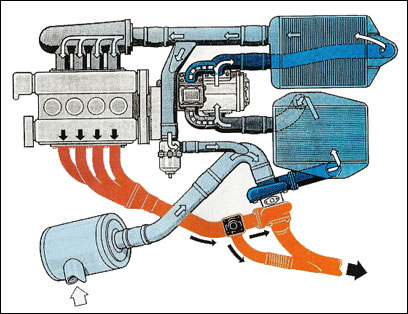
Only a few automakers have attempted such a complex hybrid system in a production automobile. Continuing with the Lancia theme started with yesterday’s post, the Italian automaker was the first to offer a vehicle featuring twincharging for sale with the homologation version of their all-conquering Delta S4 Group B rally monster. The S4 Stradale, as it was called, was fitted with a detuned but otherwise intact version of the full-blown rally car’s mid-engined turbo- and supercharged 1.8l DOHC 4-cylinder. Downrated to “only” 250 hp for the Stradale, the powerplant was capable of cranking out upwards of 500 hp in race trim, and what’s more, able to deliver that power in a right-now, linear fashion ideal for low-grip rally competition.

Lancia Delta S4 Rally Engine Motor Twincharging Turbocharged Supercharged Diagram Drawing Schematic Layout

As far as the mode of operation, there are a couple of way of doing it: Turbo first, or blower first. Lancia opted for the former, positioning the supercharger closest to the engine for immediate response, and incorporating a valve to allow the turbo to bypass the blower when up to speed and pressurize the intake charge with less restriction. The cost was obviously the complexity of the additional plumbing, drive belt, second intercooler and the like, but the system avoided the wasteful, manifold-destroying characteristics of contemporary anti-turbo-lag setups, which essentially dumped raw fuel immediately upstream of the turbine inlet in order to keep the turbo spooled between shifts.

More recently, Volkswagen has introduced a supercharger-first twincharging system on their 1.4TSI engine. Slightly less complex and more production-oriented than Lancia’s racing-focused effort, VW’s engine uses the blower’s output not only to boost the engine, but also to keep the turbo spooled at low rpm. For further reading on the 1.4TSI, check out this excellent Autozine article.

Editor’s note: This post is part of an ongoing series spotlighting obscure automotive engineering solutions. Read the other installments here:

5 Comments on Technical Curiosities: Twincharging

A Top Gear Take on Lancia

November 19, 2012 by Matt

Lancia Montecarlo Monte Carlo Scorpion Red

Really been jonesing for one of these lately. Maybe not a mid-engined Lancia Montecarlo (sold in the US as the Lancia Scorpion) as shown above, but for a Lancia in general.

What’s the appeal? Imagine a car with the cachet, élan and romance of a classic Alfa Romeo, but rare as hen’s teeth, and even less practical.

What’s attractive about an impractical car? Well, why are we often drawn to others so dissimilar to ourselves? Where’s the “practicality” in that kind of arrangement? Sometimes we just want the heartbreakers, and there are few marques able to break hearts quite as effectively as Lancia.

A few years ago, the Top Gear presenters asked themselves which automaker had produced the largest number of great cars, and after some deliberation, they (rather surprisingly) passed over such legends as Ferrari, BMW and Jaguar and settled on Lancia. The following couple of clips span only part of the show’s coverage of the brand, but they illustrate at least somewhat the cars’ appeal to obscure car nuts like myself, and if nothing else showcase some lovely shots of classic Lancias in motion.

Click here to view the video clips!

3 Comments on A Top Gear Take on Lancia

Choice Circuits: Hockenheim

November 17, 2012 by Matt

Hockenheim Hockenheimring F1 Formula 1 One Track Circuit Old Classic Full Pre-2002

Once known as the fastest F1 track, eclipsing even Monza in that regard, Hockenheim has been maimed, reduced to a shadow of its former self.

It happened in 2002. Once a 4.2-mile collection of flat-out straights connected by a series of brief chicanes and one “twiddly bit,” the race organizers finally succumbed to pressure from the various Formula 1 powers-that-be to make the circuit shorter, and thus easier on the cars and more spectator friendly. So the fabled Hockenheimring went from the layout shown at top, to this genericized “made to order” 2.8-mile aberration:

Hockenheim Hockenheimring F1 Formula 1 One Track Circuit New Post-2002 Redesign Herman Tilke

What am I on about? In truth, the redesign advocates did have a bit of a case. The long high-speed stretches were very difficult on engines and transmissions, and since the only real grandstands were clustered in the “stadium section” near the Südkurve, race fans really only caught a glimpse of the inter-car action as the cars made their way through that relatively small portion of the circuit.

That said, was the only solution to alter the course so radically? Allow me to indulge in a touch of Monday-morning quarterbacking when I say no, it wasn’t. Who’s to say additional grandstands and infrastructure couldn’t have been built to accommodate spectators at different locations around the track? And furthermore, F1 by its very nature is supposed to be a mechanically-demanding motorsport, and the intensity of the Hockenheim challenge pushed the designers to their uttermost limits in order to deliver the maximum amount of horsepower out of the engines, get it to the ground effectively and still be reliable. It’s arguable that the majority of the viewing public could care less, but for a F1 technology nerd like myself, the knowledge of what the engineers had to achieve to make an F1 car win at Hockenheim was exhilarating.

Hockenheim Hockenheimring F1 Formula 1 One Track Circuit Remains Destroyed Jim Clark Curve

The real tragedy, though, may not be simply the fact that Hockenheim was redesigned, but that the race organizers opted to destroy the unused portions of the classic circuit, ripping out the asphalt and reclaiming the area with foliage, as shown by the remains of the Jim Clark Curve above. It was an incredibly short-sighted move, eliminating the possibility that the traditional layout could be used for classic races, assuming that F1 would never again be in a place where the old circuit would be desirable, and to my mind perhaps demonstrating a hint of passive-aggressiveness on the part of the race organizers for having been made to redesign the track.

The old circuit holds particular appeal for me as it was the site of Ferrari’s first race win in almost 4 years when “my” driver Gerhard Berger triumphed in 1994. The Ferrari 412T of that year was one of the few remaining cars persisting with a V12 engine configuration when all their competitors had switched to lighter, more frugal V10s and V8s. This decision made the 412T for the most part uncompetitive except when it came to sheer engine power—an important advantage at a circuit like Hockenheim that prioritized brute force and top speed over apex-clipping nimbleness. So in a season filled with change (most drivers’ electronic aids were banned) and tragedy (Ayrton Senna’s tragic death at Imola just a few races before), Berger provided a morale-boosting victory at the German Grand Prix, a race I’ll never forget.

Watch and listen as BBC commentator and former F1 driver Martin Brundle provides a turn-by-turn analysis of Mika Hakkinen’s lap of the pre-’02 classic circuit:

Editor’s note: This post is part of an ongoing series discussing legendary and notable racing venues from around the globe. Read the other installments here:

3 Comments on Choice Circuits: Hockenheim

Which Would You Buy?
E34 BMW 525i Turbo vs. E34 BMW M5

November 14, 2012 by Matt

BMW E34 M5 Gray Grey M-Pars M-Parallel Wheels Rims

Pedigree versus performance. “Character” against raw power. The factory-sanctioned package or the DIY approach.

Let’s wade into a bit of an intramural debate here, but one whose principles hold true for many different car types and families. The subject is the ’89-’95 BMW 5-Series, known by its internal model code E34. The two flavors of the E34 pitted against each other are the range-topping ’89-’93 US-spec M5 and the entry-level ’91-’95 525i. The M5 is powered by a flame-spitting 311-hp 3.6l straight-6, whereas the 525 leaves the factory with a more sedate, miserly 189-hp 2.5l engine. The basic chassis is identical between the two cars, the M5’s driveline and suspension beefed up accordingly to handle the extra power, but nothing that can’t be bolted onto its lesser relative. An E34 M5 in a good state of tune will run you a bit north of $10K, and a clean 5-speed 525 is a comparative bargain at $2-3 grand.

So no contest, right? Does the M5 win the “desirability war” hands-down? Well, frankly, yes—unless you equip the 525’s engine with an equalizer: A turbocharger.

BMW E34 Turbo Engine Motor 525i M50 Jon Kensy Purple

It does take some effort, as no ready-made bolt-on kit exists to fit a turbo to BMW’s M50 engine in the E34 chassis. Other than the hurdle of having to DIY most of the project, it’s almost like the 525 was designed from the outset to accommodate forced induction. The M50 engine’s cylinder head, completely stock, flows well enough to support over 700 hp, and the bottom end is sufficiently stout to handle 400+ without internal mods. The ’91-’92 525’s ZF 5-speed transmission is bulletproof, as is the rest of the driveline, and the engine bay is more than spacious enough for the extra bits and bobs required. Total cost, not counting the initial purchase price? Easily over $5K to do it correctly, but still well below the “floor” asking price of an unmolested M5.

BMW E34 M5 Engine Motor S38 S38B36

Can the M5 match the speed of a properly turbo’d 525? In a word, no. When fitted to the M5, BMW’s S38 engine was nearing the end of its life, and its development potential is limited, not to say ridiculously expensive given the engine’s rarity and finicky nature. Just to rebuild the engine will cost very near the purchase price of the car, whereas a 525’s M50 engine can be found all day every day for $500 in a junkyard, a boon if your DIY turbo efforts accidentally grenade one.

So if not speed, what does the M5 offer above and beyond the 525? Character. Pedigree. Its big, rip-snorting naturally-aspirated inline-6 is essentially a mildly detuned race engine, and loves to be spun hard and wound out (making a lovely noise as it does so). Not only that, but the engine’s integration with the chassis from the factory is nothing short of perfect—BMW made sure every component from the steering to the shifter to the suspension and throttle response worked harmoniously together to create an impression of a total car more than the sum of its parts. Those enthusiasts who’ve driven an M5 say it’s an irreplaceable experience.

Which to choose, then? The project or the factory package? More power with less personality, or fewer ponies and more character? A truly tough decision.

Editor’s note: This post is part of an ongoing series wherein I stack up the pros and cons of two broadly similar cars from an ownership perspective. Read the other installments here:

14 Comments on Which Would You Buy?
E34 BMW 525i Turbo vs. E34 BMW M5

Italian Wedge: The Fiat X1/9

November 12, 2012 by Matt

Fiat X1/9 X19 X1-9 Red Black Profile Side

The 1974-1982 Fiat X1/9 carries the distinction of being one of the few (only?) cars with a slash as part of its name. Not only that, it was the last Fiat sold in the US until the brand’s reintroduction to our shores last year, and to this day remains the only production mid-engined Fiat.

Think of it as a Porsche 914 without the pedigree angst. Or a Toyota MR2 without the bizarre interior. Interestingly, the X1/9 was conceived in the same way as the later MR2: By taking an economy car FWD engine, powertrain and front suspension (in this case the Fiat 128’s) and “flipping” it 180°, positioning it immediately behind the seats to create a mid-engined sports car.

Fiat X1/9 X19 X1-9 Black Back Rear Tail

Additional features include a lift-off targa roof panel that stowed in the front luggage compartment, bumpers designed to minimize the visual impact (pun intended) of stultifying 1970s crashworthiness regulations, and a fuel tank and spare tire mounted between the passenger compartment and the engine, as close to the car’s CG as possible. This detail, together with the engine’s location and the car’s featherlight ~2,000 lb curb weight made for go-cart-like handling rivaled only by certain Lotuses. Indeed, the X1/9 is still a force to be reckoned with in certain autocross classes, a testament to Fiat’s formula.

Fiat X1/9 X19 X1-9 Interior Inside Cockpit Console Dash Dashboard

The interior is sensibly laid out and quite stylish for the late ’70s, a well-resolved demonstration of the de rigeur angular themes of the day. The engine wasn’t much to write home about, but with only a ton of car to motivate its task wasn’t arduous. Initially a 1.2l SOHC 4-cylinder developing 63 hp in US trim, a 1.5l, fuel-injected 75 hp version of the engine was rolled out for 1979, marginally improving performance; 60 mph came up from a standstill in around 11 seconds.

On another note, it’s interesting to consider the difference between Fiat’s abandonment of the US market in the early ’80s and their return in the 2010s. The X1/9 was unmistakably a niche car, something of a halo vehicle designed to bolster the Italian automaker’s dashing, somewhat romantic (in an straight-edged ’70s kind of way) appeal in the US. Perhaps having decided that approach was a failure, Fiat decided to reintroduce themselves to an American clientele with a much more mass-market car, the far more conventional supermini 500. As good a car as the 500 is, and as much as I appreciate Fiat’s shift in market strategy, I do hope there remains a bolder voice in the organization, one that would encourage the powers-that-be to gamble a bit by releasing something as quirky as the X1/9 on our shores. Perhaps once the automaker establishes more of a financial beachhead over here they’ll consider it; who knows.

9 Comments on Italian Wedge: The Fiat X1/9

Styling Misfires: The Chevy SSR

November 9, 2012 by Matt

Chevy Chevrolet SSR Hardtop Pickup Yellow

Nope. Nope nope nope.

If there ever was an instance where an automaker should have ignored the “auto show buzz” surrounding a concept and not put it into production, this is it.

Manufactured between 2003 and 2006, the SSR was Chevy’s attempt to capitalize on the retro trend pioneered by the 2002-2005 Ford Thunderbird and 1998-2010 VW New Beetle. Only, in the Chevy’s case, its direct design influences weren’t that obvious. Was it reminiscent of a stepside pickup truck? Was it supposed to recall a hot rod? An El Camino? The SSR’s murky visual lineage dampened its appeal considerably.

Chevy Chevrolet SSR Hardtop Pickup Yellow

Automotive publications, for their part, were gentle in their criticism of its looks. A two-seat convertible pickup with a 300+ hp Corvette V8 under the hood, it was in a niche by itself, and the journalistic world seemed to let the lack of available comparisons spare them the delicate task of reviewing the car without gagging.

The SSR’s few buyers during its 4-year model run, however, remained utterly convinced they had bought one of the coolest cars on the road. That being absolutely not the case, what we have in the SSR is the physical manifestation of “body dysmorphic disorder;” in other words, the inability to conceptualize how one is perceived by others. It might be a bit much to say the SSR is the Michael Jackson of cars, appearance-wise, but it’s close. Again, every owner seems to think driving the SSR elevates them to a new plane of cool, but I can’t imagine a single true car person who would drive the car without a paper bag over his or her head.

Chevy Chevrolet SSR Hardtop Pickup Red Interior Inside Cockpit Console Dash Dashboard

It’s not difficult to appreciate where I’m coming from. Try this: Whatever your thoughts about the SSR as a static piece of automotive sculpture, whatever its underhood prowess, imagine yourself ensconced behind the wheel, cruising down the main drag of your hometown. Yes, picture yourself at the helm of that tacky, cartoonish, bulky, eye magnet of a misshapen piece of quasi-retro schtick and I’ll wager you shudder a bit at the thought. Good riddance.

Editor’s note: This post is part of an ongoing series wherein I discuss unsuccessful cars whose styling was their overlooked (or denied) Achilles heel. Read the other installments here:

No Comments on Styling Misfires: The Chevy SSR

Kevin Thomas and His Homebuilt F1 Car

November 7, 2012 by Matt

Kevin Thomas Homebuilt F1 Formula 1 One Car BAR Lucky Strike Honda 2001

To clarify, that’s homebuilt, not homemade. Kevin Thomas isn’t constructing some kind of replica Formula 1 car from scratch; he’s assembling an actual F1 racer from actual F1 racer parts.

In his backyard.

As with many projects, it all started with an eBay purchase. A longtime F1 fan, Thomas was browsing the popular auction site one day when he stumbled across a listing for a pair of chassis constructed by the now-defunct British American Racing (BAR) team. On a whim, Thomas contacted the seller after the auction had ended and secured the foundation for his project.

Intended for the 2001 F1 season, the BAR chassis Thomas ended up with was relegated to testing duties, but has all the bells and whistles of the cars driven in anger by Jacques Villeneuve and Olivier Panis on circuits across the globe. Thomas has had considerable difficulty sourcing parts specifically for his chassis, so he’s had to cobble together subassemblies from other F1 cars when they come up for sale—a slow, painstaking process that requires more patience than I would have.

It also demands a decent amount of mechanical ability, or at least a willingness to learn. The car’s sidepods, for instance, are from a later Williams F1 car and adapted by Thomas to the BAR tub, and a contemporary Benetton racer lent certain suspension bits. As for the engine, Thomas plans to source a Formula Renault 3.5l V6 engine—much easier to come by than the BAR F1 car’s original 3.0 V10. The Renault engine’s output of “only” around 480 hp is less than two-thirds that of the engine the chassis was designed around, but more than enough to tax the abilities of 98% of amateur racers like Thomas, or you and me, for that matter.

It’s an amazingly ambitious project, and I wish Thomas the best of luck as he tinkers away in his backyard shed on his F1 race car.

4 Comments on Kevin Thomas and His Homebuilt F1 Car