Spannerhead Dot ComSpannerhead.com

Mystery Brick:
Volvo 242 Group A Turbo “Flathood”

September 24, 2012 by Matt

1983 83 Volvo 242 200 Coupe Group A Turbo Flathood Flat Hood Silver

Volvo “Bricks” (the 200 and 700/900 series) generally aren’t worth very much. Their average market value belies the fact that underneath the frumpy sheetmetal, they’re actually very good cars—reliable, robust and safe. Many worthwhile cars from the ’80s and ’90s, the era in which the Bricks were produced, have since hit the nadir of their depreciation curve and started to come up in value, but given the Volvos’ stylistic debits, I really don’t any of them gaining significant traction in the marketplace—ever, really.

Except, that is, for the car featured in this post. Under consideration today is the 1983-only Volvo 242 Group A Turbo “Flathood.” A specialty version of the standard 242 Turbo coupe, the Flathood (so-called for the straight front edge of its hood, a feature which had, by 1983, been superseded on American 200-series Volvos) was produced solely for homologation purposes, allowing Volvo to run a racing variant of the car in the European Touring Car Championships, a.k.a. Group A. To compete in the series, the Swedish automaker was required to construct 500 copies of the roadgoing version, and they produced exactly that number. They then shipped all 500 across the Atlantic, returned 30 back to Europe to race, and stripped the remaining 470 down to regular 242 Turbo specification and sold them through their regular dealer network.

1983 83 Volvo 242 200 Coupe Group A Turbo Flathood Flat Hood Engine Motor B21FT

However, not all the racing-specific gear was removed. Various theories exist as to just how similar the US-spec car is to its track-ready doppelganger, but what’s known for certain is that the Flathood retains its stiffer springs, intercooler and Euro-style nose. Sadly, the racer’s water injection system, Getrag 5-speed, limited slip differential and bigger brakes were all removed, but most folks who have driven both say that the Flathood feels much faster than a contemporary “regular” 242 Turbo, so it’s suspected the 2.1l, SOHC 4-cylinder B21FT engine produces more than its rated 157 hp, perhaps from an uprated turbo.

1983 83 Volvo 242 200 Coupe Group A Turbo Flathood Flat Hood Interior Inside Cockpit Console Dash Dashboard

I would love to own one. The Flathood has a sort of classic Volvo dorky style about it, emphasized by the distinctive fascia. It’s rare as well, and its official name—242 Group A Turbo—draws a direct connection with that golden age of fire-breathing turbocharged racing machines. Also, the Flathood’s inherent mechanical attributes—RWD, manual transmission, upgradeable turbo’d engine, rack-and-pinion—generate appeal all on their own. But the mystique of the car, the fact there’s a story arc to its creation and the uncertainty surrounding its exact specifications, these things give the Flathood almost irresistible appeal to Volvo Brick lovers. Count me among them.

7 Comments on Mystery Brick:
Volvo 242 Group A Turbo “Flathood”

Epic Styling Fail:
The Upcoming Jaguar F-Type

September 21, 2012 by Matt

Jaguar F-Type FType Convertible Cabriolet Cabrio Droptop Ragtop

Why? Why on God’s green earth, with modern materials and engineering know-how, did they do it? I am a whirlwind of righteous design fury; Jaguar is dead to me.

It’s the bar. The Bar. The big black bar bisecting the upcoming F-Type’s grille. It stands out; it’s obvious; it pushes up the logo and bloats the otherwise attractive grille shape.

Shown above in a teaser photo, I had high hopes for Jaguar’s XK replacement. And as much as I took issue with the styling direction represented by the automaker’s C-X16 concept, whose look heavily influences the F-Type’s, I never argued that it was an ugly car. On the contrary, the C-X16—notably devoid of a blocky grille obstruction—was drop-dead gorgeous, and a worthy, if somewhat unoriginal, inspiration for a future Jaguar.

And it seems as if the Coventry automaker followed that path almost to a tee…except for the fatal flaw in the most prominent area of the car.

Yes, I understand there are new European Union pedestrian safety regulations that have been impacting (pun intended) the fascia design of cars as notable as the new BMW 6-series. But Jaguar should have tried harder to design around the regulations for as important a car to the brand’s image as the new F-Type. As juvenile-looking as it is, as it stands now, I’d take an old XK over the F-Type in a heartbeat.

Am I overreacting? I just hate to see Jaguar repeat its styling history, when by the end of their productions runs, initially stunning cars were rendered well-nigh unrecognizable underneath all the design bloat (XK120, E-Type, etc). And now it seems as if they’re building in the bloat from the beginning…

4 Comments on Epic Styling Fail:
The Upcoming Jaguar F-Type

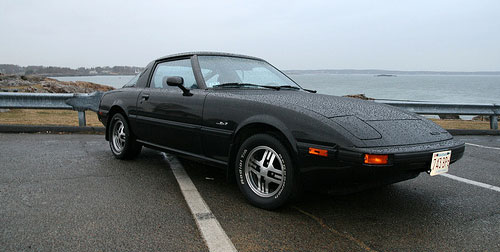
The RX-7 Story, Part I: Black

September 19, 2012 by Matt

Black RX-7

Acquired mid-October 1999, this was my first real project car. It also doubled as my first eBay purchase. On a whim while at the State Fair in Raleigh that fall, I decided to really go for this car. Aaron owned an ’86 model, the first year of the 2nd generation and a very different machine, albeit with the same “heart”—a rotary engine. I bought it in the days before eBay had a separate section of their site devoted solely to cars, so killer deals (read: bad listings) could be found by trolling the search fields regularly. Aaron happened upon the listing for the black RX-7 and tipped me off to it. There were no pictures and a very terse description of the car.

I won the auction with a bid of around $500. The car was in Shrewsbury, Pennsylvania. I talked my friend Jonathan into driving up there with me to retrieve the car. It wasn’t that difficult, seeing as how a friend of his (and unbeknownst to him at the time, his future wife) attended Messiah college nearby and he was eager to visit her. We drove the family minivan north through the night, stopping only for dinner at a roadside Blimpie’s. I left him at the college and drove back down the highway to a motel near Shrewsbury, intent on picking up the car the next day.

The following morning, after a few wrong turns I found the house and the car. The actual owner of the car (a student) wasn’t present, so I did the title transfer with his parents, who were a little perturbed at having to sacrifice part of their Saturday morning to get rid of a front yard eyesore.

Paperwork squared away, I turned my attention to the car. It hadn’t moved in a year or so and was a bit rough, with a mismatched silver front right fender. Amazingly, it started well enough and ran, at least until I got the car about 50 feet out of the driveway, at which point it went completely dead. No cranking, no dash lights; nothing. I panicked for about 10 seconds and set about trying to solve the problem. I wasn’t keen on having to tow the car from PA to central NC, so there certainly was a sense of urgency. I knew it was an electrical problem, so I rooted through the minivan to see what I could find to aid diagnosis. After some searching I came up with a spare taillight bulb and a pair of twist-ties. I rigged these together to function as a test light and poked around the engine bay of the RX-7 looking for the break in the system. Turns out a fusible link, one of the main fuses protecting the electrical system, had broken from the strain of not having had current flowing through it in some time, so I twisted the two halves of the link together, tried the car again and it fired right up. I drove the minivan back up the highway, picked up Jonathan from Messiah, and we booked it back down I95 and I85, going 80+ mph the whole way. We made excellent time, and returned home that night.

At the time, I was 20 and had very little experience working on cars, though I had a considerable amount of “theoretical” knowledge. With Aaron’s assistance and encouragement, though, I started to tear into the RX-7. A project day at his house cured a couple of electrical bugs, and he showed me how to prep and paint the fender to match the rest of the car (though I later “got happy” with a can of spray paint and ruined the day’s work). I bought a high-flow downpipe and catalytic converter to install as well, and while we were able to get it on, the rest of the exhaust system crumbled as we unbolted it, having been exposed to many northern winters. I drove it home with no catback, and marveled that such a little engine could make so much noise…

Continue reading with “Part II: Red.”

Editor’s note: This post is adapted from a “car history” post I wrote on an older blog of mine some years ago. The photo above does not depict the actual car; the only image I have of it resides in one of my parents’ photo albums and will be added once scanned.

2 Comments on The RX-7 Story, Part I: Black

My Favorite Lambo: The Urraco

September 17, 2012 by Matt

Lamborghini Lambo Urraco Uracco Urracco Red

Yup, this is the one. Forget the Miura, Countach, Gallardo or Aventador (among others); I’d walk past all of them in favor of the lowly, 2+2, slightly ungainly-looking Urraco.

I think I fell in love with it as a boy. I had the standard white Countach wall poster, and I talked my parents into buying me one of those glossy coffee tables books about the history of Lamborghini so that I could drool over more illustrations of the flamboyant ’80s supercar icon. But a funny thing happened: As nice as the half dozen Countach images were, I discovered other Lambos. The Miura had these curves, and looked so different from my beloved Countach, and in between the two there were a few other models like the Sihouette, Jalpa, Espada…and this intriguing-looking mid-engined 2+2: The Urraco.

Lamborghini Lambo Urraco Uracco Urracco Yellow

While its proportions were a bit “off” on account of the rear seats pushing back the transversely-mounted engine, the detailing was understated and tidy, and the car’s uniqueness and lack of notoriety compared to its more flamboyant stablemates was appealing, even more so now that I’ve gotten over my boyish attraction to wings ‘n things.

Lamborghini Lambo Urraco Uracco Urracco Engine Motor V8

Powered by a 2.0l-3.0l range of SOHC (and in the case of the 3.0l, DOHC) V8s, output nudged 250 hp in the later versions, good for an optimistic 5.6 second sprint to 60 mph. The driver was treated to a Porsche-like swath of instrumentation (when it worked) and handling was decently balanced, as you’d expect from the mid-engined configuration.

Lamborghini Lambo Urraco Uracco Urracco Interior Inside Cockpit Console Dash Dashboard

I think my attraction to the Urraco was finally cemented after viewing what’s probably become, for some reason I can’t quite put my finger on, my favorite Top Gear car escapade: The Budget Supercars Challenge (Season 7, Episode 4). In it, the presenters each purchase a mid-engined, Italian exotic for less than $16,000 and have to coax their second-hand thoroughbreds through a number of trials, among them a track test, dyno evaluation, serviceability contest and fuel economy challenge. All three cars— Richard’s Dino 308 GT4, Jeremy’s Maserati Merak V6 and James’ Urraco—perform miserably, but for me that’s kind of beside the point. All three cars are rare and cool and it’s just a treat to see them driving around and to get firsthand impressions and historical tidbits from the guys. The Urraco in particular stands out to me; without hesitation, it’s the one I’d drive home (assuming I could get it home). As far as quirky European supercars go, it’s just right.

Click here to view the entire challenge, in four parts.

6 Comments on My Favorite Lambo: The Urraco

The FWD BMWs Are Coming…

September 14, 2012 by Matt

BMW Concept Active Tourer FWD Brown EV Electric Car Hybrid Plug In

I can hear the PR spin now: “It’s just a concept. And it’s a hybrid. No relationship to our performance models whatsoever! Nothing to see here… Move along.”

This is how it begins, with an innocent “broadening of the product line” to compete effectively in more market segments, in the case of the BMW “Concept Active Tourer” (shown above) the burgeoning small crossover niche. And I predict, after a production version is released, a conventional non-hybrid powertrain will be offered alongside the hybrid. And slowly, gradually, that engine and chassis will underpin a new class of compact BMWs, a 1-series replacement perhaps. And with that, one of the automaker’s core principles will be compromised.

Yes, as established in my post last year on the matter, I’m well aware BMW is already responsible for the development of a FWD car in the Mini—and a good one at that—but the BMW brand itself, the car with the unmistakable double kidney grille, has remained untarnished by the inevitable dynamic compromises that come with a FWD layout. There’s simply no way to make a FWD car feel like a RWD car, and the qualities inherent in the latter have always been essential to the “BMW feel.” So again, its the Bavarian automaker’s prerogative to slap a blue and white roundel on whatever they want, but a spade can’t be made a heart, and any salesperson from the company claiming that a new FWD car “still has the same feel” as one of their classics is, well, selling something. Interested to see how this plays out.

6 Comments on The FWD BMWs Are Coming…

Mercs I Would Consider: The C111

September 12, 2012 by Matt

Mercedes C111 Orange

Okay, so being an experimental car, I can’t really consider this one from the standpoint of a possible purchase. But it’s still one of my favorite Mercedes.

Appearing in at least three distinct incarnations starting in 1969, the first two C111 evolutionary steps represented testbeds for Mercedes’ Wankel, or rotary, engine program, and the last housed the automaker’s latest high-performance diesel engine efforts. More than an engine platform, though, the C111 was an outlet of sorts for Mercedes’ engineers. The automaker’s racing program had been shuttered in the aftermath of the 1955 Le Mans disaster, and its development team was hungry to apply themselves to something more exciting than standard-issue production sedans. As it was produced, then, the C111 was trimmed and finished to a degree unheard of for an average technology demonstrator. No spartan development mule, all three generations sported a tractable engine, decked out interior, a refined chassis and even air conditioning. Indeed, as the late Paul Frère reports in this Road & Track feature article:

The C111-II is so elegant and businesslike that, with modern technology under its skin and wider tires, it would be the hit of any motor show today. No wonder that at the time, the factory received many blank checks from potential customers [eager] to acquire a replica.

Mercedes C111 Orange Wankel Rotary Engine

Despite the luxurious trimmings, all three incarnations of the C111 were very quick. The initial 3-rotor Wankel-powered C111-I’s engine pumped out a characteristically smooth 280 hp, and the II’s 4-rotor engine raised that power figure to an even 350. That was a lot of power for the late ’60s and early ’70s, and it allowed the car to reach 60 mph from a standstill in under 5 seconds, as good as any contemporary muscle car from our neck of the woods. Even the later, diesel-powered C111-III, while not quite as fast as its predecessors, set several speed + economy + endurance records.

The bodywork was steadily refined throughout the car’s evolution, and has a distinctly Teutonic, functional feel to it, kind of what a German GT40 Mark 3 might have looked like. That said, I think it looks fantastic, and as Frère alluded to in the above quote, the C111 has a kind of timeless appeal. Completely free from any Mercedes styling cues—gullwing doors excepted—the car sort of stands alone in the automaker’s history as one of the few times they really gave their engineers and stylists free rein to consolidate their expertise and innovative leanings into one car.

Mercedes C111 Wankel Rotary Engine Motor 4-Rotor

Why wasn’t it produced? As much freedom as Mercedes gave their development team with the C111 project, they were clear to point out that the car was a technology demonstrator, and had no chance of progressing beyond that stage. Also, as refined as it was, the engine technology was the C111’s real raison d’être, and when Mercedes started hitting hurdles with their Wankel engine program, instead of persevering like Mazda did, eventually overcoming most of the technical and production challenges, the German automaker decided to pull the plug and direct its resources elsewhere.

Mercedes C111 Interior Inside Cockpit Console Dash Dashboard Gauges Instruments

It’s a shame. I see the C111 as a sort of a proto-BMW M1, which was itself a kind of pre-Acura NSX: An archetype of a truly user-friendly supercar. It had some rough edges, to be sure (Frère spotlights an outdated steering system and tricky handling at the limit, among other things), but overall the C111 made a considerable effort to “meet the driver halfway,” as it were, instead of being the hot, cramped, sweaty, evil-handling supercar its Italian contemporaries were. Between its refinement, looks and technological bravery, I have a great deal of admiration for it.

Editor’s note: This post is part of an ongoing series highlighting Mercedes models worthy of enthusiast consideration. Read the other installments here:

No Comments on Mercs I Would Consider: The C111

Alluring At Every Speed:
The 2nd-Gen Chevy Corvair

September 10, 2012 by Matt

1965 Chevy Chevrolet Corvair Black

Is this the best-looking American car ever made?

Honestly—I’d take a ’65-’69 Corvair in a heartbeat over contemporary muscle cars. It’s arguably more attractive than even the C2 Sting Ray ‘Vette. Yes, I think it’s that good. Add in a generous helping of uncharacteristically daring (for GM) engineering, and it’s a done deal. Sign me up.

1966 Chevy Chevrolet Corvair Red

1966 Chevy Chevrolet Corvair Red Rear Back Taillights

The well-written Ate Up With Motor article on the history of the Corvair calls out its “Italianate curves” as a debit relative to its then-new, formidable competition—the Mustang—what with the Ford’s long-nose, short-deck proportions and less exotic styling, but I’ll take the ‘Vair hands down. The subtle hips, the rakish nose, the unadorned flanks—it’s got it.

1965 Chevy Chevrolet Corvair Engine Motor Edelbrock Carb Carburetor

While still sporting the rear-mounted, air-cooled flat six, the 2nd gen Corvair was in many ways a completely different car than the notoriously-flawed ’60-’64 1st generation. The earlier car was the subject of Ralph Nader’s career-making exposé of unsound decision-making practices at GM that knowingly produced a car occasionally difficult for the average driver to handle, but the 2nd gen was improved in every way. Gone was the rudimentary swing axle rear suspension in favor of a new multilink design, and the independent front suspension was revised as well to better coordinate with the rear, producing a car with remarkable—and predictable—dynamics for a car from Detroit. Firm up the suspension a bit, tighten the steering a hair and it could easily pass for something European.

1965 Chevy Chevrolet Corvair Interior Inside Cockpit Dash Dashboard Gauges Console

Even the cabin showed atypical restraint for the day. A clean swath of vinyl with only minor chrome fluting, the only “excessive” element was perhaps the over-instrumentation. The driver was treated to six gauges: A speedometer, tach, fuel, clock, cylinder head temp and manifold pressure. As an enthusiast who likes to have as much information as possible about the car’s current state, the plethora of gauges is actually a major selling point.

Yes, even though I’m not generally of fan of cars from my native country, I’d make a very notable exception for the 2nd gen Corvair. Lovely looks, interesting (and unique) engineering, and treats in the details. It’s a standout.

No Comments on Alluring At Every Speed:
The 2nd-Gen Chevy Corvair

On the Return of Iconic Engine Layouts

September 7, 2012 by Matt

Audi TT RS Engine Motor 07K.3 CEPA

So yeah, it’s sideways. So what? At least there’s a brutally turbocharged 5-cylinder back under the hood of an Audi (the TT RS), where it belongs.

I give Audi a lot of credit for recognizing and acknowledging their engineering legacy, and I’d like to think that it was an intentional engineering decision; in other words, that it was more than just a happy coincidence that 5 cylinders ended up working better than 4 or 6, and Audi decided to capitalize on that fact from a marketing standpoint. Whatever the case, it’s wonderful to hear the distinctive rasp of the 5-cylinder firing order again. With the configuration’s reintroduction, the German automaker establishes a real, tangible connection with their legacy—it’s more than lip service paid to some abstract tuning philosophy; the engine layout that powered their all-conquering Group B rally cars is under the hood of a current offering, in honest-to-goodness cast iron and aluminum. It counts for a lot to be able to touch, hear and experience an automaker’s history in real time.

How incredible would it be if other automakers followed Audi’s lead in fitting a car or two with an engine configuration inspired by their manufacturers’ greatest hits? BMW could roll out a “reimagined” update of their classic “big block” (M30, M88, S38) six. Nissan and Toyota could reintroduce fresh takes on their legendary twin-turbo straight sixes (JZ, L, RB, etc). Volvo could develop a modern version of their vaunted Redblock turbo 4 from the 200- and 700/900-series. Porsche could fit at least a few of their myriad flavors of 911 with an actual air-cooled flat-6, an engine that left with the much-missed 993 generation. And finally, Mazda, whose signature engine, the rotary, has most recently been given the axe, could breathe new life into their stalled 16X program.

The sad fact is, though, that in our current regulatory climate, it’s doubtful the reintroduction of any of those configurations would be possible. Ballooning front crumple zones (as well as the marketing allure of the almighty V8) killed the big straight 6, and emissions and efficiency considerations spelled the end for the air-cooled mill and the rotary. Furthermore, part of the character of those classic powerplants is wrapped up in their lo-fi technology, like single overhead cams and distributor ignition systems. With the understanding that those certainly won’t be returning, how far would a prospective “throwback” engine have to go to maintain a connection with its inspiration? In Audi’s case, the recipe was simple—5 cylinders, between 2 and 2.5 liters of displacement, and a turbocharger—but it’s not as cut-and-dried with other automakers. It is fun to think about, say, a lighter, simpler post-F10 BMW M5 with a big, free-revving naturally-aspirated straight six under the hood, but with modern materials and styling. One can dream.

No Comments on On the Return of Iconic Engine Layouts

Earthbound Spaceship: The Subaru SVX

September 5, 2012 by Matt

Subaru Alcyone SVX Blue

Let’s talk some more about the Subaru SVX. Why? Because I want to.

Yes, it’s already been featured as part of the “Underrated Lookers” series, but I think the car is interesting enough for more than just one post.

Subaru Alcyone SVX Red Rear Back

I remain fascinated by its appearance. For all Subaru’s studied weirdness, for me, the ’92-’97 SVX is the one point of intersection between actual attractiveness and the automaker’s deliberate aesthetic nonconformity. In other words, even a stopped clock is right twice a day, and the SVX represents one of those times for Subaru. The proportions are good, the slight fender flares a nice touch, and the whole car radiates a kind of pitch-perfect fighter-jet aggressiveness. Not only that, as pointed out in my earlier post, I challenge anyone to name a more spaceship-like car. Honestly—close up the wheel arches, graft on a pair of ion engines, strap in, engage the hyperdrive and you’re good to go. It’s nerd-tacular, and I love it.

Subaru Alcyone SVX Interior Inside Cockpit Console Dash Dashboard

The interior is subdued compared to the extroverted bodywork, but it still has a couple of odd touches, most prominently the decorative “door” for the stereo controls in the center console, as well as the handle-like, horizontal handbrake lever. Beyond that, it sports a nice bank of clear gauges and all secondary controls are laid out in a sensible manner.

Subaru Alcyone SVX Engine Motor EG33

The EG33 engine was Subaru’s first flat-6 fitted to a production car. A 3.3l, 230-hp mill, its basic design is very sound, but at the time of its release, Subaru had no manual transmission capable of handling its 228 ft-lbs of torque. So there was sadly no stickshift option available from the factory, even in Japan, which limited the car’s appeal among enthusiasts. Fortunately, for we shadetree mechanics, many later Subaru manuals (from the WRX, Legacy, etc) will bolt up, albeit with some modification needed to the shift rods and driveshaft. A swap isn’t an unattainable ambition, and kits even exist to facilitate the process.

Dynamically, the car is a bit of a mixed bag. Its permanent AWD system gives it sure-footed handling, but the front weight bias compromises the car’s balance, and its admittedly hefty 3,500 lb girth dampens the fun as well. That said, any prospective buyers hopefully aren’t expecting a light and lively sports car, but a larger, stylish, comfortable, competent-handling GT, and in the latter capacity the car excels. I have a penchant for cars with those attributes; add a dash of the SVX’s weirdness, and I’m sold.

13 Comments on Earthbound Spaceship: The Subaru SVX