Spannerhead Dot ComSpannerhead.com

Needs A Good Home:
Joel’s 1973 Porsche 911T

September 3, 2012 by Matt

1973 Porsche 911 911T Classic Red

My experience behind the wheel of this beauty is, to date, my only time in a Porsche. As a long-time car guy, I’d be lying if I said I wasn’t a bit ashamed of that fact. But it doesn’t take anything away from the transcendence of the event.

Joel and I had been friends for a little over a year, and I was on the verge of a significant move. As a kind of going away present, he let me tool around for a little while at the helm of the car pictured in this post, his 1973 Porsche 911 911T, now for sale.

1973 Porsche 911T Classic Red

It was everything I thought it’d be and more. The steering’s communicative nature was evident even at low speed, and there was a pleasing mechanical directness to the gearchange and the bottom-hinged pedals. I loved the overabundance of gauges spanning the dash, and the 911’s racing pedigree was evident in every response; the classic air-cooled thrum from behind me eager for more gas, more speed.

1973 Porsche 911 911T Interior Inside Cockpit Console Dash Dashboard

For those who don’t know, the “T” submodel of the 911 was the new entry level replacement for the outgoing, 4-cyl 912. Featured a slightly detuned, 140-hp variant of Porsche’s signature 2.4l flat-6, the 911T slotted in nicely below the contemporary 165-hp 911E and 190-hp 911S. The 911T’s lack of power compared to its brethren may initially seem like a turnoff, but the classic lines and handling and still present in spades, the engine still has six cylinders, and even the range-topping 911S isn’t going to win any stoplight drag races nowadays. Any Porsche is partially about the speed, sure, but the classics are more about the experience, and that the 911T delivers just as well as its stablemates.

I’d love to see it go to a good home. From Joel’s description, it’s in excellent, original condition (read: pre-restored), with only hints of surface rust in a couple of places. It deserves to be well looked after.

3 Comments on Needs A Good Home:
Joel’s 1973 Porsche 911T

Early Impressions: Mark 3 Ford Capri

September 1, 2012 by Matt

European British Ford Capri Mark 3 III Mk3 Blue Gray Grey

The year was 1988. I was 9 years old, living in southern France with my family. A third grader, I took the bus home from school every day with my best friend Timothy.

By some incredible chance, the house in which we were living was situated directly across the street from one occupied by a British family, with boys whose ages corresponded almost exactly to those of my brothers and me. Not only that, but our interests were nearly identical as well, so Timothy and were inseparable for the 2 and a half years we lived in France.

One day, though, we didn’t take the bus home. Timothy’s uncle was visiting from the UK, and instead of flying, he decided to drive his late-model Mark 3 Ford Capri, and that afternoon, picked us up from school in it.

European British Ford Capri Mark 3 III Mk3 Silver

It was low and rakish. I did like cars, to the point of having the requisite white Lamborghini Countach poster on my wall, but didn’t know much about “lesser” vehicles like the Capri. Still, I liked what I saw. Crammed in the back seat with Timothy on the way home, I remember being mildly amused by the fact the steering wheel was on the right side (this being my first ride in a British car), and beyond that, by the size of the wheel. It may be an odd thing to stick in one’s mind, but the one thing that stood out was how incredibly small it was. Beyond the car’s external shape, that steering wheel communicated an undeniable sportiness, as impractical as it must have been, and made an impression on me.

European British Ford Capri Mark 3 III Mk3 Interior Inside Cockpit Console Dash Dashboard

I’m still slightly jealous that Europe got multiple generations of the Capri while we here in the US had to make do with pony cars like the Smokey and the Bandit Firebird and the Fox body Mustang. Ours were worthwhile in a straight line, but profoundly crude with respect to handling. The Capri, on the other hand, possessed a remarkable amount of cornering sophistication, low (~2,500 lb) weight and a whole host of engine options, ranging from a miserly 1.3l 4-banger to a 185-hp 2.8l turbocharged V6. Sure, it still sported a live axle out back and it was rough around the edges compared to its pricier rivals, but its priorities were in the right place, and for that, I wish my memory of it hadn’t been isolated to my time in France.

No Comments on Early Impressions: Mark 3 Ford Capri

New 2014 Mazda 6 Looks Brilliant

August 29, 2012 by Matt

2014 New Mazda 6 Six Red

If I were in the market for a new midsize sedan, I’d pick up one of these in a New York minute.

Autoblog recently reported on the upcoming 2014 Mazda 6, unveiled this week at the Moscow Auto Show, and boy, is it a looker. The second Mazda (after the comparo-winning CX-5 mini-SUV) to feature Mazda’s new Kodo design philosophy, the new 6 solidifies the automaker’s move away from grotesque smiling grilles toward a more attractive, distinctive face. The new 5-pointed grille opening is at once lower, giving the nose a more sports-car-like profile, and more upright, lending it additional aggressiveness as the headlights sweep into the very prominent front fender bulges. While they may initially seem out of sync with the slightly more slab-sided rear flanks of the car, recall that flared rear fenders on a sedan can seem a bit cartoonish if done incorrectly (see: current Nissan Maxima) and besides, the fronts serve a visual purpose: To highlight Mazda’s traditional emphasis on handling and driving enjoyment.

2014 New Mazda 6 Six Red

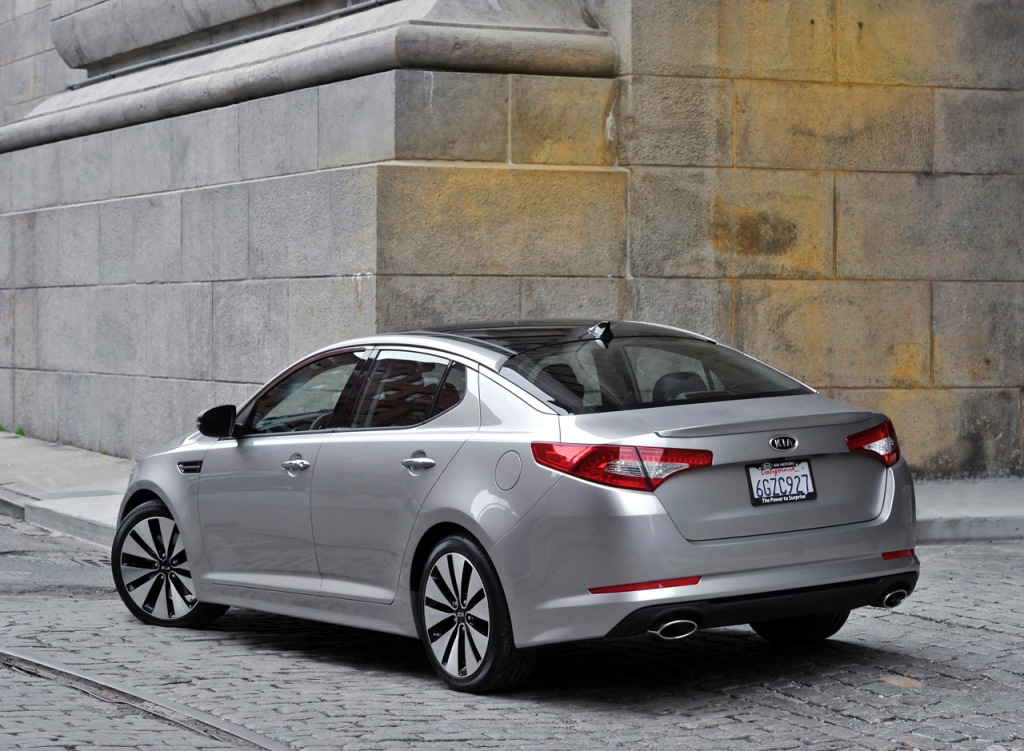
The rear, for its part, is nicely tailored and reminiscent of the very handsome Kia Optima’s. It’s also thankfully free of any trinkets and extraneous ornamentation that would quickly date the car; as a result, I have a feeling the shape will seem fresh for quite some time.

2014 New Mazda 6 Six Interior Inside Cockpit Console Dash Dashboard

The interior is spectacularly well done. It features a meaty 3-spoke wheel, pleasing lighting and detailing and a neatly laid out center stack with actual grasp-it knobs flanking the multifunction screen. I don’t think it’s overstating the case to call the new 6’s interior Audi-esque, and ’round these parts, cabin styling accolades don’t get any higher than that.

With the shape spot-on, the only potential cause for concern is the output of the engines Mazda plans to offer under the new 6’s hood. The aforementioned CX-5 won the recent Car and Driver comparo on the basis of its chassis dynamics; speed-wise it ranked dead last among its competitors. Mazda has an unfortunate history of creating brilliant-driving, yet underpowered cars, and here’s hoping the new 6 bucks that tendency. I will say things don’t look so rosy at the moment: The only engine available with a 6-speed manual is a 2.0l, 148 hp 4-cylinder. The new 6 would have to be made of feathers and aerogel for that kind of output to be able to move it at a respectable pace. There will be a 189-hp 4-cylinder option, still a rather pathetic number nowadays, but sadly it looks as though the stronger engine will only be mated to a slushbox.

If styling and cornering acumen alone were enough to secure the top spot in the hotly-contested midsize segment, I’d say Mazda hits the bulleye with their new 6. Let’s just hope the automaker’s engine choices don’t let down the rest of the car.

8 Comments on New 2014 Mazda 6 Looks Brilliant

Styling Misfires: The Chrysler Cirrus

August 27, 2012 by Matt

Chrysler Cirrus Green

I have a feeling Chrysler vehicles will appear as parts of the “Styling Misfires” series with distressing regularity. It’s unfortunate, really, given the automaker’s penchant for engineering creativity (when sufficiently funded) compared to its rivals, that its designs should be so enduringly bad.

The car spotlighted in this post, the ’95-’00 Cirrus, was kind of a big deal for Chrysler. Coming on the heels of the unlamented, epically frumpy LeBaron, it was expected to spearhead a surge of popularity for its manufacturer in the lucrative midsize segment. Designed to compete against the Honda Accord, Toyota Camry as well as the newly-introduced Ford Contour, the Cirrus had its work cut out for it.

Chrysler Cirrus Brown Auburn Maroon

And while the basic chassis dynamics were good, the car certainly wasn’t as polished and refined as its Japanese rivals. Not only that, the fascia was just hideous to behold. If it had any appeal within the current styling climate, that trend evaporated before its wheels hit the showroom floors. To state the obvious, the Cirrus looks like its bumper got clobbered and was cursed to forever carry a bloated lower lip as a reminder of the altercation. The cause must have been an all-too familiar scene from the design world: Stylists get too engrossed in their creation without pausing and taking a few steps back to examine the context of their work and ask themselves the hard questions like “What would this look like to the average passerby? What bodily feature would they immediately compare it to?” Nope—the designers must have simply put their heads down and carried on.

For what it’s worth, I tried very hard to like the Cirrus. I really did. Most automotive publications actually praised the styling direction, complimenting its “daring” and “distinctive” lines in contrast to its competitors’ more conservative shapes—and I took them at their word. Rather than trusting my intuition that what I beheld in the Cirrus was a ghastly, bloated-looking design, I distinctly remember concluding that I just must not have been able to appreciate it; that the fault lay with me; that I needed to recalibrate my taste. Contributing to this mindset was the fact that Chrysler was, and still is, the “underdog” compared to the other two, more robust members of the Big Three: GM and Ford. I liked the underdog; the idea of taking chances both mechanically and stylistically appealed to me, so I was even more predisposed to approve of the Cirrus’ design.

In the ensuing years I came to appreciate the fact (obvious to most) that even the so-called “experts” among the journalism world can be guilty of bandwagoning just as much as the rest of us, and with a more confident aesthetic sense, I realized my gut reaction to the Cirrus styling had been spot-on. Lesson learned.

Editor’s note: This post is part of an ongoing series wherein I discuss unsuccessful cars whose styling was their overlooked (or denied) Achilles heel. Read the other installments here:

4 Comments on Styling Misfires: The Chrysler Cirrus

FWD Champions: The Mazda Millenia

August 24, 2012 by Matt

Mazda Millenia White

Here’s an oddball.

The ’95-’03 Mazda Millenia was essentially an orphan: It was built on a unique chassis, and no direct predecessors or descendants. It was intended to be one of the initial pillars of Mazda’s Amati luxury brand, but when that project was shelved, the automaker decided to roll out the Millenia under their main brand as a kind of replacement for their range-topping RWD 929 luxury car. The Millenia, though, hewed to a substantially different philosophy than the 929, being smaller, lighter, FWD and with more of an emphasis on handling excellence as opposed to smooth, serene highway cruising.

Mazda Millenia White

It was never a roadburner, even with the optional 210-hp 2.3l Miller Cycle V6 (more on that later), but its chassis dynamics were typically polished and lively, a rarity for cars in its class. Also, the Millenia weighed in at a trim (for its class) 3,400 lbs, a figure that benefited performance and fuel economy.

Debits? Pretty anonymous styling, although the basic proportions are well-executed and handsome, especially in person. It has the same overall stance as my BMW E34 525i: Solid yet flowing, and perfectly tasteful. My only quibble is with the nose area: The grille is oddly placed and shaped, and the other elements seem to have been located with an arbitrariness uncomfortably recalling the contemporary Chrysler 300M. As nice as the rest of the styling is, it’s a shame Mazda couldn’t give the Millenia a more cohesive face.

Mazda Millenia Engine Motor Miller Cycle V6

The top-of-the-line V6 engine was unique. Wringing 210 hp from only 2.3 liters of displacement, it employed a variation of the traditional 4-stroke suck-squish-bang-blow process known as the Miller cycle. The idea is to reduce pumping losses during the compression stroke by holding the intake valve open for much longer, well into the piston’s upward rise, and relying on a supercharger to force the intake charge to stay inside the cylinder. The power loss from the supercharger is less than would be incurred by the piston having to compress as much of the fuel/air mixture as it would with a conventional cam profile, so the upshot is more net power from less displacement. It’s a neat idea, and it worked, giving the Millenia class-leading fuel economy with respectable power from a smallish engine, as the cost of a bit of added complexity.

Mazda Millenia Interior Inside Cockpit Console Dash Dashboard

The Millenia was treated to a refresh for the 2001 model year, with most of the emphasis going to a fascia redesign which, ironically, made the car even more bland-looking and anodyne. And when the axe finally fell at the end of 2003, after a long, eight-year model run, Mazda never fielded a replacement, ending their participation in the luxury + performance market niche.

The Millenia deserved more success. Never quite sure how to market the car, Mazda seemed to suffer from much of the same ambivalence about their own product that afflicted the early Infiniti Q45’s model run. It was a luxury car with a few novel technical tricks up its sleeve, and blessed with a taut chassis and a dash of performance, and the Japanese just weren’t sure how to take on BMW on their own turf. I’m still not quite sure they are. Perhaps with more marketing resolve the Millenia could have been pitched as a worthy contender (the chassis was certainly up to par). Pity it wasn’t.

Editor’s note: This post is part of an ongoing series highlighting FWD cars I think highly of, in spite of my overwhelming RWD bias. Read the other installments here:

3 Comments on FWD Champions: The Mazda Millenia

Thrust: The Audi B5 S4

August 22, 2012 by Matt

Audi B5 S4 Blue 1999 2000 2001 2002 Stock

Well, I love this car. I love its sleeper quality. And I especially love the audacity of its engineering: As pointed out in my “Audi’s Greatest Hits” post, at a time when performance in the automotive world in general was on the wane, and Audi in particular was still emerging from their stolid, conservative image in the US, the automaker brazenly decided to stuff a pair of turbos into the B5’s cramped engine bay alongside the AWD gear and sell it to the public. You want mechanical density? Here it is, folks.

Audi B5 S4 Silver 1999 2000 2001 2002 Stock

I can’t think of a single line I’d change on the exterior. I don’t say that about many cars. I even like the stock ride height and 17″ “Avus” wheels. Starting with the already spot-on shape and detailing of its lesser statemate, the A4, Audi added extra grille vents, side skirts and gave the S4 a much more aggressive stance overall—but not overpoweringly so. It represents the quintessential sleeper, its visual prowess deriving not so much from secondary elements as its proportions. The upshot is a much more timeless kind of style, understated but communicated in a way enthusiasts of many different automotive eras can appreciate.

Audi B5 S4 Interior Inside Cockpit Console Dash Dashboard 1999 2000 2001 2002 Stock

Audi consistently makes the best interiors in the industry, and the B5 S4’s fits right in with their pattern of excellence. The consummate driving environment, all business yet perfectly tasteful, demonstrating a mastery of materials unrivaled by any other automaker.

Audi B5 S4 Engine Motor Biturbo Twin Turbo 1999 2000 2001 2002 Stock APB AGB AZB

The S4’s “biturbo” 2.7l, 251-hp (in US trim) V6 marked the beginning of a new era for Audi vis-a-vis performance engines. Eschewing the inline-5 that had served them well for nearly 20 years, they began hanging a pair of turbos off the sides of “V” engines, starting with the S4’s and progressing through the later RS6‘s V8, and so on. Another noteworthy detail is the fact that the engine sports 5 valves per cylinder, a configuration adopted only by Audi and Ferrari, and later abandoned by both as not worth the added complexity. The benefits with respect to airflow are undeniable, though, as demonstrated by the fact that the S4’s engine is capable of generating twice its rated horsepower with the simple addition of larger turbos, some enlargement of intake and exhaust paths, and some software tuning. No changes to the engine core whatsoever.

Fitting all that kit under the hood is a masterpiece (or nightmare; take your pick) of packaging, and I stand amazed Audi decided to entrust its buyers with a level of powerplant and driveline complexity more in line with that of high-end race cars. And truth be told, the B5 S4 has developed a bit of a reputation for fragility, but when everything’s working properly under that perfectly-penned bodywork, there are few cars I’d rather own.

2 Comments on Thrust: The Audi B5 S4

Interesting Engines:
The Pratt & Whitney R-4360

August 20, 2012 by Matt

Pratt & Whitney R-4360 Wasp Major on stand

I’ll admit it. I’m an engine junkie. Despite not being an engineer by degree or trade, I’m fascinated by the myriad methods pioneers have devised to produce motive power for vehicles. So then, this post will kick off a new series aimed at discussing engines I find particularly interesting.

Let’s go for the gold in the first post: The Pratt & Whitney R-4360 Wasp Major, the largest mass-produced aircraft piston engine ever made. A 28-cylinder, 71-liter, air-cooled radial monster, the ultimate incarnation—the “51VDT”—could deliver a staggering 4,300 hp. Even the first versions of the R-4360 could crank out north of 2,500 hp. Initially “just” supercharged, the final evolution of the Wasp Major incorporated a turbocharger as well.

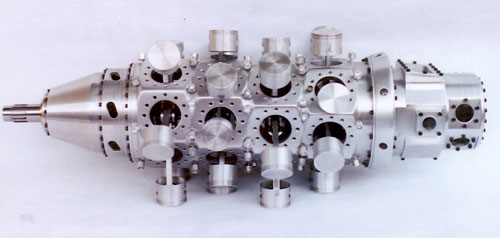
Pratt & Whitney R-4360 Wasp Major case assembly crankcase pistons

As illustrated above by a view of the engine’s crankcase, the four rows of seven cylinders were offset radially to allow cooling air to reach the rear rows; even so, there were teething problems getting temps under control in the rearmost cylinders. The mixture powering each piston was ignited by two spark plugs per cylinder, meaning a full 56-plug change was a full-day job for a mechanic. Fuel injection was in its infancy during the R-4360’s gestation, so a pressure carburetor (with a concept similar to single-point injection) metered fuel to the engine.

Applications? The Wasp Major powered some of the largest and most potent aircraft of its time, including six for the Convair B-36 Peacemaker, and four for both the Boeing B-50 Superfortress and Northrop’s pioneering B-35 flying wing. More recently, the R-4360 has found success in pylon-based air racing, the re-engined Hawker Sea Fury Dreadnought clinching gold in the Unlimited class at the Reno Air Races in 1983 and 1986.

Perhaps one of the most amazing aspects of the Wasp Major arises not from the engine itself, but from the turboprops and jet engines that replaced it. Consider, for example, that eight R-4360s were necessary to lift Howard Hughes’ admittedly gargantuan Spruce Goose just 70 feet off the water for a mile. And nowadays, a jetliner of roughly the same size and gross weight like the Boeing 777-300 is accelerated to speeds and altitudes unheard of during the Wasp Major’s heyday with just two General Electric GE90 turbofans. It says a lot for the quantum leap in efficiency and reliability that the 777’s engines are arguably less complex than the R-4360 even as they develop an order of magnitude more power. We’ve made amazing technological progress in the past 60 years, but that doesn’t dampen a bit of the Wasp Major’s fascination.

Editor’s note: This post is part of an ongoing series examining unique and significant powerplants. Read the other installments here:

15 Comments on Interesting Engines:
The Pratt & Whitney R-4360

On Nature Versus Quantity

August 17, 2012 by Matt

“We need to get back to enjoying performance because of its nature, not because of its quantity.”

— Chris Harris

Is there an Automotive Quote of the Year™ award?

I wrote about this issue more than a year ago in my “Hoping for Détente” post. And it seems like, at least in the form of the Toyota 86 (the internal code for the car variously branded as the GT-86, Subaru BRZ and Scion FR-S), that my hopes have been answered. Not fulfilled, mind you, but responded to.

Chris Harris would agree. In the clip above, the 86 emerges victorious in a three-way comparison test between it, the Nissan 370Z and a used Porsche Cayman. The reason the slowest, lowest-output car comes out on top? Harris boils it down to the accessibility of the 86’s handling limits, and the resulting driving enjoyment from steering with the throttle through turns without the danger of parking the car in the weeds. That responsive, interactive quality has been the secret to the Mazda MX-5 Miata’s success over the years (along with a myriad of classic sports cars), and Toyota/Subaru were exceedingly wise to adopt that formula rather than taking the all-to-easy route of building a Mustang GT hunter (are you listening, Hyundai?).

Interestingly, the clip dovetails nicely with another “experiment” Harris performed in which he fitted a 480-hp Mercedes C63 AMG with space-saver “donut” spare tires in order more easily induce oversteer. It was a stunt, to be sure, but he made a valid point: The loss of grip actually made the car more controllable, to a degree, simply because the handling limits were lowered into the driver’s normal sensory range. Appropriate, then, that the visuals of the C63 on donuts and the 86 driving away are so similar in that both cars seem “under-tired.” The Toyota’s tires, in particular, seem very narrow compared to the norm for its performance class. I wonder if, ironically, that isn’t one of the keys to its handling brilliance?

6 Comments on On Nature Versus Quantity

Breathtaking Le Mans Classic Photos

August 15, 2012 by Matt

Laurent Nivalle Le Mans Classic 2012 Photos Photographs Images Pictures

If you have a few minutes, stroll through this collection of stunning Le Mans Classic photos taken by Laurent Nivalle at the 2012 event. Each one is poster-worthy.

The most amazing thing about them (in addition to the obvious artistry) is the photographs’ aged quality, which makes them look absolutely, perfectly “period.” Was there a more romantic time in racing than the ’60s through the early ’80s? The cars, at least, certainly exhibited more creativity, coming as they did in a myriad of shapes, as opposed to the computer-designed homogeneity on display nowadays on any given circuit on any given weekend. For that reason, among many others, we might well consider that time a golden age.

H/t to Ray at Core77 for the link.

No Comments on Breathtaking Le Mans Classic Photos