Spannerhead Dot ComSpannerhead.com

The Opel Manta Connection

August 13, 2012 by Matt

Opel Manta A Red

I think I may have figured out my uncanny attraction to these. In a nutshell, the Opel Manta is the “cooler version” of my first car, Twinkie.

Twinkie was my 1982 Toyota Tercel. Commendably loyal, peppy below, say, 30 mph, and possessed of an endearing (yet dorky) coupe shape, Twinkie’s character forever spoiled me for anything so mundane as a boring transportation appliance. And the Opel Manta, I’ve determined, takes all the attributes that drew me to Twinkie, and amplifies them. Consider:

  • Small-ish size: Check. The Manta is barely bigger than my old Tercel and checks in at a featherweight 2,100 lbs.
  • Endearing coupe shape: Yessir. There’s nothing as appealing about the Manta as its beautifully-penned proportions, restrained and tasteful fascia and fetching teardrop profile. Lovely.
  • Peppy below 30 mph: Got it. Only offered in the US with a robust-yet-indifferent 1.9l cam-in-head 4-cyl producing a ground-pounding 90 hp, acceleration was nothing to write home about. In its defense, smoky burnouts were never really in sync with the Manta’s delicate aesthetic, and furthermore, during its 1970-75 model run, its contemporaries’ power figures were taking emissions-choked nosedives as well.
  • Snappy handling: Right on. The Manta improves on Twinkie’s admirably taut demeanor in the (low speed) twisties by being RWD and featuring rack-and-pinion steering, along with a rear sway bar and more European-style (read: firmer) suspension calibration. In its day, it was roundly praised for its chassis dynamics, and garnered quite the rally race competition pedigree.

Opel Manta A Red Rear Back Angle Taillights

Yes, I can say with a fair degree of confidence that my 5-odd year “relationship” with Twinkie primed me for my heretofore unexplained attraction to the Manta. I’ve written about it before, in the very first entry in my Ones That Got Away series, but hadn’t really figured out why I like it so much other than waxing effusive over how cool it is, and going on about how well it seems to complement my own self-image.

But now it all makes sense. One day…

No Comments on The Opel Manta Connection

The Greensboro Car Expedition

August 11, 2012 by Matt

He wanted to see a Mercedes SLS AMG. Well, we saw one. And a few other gems.

Having dropped by our local Mercedes dealership, we heard from a salesperson there was an SLS AMG in the showroom at the Greensboro store. My son is very interested in car superlatives at the moment (i.e. the fastest, the best put-together, the most expensive, etc), and having got wind of the rumor that the fastest Mercedes lived just down the road, we had to make the pilgrimage. We also took the opportunity to visit the “Porsche store” (his word for it) as well—in reality a premium performance car dealership with a variety of makes.

Click on the jump to view the photos!

11 Comments on The Greensboro Car Expedition

The Aesthetics of Racing: Ford GT40

August 8, 2012 by Matt

Ford GT40 Mark II 2 Gulf Racing

Pure function can be brutally attractive.

Even though its profile changed in detail between its four incarnations, whatever specific shape it took, the legendary Ford GT40 epitomizes the function-as-form racer aesthetic.

The Mark I and II shape, shown above, remains the most well-known GT40 variation. The car’s genesis is familiar to most car buffs: After an aborted attempt to buy Ferrari outright, a racing-victory-hungry Henry Ford II decided to build his own Ferrari beater, and after a few years of working out the kinks, scored 4 straight 24 Hours of Le Mans victories from 1966 through 1969. The body of the 427-powered Mark II, which delivered the first Le Mans victory in 1966, was a British-based Lola creation, so it was technically an Anglo-American car. Still, whoever made it, the GT40’s design is absolutely arresting (especially for the mid-’60s), devoid of anything that would compromise its singular mission. There were no wings, no frills, no fancy multi-cam V12s—just brute American pushrod force to complement the stubby, blue-collar shape.

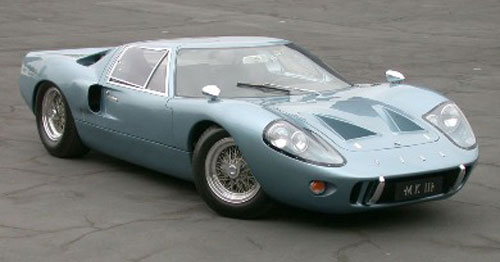
Ford GT40 Mark III 3 Road Car Blue Gray Grey

With the Mark III, shown above, Ford civilized the GT40 just a bit for road use. It’s a tribute to the basic appeal of the car’s proportions that the only major external changes came in the form of different headlight clusters and a slightly lengthened tail for additional storage. A contemporary of the groundbreaking Lamborghini Miura (the first mid-engined supercar), the GT40’s dynamics and racing pedigree easily trumped the Italian exotic’s. Sadly, only 7 were made.

Ford GT40 Mark IV 4

The wholly made-in-America Mark IV was a substantially different beast. Even though it retained the same overall look and feel as its predecessors, much of its aesthetic appeal was sacrificed in the name of additional aerodynamic refinement. Dispensing with the Lola-designed bodywork, Ford brought the design in-house, tweaking and refining the basic theme. The Mark IV kept the GT40’s signature stubby shape, and delivered the only true all-American Le Mans victory, driven by the all-star pairing of Dan Gurney and A. J. Foyt in 1967.

I don’t know that there’s even been a car quite as effective looking as the GT40. Delicate F1 racers and more modern endurance machines are typically festooned and underpinned with far more sophistication, but the results seem to be cars that politely ask the elements (air, road surface, etc) to cooperate. The GT40, on the other hand, commands respect; its shape demands compliance from its partners in victory. It gets the job done, not glamorously, but effectively, and there’s an undeniable beauty in that.

Editor’s note: This post is part of a series examining the aesthetic merits of cars designed almost wholly with function in mind. Read the other installments here:

7 Comments on The Aesthetics of Racing: Ford GT40

On Car Contentment

August 6, 2012 by Matt

Curvy Road

How can a sports car driver ever be happy with their car?

Sports cars, by and large, are about speed. Speed in the twisties, or speed down the strip on a Saturday night, even speed to a halt (braking). But here’s the thing many of us realize, especially after embarking on our car’s modification program: There will always be someone faster. There will always be cars that cling to the corners more tenaciously, are more direct in their responses, and hook up better off the line. How does one reach automotive contentment, then? How can you be really happy with your car when you’re annihilated at a stoplight race or humiliated around the road course? Can you be?

The key I think is to own a car that is special to you for reasons unrelated to pure speed. A car that agrees with you. A car that feels like home when you sit in it and lets you breathe more deeply when you sink into the seat after a hard day at work. A car that makes you smile just tooling around town at 25 mph. A car that is your car.

I used to ponder the owner loyalty of cars I was familiar with—the FB RX-7, the Z-car, FD RX-7, the Mark 4 Supra, etc… and why for example many, many first-gen RX-7 owners will hang onto their cars through thick and thin, whereas more than a few Mark 4 drivers go through a couple of cars in a year, and I think there’s more at work than simply the financial ability to buy and sell cars frequently. For a lot of owners, there’s something the FB has that the Mark 4 doesn’t (and vice-versa, of course), counterintuitive to many of us who are acquainted with the latter car’s prowess, and I think those subtler qualities are lost on a lot of the performance-fixated automotive community.

We’re all addicted to speed, sure, but that intangible special quality of a car we’re really attached to is beneficial in more than one way, I think. It’s that knowledge, that feeling, that promotes a sense of contentment when we’re approached a light and revved on and we decline to go, just knowing that we don’t have anything to prove. It’s that knowledge that makes us humble about our cars, and fosters an atmosphere in which we can genuinely appreciate others’ cars without getting defensive. We see our car’s flaws, to be sure, but somehow they’re okay; they’re inconveniences cheerfully borne.

And that’s what made me keep the Supra. With the addition of a few mods, I felt myself getting caught up in the Great Speed Race™, uncomfortably so, and wanted an “out,” another car where it might be easier to sense its other endearing qualities upon an initial drive, and I immediately gravitated towards my first automotive love (the FB). But then I realized I could have that with the Supra too. All I had to do was to re-experience what made the car special to me.

It was a cold night when I slipped into the perfectly contoured seat, surveyed the dash, with all the controls and switches ideally placed. I turned the key, the car started with an elastic smoothness and settled down to a rock-solid 700 rpm idle. I flipped the lights on; the headlights popped up and the gorgeous analog gauges were lit up with a pleasingly pale green. I gripped the thick steering wheel and rested my hand on the shifter. Everything felt substantial, solid. The car just fit me. I thought about the way the car looked and the image that projected—not the flashiest, most curvaceous body style, but understated, well-proportioned, and attractive—and I thought about my own self-image. My impression of the car and my concept of what I wanted to project lined up perfectly. It agreed with me; it was home—and I wasn’t even moving. After that moment even the metallic rip of the inline-six up to redline and the whistle of the turbo on the way home were just fluff—the car and I shared a bond deeper than raw speed, and any thoughts of parting with it were pushed from my mind.

What makes your car your car?

Editor’s note: This post was originally written in November 2003 and published in a LiveJournal automotive community. Ironically, I would unload the car within a year, but that was more due to shifting priorities in general rather than any dissatisfaction with the car itself.

6 Comments on On Car Contentment

FWD Champions: The Citroën SM

August 3, 2012 by Matt

Citroen SM Gold Bronze

Behold, one of the coolest cars ever made (even Automobile magazine agrees with me): The Citroën SM.

Featuring a far more tasteful, structured shape than the technically groundbreaking yet gothic and overwrought DS, the SM was Citroën’s performance model for the duration of its 1970-1975 model run. Developed during the French automaker’s partnership with Maserati, the SM was fitted with one of the Italian company’s 2.7l, 170-hp V6 engines, later bumped up to an even 3.0l and 180 hp. Paired with a bantamweight 3,300-lb car, the V6 delivered competent acceleration and top speed for the day.

Citroen SM Black

The SM’s engine was oriented “backwards” behind the front axle line, in the same manner as the engine of the later Saab 900. This mechanical configuration minimized FWD’s inherent weight distribution shortcomings and made room under the hood for the car’s complex hydraulic system, by then a Citroën trademark and arguably the key to its overall excellence.

Citroen SM Engine Motor

The SM’s hydraulics powered most major peripherals under the hood and within the chassis, including steering, braking and the self-leveling suspension system. The fully-powered steering, in particular, was a technical tour de force in the sense that the hydraulic power provided the driver feedback normally communicated by the suspension geometry. The result was that the front suspension could be optimized for roadholding alone, without having to compromise in ways the undercarriages of conventional cars do by incorporating a self-centering quality, for instance. No, in the SM’s case, the hydraulic pressure centered the steering automatically, allowing the front suspension to be fully optimized to maintain as consistent a contact patch as possible at all times. Brilliant, really.

Citroen SM Interior Inside Cockpit Dash Dashboard Console Shifter Brown Maroon

The upshot of all the technical trickery was, for its day, an unrivaled blend of roadholding, stability and ride comfort, especially for a FWD car. The SM’s mechanical uniqueness alone guarantees it a spot in the Cool Car Pantheon™, but add to that forward-looking yet timeless design, inside and out, and consider its rarity and quasi-exotic cachet, and the SM quickly rises to the level of the all-time greats. I want one.

Editor’s note: This post is part of an ongoing series highlighting FWD cars I think highly of, in spite of my overwhelming RWD bias. Read the other installments here:

4 Comments on FWD Champions: The Citroën SM

Rumors Abound Concerning
Potential New Mazda RX-9

July 31, 2012 by Matt

Mazda RX-9 Concept Red

Time for a bit of rotary news.

Autocar reports some insider knowledge of Mazda’s plans for an upcoming successor to the recently-axed RX-8 and legendary RX-7.

If the rumors are true, the new RX-9, as it’s likely to be called, will be built around the Japanese automaker’s latest refinement of the rotary, known internally as the 16X. Unlike nearly all previous generations of Mazda’s iconic engine, the 16X features a longer equivalent of a rotary’s stroke, greatly increasing its efficiency and alleviating much of its bemoaned lack of low-end torque.

Design-wise, now that Mazda has thankfully abandoned its cartoonish Nagare design theme in favor of the much handsomer Kodo styling philosophy, there’s no reason to expect the RX-9 to sport a grotesque, grinning maw. No, I’m hopeful the upcoming sports car will feature a more aggressive variant of the recently-released CX-5‘s attractive nose.

All the pieces are in place: Brand-new Wankel engine, appealing design direction… All that’s left is to build it. Substantiate the rumors, Mazda!

Editor’s note: The car pictured at top is a Mazda concept and doesn’t officially represent a definite design direction for a new production sports car.

2 Comments on Rumors Abound Concerning
Potential New Mazda RX-9

Styling Misfires: The Chrysler 300M

July 29, 2012 by Matt

Chrysler 300M Silver Gray Grey

This truly is a case of the Emperor’s New Clothes. Astonishingly, the Chrysler 300M was Motor Trend‘s 1999 Car of the Year and placed in the coveted Car and Driver 10 Best for both 1999 and 2000.

I have one question: Did they look at it? If they did, what other explanation could there be for the accolades it earned? Were the editors paid off by the automaker’s marketing department? Or was there some other reason for the peer pressure that seems to have prevented them from calling Chrysler on their styling disaster?

Chrysler 300M Black

Mercifully, the car was only with us for 6 years, from 1999 to 2004. An example of Chrysler’s “cab forward” platform architecture, the 300M’s front wheels were powered by a 255-hp V6. Billed as a sports sedan and formulated in large part for the European market, its handling, power and interior space were by all accounts respectable.

But for heaven’s sake, just look at it. The 300M’s length was reduced for more size-conscious European sensibilities by simply lopping the end off the trunk, creating a massive disconnect with the rounded lines everywhere else on the car. The overall proportions are blobby and distended, and the nose, oh the nose. The car’s fascia seems more like a random collection of shapes sprayed onto the front bumper with no relationship whatsoever to each other. It’s just a disaster.

So the question remains: Why on earth did no automotive journalist pipe up and topple Chrysler’s stylistic house of cards? I suppose we’ll never know.

Editor’s note: This post is part of an ongoing series wherein I discuss unsuccessful cars whose styling was their overlooked (or denied) Achilles heel. Read the other installments here:

9 Comments on Styling Misfires: The Chrysler 300M

New Road Tests Reveal
a Potential Winner in Cadillac ATS

July 26, 2012 by Matt

2013 New Cadillac ATS Red

The first road tests from Car and Driver and Autoblog are in, and the consensus seems to be that aside from a few questionable choices, the new Caddy ATS is more of a contender for the entry-level sports sedan throne than any American car has ever been.

The high points? Ideal (50:50) weight distribution, chassis dynamics including beautifully predictable and linear handling response and communicative steering. The presence of a manual transmission option paired with at least one engine option (the mid-range 270 hp turbo’d 2.0l 4-cylinder) drew praise as well. The publications also agree that the interior, and in particular the nav system are well done. The whole package, too, seems nearly perfectly calibrated on European tastes, which bodes well for conquest sales, since potential buyers of the BMW 3-series or Audi A4 will be already keyed into that ethos.

2013 New Cadillac ATS Interior Stickshift Manual Trans Transmission Tranny

Both reviews seem to agree that the lowest-power engine option may be a mistake. The 200-hp, 2.5l Ecotec 4-cylinder is badly matched to the car, and the two higher-power engines complement the chassis better, and motivate its 3,450-lb bulk much more competently. Also, in the opinion of this pundit, if Cadillac truly wants to compete on the same level as their European counterparts, they need to offer a manual transmission option with all engines, regardless of a the meager percentage of buyers that will actually elect to check that box on the option sheet. It may not make much sense in term of the bottom line, but it’s a matter of perception, and as much as the ATS is billed as a game-changer, Cadillac should have gone all in and spent the bucks to fit the stickshift to all the powerplants.

Finally, I just want to pause for a minute and reflect on the minor miracle that this car exists as all. Back in January, the car was unveiled, I expressed my hope that after 40-odd years of trying, Cadillac would actually “get it” and succeed in creating a viable alternative to the classic European sports sedan, and based on the road tests, it seems like they may finally have. It’s sort of the automotive equivalent of the Red Sox finally winning the World Series after the decades-long “curse.” Eagerly anticipating the first comparison test…

4 Comments on New Road Tests Reveal
a Potential Winner in Cadillac ATS

In Defense of Manual Chokes

July 24, 2012 by Matt

Choke Knob

Thought about this whilst mowing my lawn Sunday afternoon. The mower had run out of gas in the middle of the back yard, and after a refill, it took me a good minute and a half of yanking on the cord to restart it. The reason for the difficulty? The automatic choke on the mower’s carburetor had reset itself and was delivering a rich mixture to an already-warm engine. Well, that and the float bowl was drained from having run out of gas… But I digress.

It used to be the case that almost all carbureted cars were fitted with a knob or lever somewhere in the cockpit that gave the driver control over the carb(s)’ choke. What does a choke do? In simple terms, it controls the ratio of air to fuel entering the engine. A cold engine needs a rich mixture, and a warm engine needs a lean mixture. Upon a cold startup, the driver would engage the choke, richening the mixture, and gradually back it off as the engine warmed.

But modern engine management has superseded all that. A fuel injection system’s electronic brain controls the A/F ratio far more precisely than a human ever could, and in response to the direct needs of the engine, not a driver’s vague sensing of those needs. Also, unlike another “holdover” from days when drivers had more control over their vehicles—the manual transmission—with which there are substantial, objective benefits over an automatic, there’s absolutely no downside to computer control over the mixture. From an engineering and practical standpoint, EFI is a lock.

So what’s the point? Well, truth be told, this post really is the equivalent of an audiophile pining for the added character of a vinyl record over the cool sterility of the thoroughly superior compact disc. As with carbs in general, the patina of a manual choke control’s presence engages the driver with the car in an irreplaceable way. Yes, it helps to know a bit more about the inner workings of the engine, and no, I wouldn’t pine for the good old old OLD days when drivers had to manage non-synchromesh gearboxes or control spark advance, but so help me, I do miss that little plunger knob on my old RX-7’s dash that read “CHOKE.” Heck, it even had a vacuum servo to retract it in case I forgot to when the engine warmed up, but just knowing it was there…

With respect to how much we let our cars “do for us,” I’m convinced everyone has their sweet spot. Again, there are certain functions I’m more than happy to let automated systems handle. But for my part—and maybe it’s a comfort/security thing—a few more buttons and controls, such as the aforementioned choke knob, would be welcome.

2 Comments on In Defense of Manual Chokes