Spannerhead Dot ComSpannerhead.com

Mercs I Would Consider: The W124 500E

April 3, 2012 by Matt

Mercedes Benz 500E E500 W124 Hammer AMG Black Gray Grey Gunmetal

Mercedes’ first true executive cruise missile to be factory-sanctioned (as opposed to built by aftermarket tuner AMG), the 500E established the template for all future fast Mercs.

Developed in conjunction with Porsche for a ’91 model year debut, the 500E (or E500 as it was renamed during its last year of production in ’94) is a true Autobahn siege weapon. The 32-valve M119 V8 was bumped out to 5.0l, delivering 322 hp and 354 lb-ft of torque, hustling the 3,800-lb sedan to 60 mph in well under 6 seconds. Everything else about the car was upgraded as well, from the reinforced 4-speed auto transmission to the suspension and brakes, both appropriated from Merc’s top-of-the-line SL roadster. Steamroller wheels and tires were crammed beneath flared fenders and the ride height was marginally lowered, completing the package.

Mercedes Benz 500E E500 W124 Hammer AMG Engine Motor M119 V8

Those who’ve driven the 500E say the raw numbers only tell part of the story. On paper, its archrivals the Audi S4 and BMW M5 may be able to keep up, but the Merc has more than a liter of displacement on both of them, and the M119’s midrange torque is torrential and unrelenting, in contrast to the S4 and M5’s more peaky powerplants. Couple the wide, flat torque curve with Mercedes’ signature billet-like body structure and you have the automotive definition of an iron fist in a velvet glove.

Mercedes Benz 500E E500 W124 Hammer AMG Interior Inside Cockpit Console Dash Dashboard

In a way, the 500E is sort of the Buick Grand National of the German luxury automaker set; like the Grand Nash, it follows its country’s native “performance rules” to a tee: Understated styling, fine-tuned for Autobahn operations, yet also providing functional and luxurious accommodations for four businessmen. Its looks are based on a harmless family sedan’s, but have been injected with an extra dose of aggression. And like the Buick from the Dark Side, knowledge of its true capabilities is reserved for a subset of the car enthusiast scene in general. The 500E isn’t quite a complete sleeper in the sense that its fender flares and other tweaks certainly display an intimidating stance, but as with the GN, it perfectly walks the tightrope between showing too much and not enough, and for that, it earns my admiration and desire.

Editor’s note: This post is part of an ongoing series highlighting Mercedes models worthy of enthusiast consideration. Read the other installments here:

4 Comments on Mercs I Would Consider: The W124 500E

Datsun 240Z Restoration:
Meat on the Wheels

April 1, 2012 by Matt

Datsun Nissan 240Z 260Z 280Z Z-Car Tires Wheels Slotted Mag BF Goodrich Radial Comp T/A

Finally got the Z’s new shoes on. Vintage-looking BF Goodrich Radial T/As in size 225/60-14. My dream tire for the car.

The slotted mags cleaned up pretty well. The lug nuts still have a good deal of brake dust on them, but those are relatively cheap to replace outright. I also need to get a set of center caps for the wheels.

Datsun Nissan 240Z 260Z 280Z Z-Car Tires Wheels Slotted Mag BF Goodrich Radial Comp T/A

225-width tires are a lot of meat for a 2350-lb car. They’re about as much tire as can be stuffed on a 7-inch-wide wheel. From what I gather, the tires are made equally with looks and performance in mind (maybe a bit more in the looks department), so they should perform well, if not spectacularly. The picture above illustrates the need for an air dam as well. The front of the car simply looks too light with just the valence.

Datsun Nissan 240Z 260Z 280Z Z-Car Tires Wheels Slotted Mag BF Goodrich Radial Comp T/A

The car most likely needs a drop as well. In fairness, there are no fluids in the engine bay at the moment, nor are there carbs. So that lack of weight accounts for some of the front fender gap. The side rub strips are coming off, too; a gentleman in the local Z club is interested in them.

Datsun Nissan 240Z 260Z 280Z Z-Car Interior Inside Cockpit Console Dashboard Dash Red Auburn Burgundy

Snapping pictures this afternoon, I realized I hadn’t taken a good clear one of the interior recently. Some issues that need to be addressed include the missing horn pad, cracked dash, cracked center console, tarnished plastic bits, shredded shift boot and ripped driver’s seat bottom. I’ve got a replacement for the latter, but the rest of the stuff will have to be sourced.

Next up: Dropping the fuel tank! What joy is mine… Stay tuned.

Editor’s note: This post is Part 12 of an ongoing series chronicling my efforts toward the restoration of my 1972 Datsun 240Z, originally my father’s. Read the other installments here:

12 Comments on Datsun 240Z Restoration:
Meat on the Wheels

Aaron’s FD RX-7: Bringing It Back

March 31, 2012 by Matt

Mazda RX-7 RX7 FD 3rd Gen Generation Montego Blue Touring Repair Restoration

Took a little detour today to pay a visit to my friend Aaron and his labor of love: A neglected/abused ’93 Mazda RX-7 Touring.

Aaron and I have both been rotary engine enthusiasts for ages, but he goes back even farther than me—his first car was an ’86 RX-7 GXL. His uncle was the car’s original owner, and he had replaced it with a 3rd generation car, giving his nephew rides and creating a strong sense of “someday…”

And after years of pining, Aaron finally picked up his erstwhile dream car a little less than a year ago. We’ll charitably call the seller a younger individual from backwoods West Virginia. He had festooned the car with diametrical opposite of everything that really fits the car’s character; a giant subwoofer box, huge rear wing, ugly body kit, heavy aftermarket wheels and a nitrous system pretty much kill all an FD RX-7’s innate “driver’s car” appeal, no mean feat. On top of all that, the car had sat immobile outside for several years before the seller decide to unload it. So Aaron got a deal, but had his work cut out for him in restoring the car’s luster.

Click here for more pictures!

4 Comments on Aaron’s FD RX-7: Bringing It Back

Infiniti Emerg-E Concept:
Mid-Engined Bandwagon

March 29, 2012 by Matt

Infiniti Emerg-E EmergE Concept Show Car Silver

It’s ironic the new Infiniti Emerg-E is called a concept car. After all, a concept is supposed to showcase new engineering solutions or styling directions for an automaker, and the Emerg-E offers absolutely nothing original on either front.

Infiniti Emerg-E EmergE Concept Show Car Silver

First, the design. For an easy Emerg-E recipe, take one part Jaguar C-X75 concept car, a dash of Lexus LF-LC grille, and a soupcon of new Acura NSX proportions. Maybe tweak a line or two here or there, slap an Infiniti badge on the nose, and voilà: Your Emerg-E. It’s actually quite amazing the Japanese automaker didn’t anticipate design critics in the industry immediately perceiving the similarities, especially since the three cars listed have all been released fairly recently, and are thus fresh in everyone’s memory. The whole affair reinforces a perception Infiniti have created for themselves over their twenty-plus years of existence: That of a car company in a perpetual state of catching up, of nipping at the heels of their competition, cribbing their ideas where necessary but unable to put forth anything truly original on their own. Design-wise, Infiniti’s new concept does absolutely nothing to dispel that notion, and I’m surprised more automotive news outlet aren’t calling them on it besides little comments here and there, such as, “[T]he nose looks a bit long, and incongruously, it seems to offer a riff on the spindle grille that Lexus is rolling out portfolio-wide” from Autoblog article linked to above. C’mon, guys. This kind of photocopied styling is going to continue until a design gets truly and deservedly panned. I hope I’m not alone in this.

Infiniti Emerg-E EmergE Concept Show Car Interior Inside Cockpit Console Dash Dashboard

Under the skin, the copycatting continues. An oh-so-trendy pair of 200 hp electric motors deliver power to the rear wheels, batteries recharged by a 1.2l gasoline engine, much like the system in the Chevy Volt. I suppose Infiniti really didn’t have any original ideas here either, since every new shiny vehicular object on a rotating pedestal has been powered by a collection of electric motors for several years now.

I want to like Infiniti; I really do. They were kind of awesome once, with their “Japanese BMW” ambitions, but somewhere along the line they lost a creative spark. And if they’re ever really going to experience a breakthrough in the marketplace, they’re going to have to recover it and put forth something truly groundbreaking and visionary. The Emerg-E concept isn’t it.

No Comments on Infiniti Emerg-E Concept:
Mid-Engined Bandwagon

2013 Ford Fusion:
An Aston for the Masses?

March 27, 2012 by Matt

2013 13 Ford Fusion Red

Forget the joke car that is the Aston Martin Cygnet; this is the real “economy Aston.”

An alternate subtitle for this post could be, “If you’re going to crib styling details from another brand, pick the automaker known for making arguably the best-looking cars in the world.” Ford’s 2013 Fusion is a masterstroke, really, and a key it’s-so-obvious-why-didn’t-we-do-that moment for Ford’s rivals. The challenge for the Detroit giant, perhaps, was to design a car that hewed closely enough to the sultry Aston look without being an outright photocopy of the big British GTs, and I think they’ve pulled it off. Out of necessity, the Fusion’s proportions diverge from those of their vastly more expensive inspiration, and the grille shape, while familiar, isn’t pinched in the corners in the classic Aston tradition, so it’s different enough to be distinct.

2013 13 Ford Fusion Red Rear Back

Even the rest of the car’s styling has Aston overtones, from the chrome strip surrounding the window area to the cohesive shape to the high-mounted, monoblock taillights. It’s a design that will still look fresh in 20 years time, which is more than can be said for most luxury cars, let alone econoboxes, which usually age very rapidly.

2013 13 Ford Fusion Interior Inside Cockpit Dashboard Cluster Instruments Console Stereo

Unfortunately for we enthusiasts, the good news—and Aston similarities—mostly end with the styling. The engines offered will be a triplet of 4-bangers, the lowliest one naturally-aspirated and the other two turbo’d, with power outputs from the mid-100s to the mid-200s. A manual transmission won’t be mated to the top-shelf engine (it will be available for the other two), although AWD will be an option. A couple of hybrids (one closer to a pure electric) round out the powerplant choices. All that is fine and good, and no doubt covers the waterfront of popular demand, but the absence of a sport package or stickshift option with the hot engine means, at the very least, that the Fusion won’t initially cater to the enthusiast crowd. We can hope, then, that Ford chooses to offer a Fusion SHO or SVT or some such a year or two out—a number of spicier packages would nicely complement the wide range that’s available for the Mustang. At least the car is built on the European Ford Mondeo plaform and has that Euro “tautness” built in. That’s something.

No Comments on 2013 Ford Fusion:
An Aston for the Masses?

Unpredictable Deluge:
The 2012 Malaysian Grand Prix

March 25, 2012 by Matt

2012 Malaysian GP Grand Prix Sepang Race Track Map Circuit Diagram Layout Schematic

The second round of the 2012 Formula 1 championship at Sepang in Malaysia was an eventful one, if only because of the weather.

Most of the kinks having been worked out of the new 2012 cars, qualifying was less a parade of second-stringers than in Melbourne a week ago. For the second straight week, Lewis Hamilton clinched the pole, flanked by his teammate Jenson Button for a solid McLaren front row. If this season seemed to be shaping up to be dominated by McLaren in the manner last year was owned by Red Bull, and specifically Sebastian Vettel (who qualified 6th this week), the actual race would debunk that notion.

Malaysia’s unpredictable weather not only meant the rain came and went within the span of half an hour, it also made some parts of the circuit relatively dry while others were practically flooded. The net result was that tire strategy and driving skill came to the fore like it had in few other F1 races in recent memory.

Cars switched continually between full wet tires and intermediates, some drivers opting for slower but safer full wets, and others electing to continue on the intermediates in the hopes the rain would subside and they would save themselves a pit stop. And after much shuffling of the field and a remarkably low number of retirements given the poor conditions, along with a full stop of the race when the downpour was at its most intense, Ferrari driver and two-time world champion Fernando Alonso emerged far ahead of the rest of the field, tailed only by rookie Sauber driver Sergio Perez. The latter put up a good fight against the faster Ferrari, but ran wide during an attempted overtaking maneuver late in the race and had to concede the win to Alonso.

I was pleased with the outcome. I like Ferrari’s quasi-underdog status this year, and Alonso is an excellent, solid driver whose talent has been proven in a number of different machines. It was a hard-earned win, and will hopefully inject some confidence (as if any were lacking) back into the Maranello team after a few seasons nipping at the heels of Red Bull and McLaren.

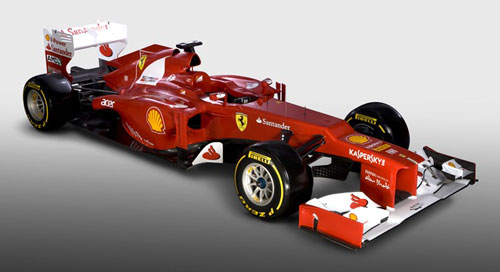
On an aesthetic note, I noticed something about the cars that had been built into their design since the beginning of the season, but I just now caught: Most of them are shovel-nosed, like so:

Ferrari 2012 Formula 1 F1 Race Car Red Type 056 56 Alonso Massa

Apparently, there was a regulation change that lowered the maximum height of the nose, but retained the max height of the structure supporting the driver, and as a result, most constructors have adopted a “stepped” nose design. It may be functional, but good gosh, can you say “Ugliest F1 cars ever?” They’re just terrible.

No Comments on Unpredictable Deluge:
The 2012 Malaysian Grand Prix

Underrated Lookers: The ’93-’01 Subaru Impreza

March 23, 2012 by Matt

Subaru Impreza 2.5RS Blue

A discussion of the Subaru Impreza could have fit into a couple categories: The one it’s featured under, Underrated Lookers; or another one, Sophomore Slumps. The grounds for its inclusion under the latter would been the atrocious, bug-eyed styling visited upon the second-generation car; however, apart from its looks, the 2nd gen is actually a brilliant machine: relatively lightweight, tossable, simple, rugged and easy to tune for power. It certainly isn’t slumping as far as its dynamics. So, by process of elimination, the first-generation ’93-’01 Impreza slots into the category you see; and I might add, one that it fits very well.

Subaru Impreza 2.5RS Blue

It’s one of Subaru’s most cohesive designs. Even with the addition in later years of rally-racing-themed scoops, vents, spoilers and lighting, the basic shape still looks understated, handsome and capable. Chiefly responsible for the ’93-’01 Impreza’s visual impact are its simple-yet-aggressive grille treatment, its athletic stance and especially its subtly-flared fenders, which give the car an ever-so-slight waisted look. The effect emphasizes Subaru’s characteristic AWD system and the fact that tractive power can be transmitted through the tires’ contact patches at all four corners. The fender flares also make the car look lithe, agile, nimble and playful. It’s a car that invites a drive, in other words.

Subaru Impreza 4 Four Door Silver

Even the four-door form looks fresh, as the automaker wisely decided to retain all the key styling features from the coupe version. Both body styles shared all underpinnings, in the same way that BMW 3 Series coupes and sedans are mechanically identical, and to this day I (and most enthusiasts) lament the fact that Subaru declined to market the very fast, turbocharged variants of the Impreza—the WRX and WRX STI—in North America (the rest of the world got them). No, we had to make do with a naturally-aspirated, 165-hp 2.5l flat-4 and wait until the arrival of the 2nd generation car for forced induction and real speed. So we American enthusiasts are placed in the awkward position of having to decide between looks (1st gen) or factory speed (2nd gen). Unless, that is, one was willing to undertake an engine swap and combine the best of both, which in this case might be the way to go for the Subaru buff who wants to construct a modern classic.

Editor’s note: This post is part of an ongoing series featuring cars whose design I find appealing, in contrast to mainstream opinion. Read the other installments here:

No Comments on Underrated Lookers: The ’93-’01 Subaru Impreza

Datsun 240Z Restoration:
Inspiration (Sort Of)

March 21, 2012 by Matt

Triad Z Club Lineup Datsun Nissan 240Z 260Z 280Z Greensboro Winston Salem High Point

Well, I had good intentions.

Last night, I brought my good camera to my second monthly Triad Z Club meet, and even arrived a bit early, hoping to snap some nice pictures of Z-cars for inclusion here, but…on the way to the meet, the sky decided to fall down.

Absolutely torrential spring rains pelted my car on the highway, and cleared up abruptly a few miles before my exit, only to start again once I reached the meet location. Several brave souls had actually driven their Zs, but I had to rush inside when I arrvied, and it was dark and still drizzling when we left. So none of the pictures I did take are of display quality, to say the least.

Triad Z Club Lineup Datsun Nissan 240Z 260Z 280Z Greensboro Winston Salem High Point

In their place, then, I present a few photos of previous year Triad Z Club meets, generously forwarded to me by the club’s president. There are many more; I just picked out several of the better ones. Hopefully they convey a sense of how significant membership in a local group can be when it comes to maintaining motivation during a long restoration project. I attend the meetings as much for the camaraderie as for the chance to see “my car, done” in the flesh at least once a month.

Triad Z Club Lineup Datsun Nissan 240Z 260Z 280Z Greensboro Winston Salem High Point

The silver lining to the whole rainy evening (besides the conversation) was the fact that I’m tentatively slated to take over some, if not all, of the club website-related responsibilities, including putting together an e-mail list or online forum. I’m excited to be able to contribute to the group in such a way.

Editor’s note: This post is Part 11 of an ongoing series chronicling my efforts toward the restoration of my 1972 Datsun 240Z, originally my father’s. Read the other installments here:

1 Comment on Datsun 240Z Restoration:
Inspiration (Sort Of)

Ferrari 400, 400i and 412:
Forgotten Big Ferraris

March 19, 2012 by Matt

Ferrari 400 400i 412 GT 2+2 Silver

Most big Ferraris are usually overlooked anyway, deferring to their smaller, faster siblings when it comes to headline-grabbing, but Ferrari’s ’76-’89 400, 400i and 412 (collectively known as the 400-series) were especially demure. A certain flamboyance being a key quality of the brand in general, it’s easy to see why the 400-series faded into the background.

Ferrari 400 400i 412 GT 2+2 Brown Rear Quarter Back Taillights

Sharing a model year range identical to another big coupe, the BMW E24 6 Series (I’m a former 6er owner, so I immediately made the connection), the initial Ferrari 400 was a larger-displacement evolution of the awkwardly-named 365 GT4 2+2. Retaining that model’s mold-breaking Pininfarina styling, the initial 400 touted a 335-hp 4.8l V12, motivating the 3,300-lb car to 60 mph in around 6 seconds. The engine delivered the power to the ground through a standard-issue 5-speed manual or, in a Ferrari first, through a 3-speed, GM-sourced automatic transmission. In fact, the optional presence of the latter is perhaps the 400-series’ best-known attribute among car buffs in general; mention the car and it’s fair bet you’ll hear a comment along the lines of, “Oh yeah, that was the first Ferrari with a slushbox, right?”

Ferrari 400 400i 412 GT 2+2 Interior Inside Cockpit Console Dashboard Dash Seats

Leaving aside the open question of whether an automatic genuinely better matched the big GT’s demeanor than a manual, or if it was just a capitulation to the effort-averse tastes of the all-important American market, I’m convinced the car itself was a diamond in the rough. Especially considering its Ferrari stablemates like the yuppie-ish Mondial or cartoonish Testarossa, the 400-series shone for its conventionality. The Italian automaker had waited until the mid-’70s—the last possible moment—to jump on the mid-engined bandwagon, and it would take the arrival of the Acura NSX in 1990 to convince them that it took more than simply dropping an engine amidships, with little attention paid to driveability or ergonomics, to make a compelling supercar. Thus, in the intervening years, the mid-engined Ferraris were comparatively half-baked, in contrast to a formula the automaker knew and could execute as well as anyone: Front-engined V12 + RWD. So the 400, 400i and 412 benefited greatly from Ferrari’s mastery of that layout.

Indeed, even if the ultimate 412 weighed perilously close to 4,000 lbs, dashing any expectations of a lithe and nimble corner-carver, the chassis was graced with double wishbones all around and delivered as polished—if not hair-raising—a driving experience as any Ferrari had up until that point. Also, even if its boxy, angular lines are resolutely stuck in the ’70s and ’80s, Pininfarina aced its proportions and penned a handsome, somewhat timeless shape that looks smaller than its mass would suggest. No, Ferrari’s 400-series deserves more recognition than it received in its day, and it has all the earmarks of a future classic.

2 Comments on Ferrari 400, 400i and 412:
Forgotten Big Ferraris