Spannerhead Dot ComSpannerhead.com

Strong Debut for McLaren:
The 2012 Australian Grand Prix

March 18, 2012 by Matt

2012 Australian GP Grand Prix Melbourne Circuit Track Race Map

No nerves for McLaren’s Jenson Button during the first grand prix race of the 2012 Formula 1 season today in Melbourne, Australia.

After all the usual off-season F1 drama (team/driver clashes, name changes, calendar shuffles, etc), Button, the ’09 F1 world champion, showed that he’s still at the top of his game by notching a solid win for McLaren, his teammate (and ’08 world champion) Lewis Hamilton taking third and sandwiching ’10 and ’11 world champion Sebastian Vettel on the podium for a star-studded victory celebration.

If the race was a more-or-less straightforward affair, marked by the usual contact and crashes (most painfully a last-lap foul-up that cost new Williams driver Pastor Maldonado more than a few places), the real surprises came during the qualifying session as the drivers grappled with their new machines under race conditions. McLaren posted a strong showing, with Hamilton on pole followed by Button, but from 3rd on down it was as if the constructor’s deck had been shuffled, with a Lotus and Mercedes in the 3rd and 4th slots, and the two Ferraris of Fernando Alonso and Felipe Massa all the way down in 12th and 16th, respectively.

As mentioned, the race straightened things out, more or less, with Alonso completing a particularly strong drive to come in the points in 5th. The location was beautiful as well, with long afternoon shadows from palm trees gently painting the circuit as the new 2012 F1 cars—more high-nosed than last year’s, with sleeker bodywork—powering around the tight circuit. Stay tuned for the next chapter in the unfolding 2012 F1 season, the Malaysian GP, in two weeks.

A bit of a side note: I really have a bone to pick with Speed’s coverage of the race. It’s the only station that shows F1 live (or at all) here in the US, and this year they’ve decided to do away with their afternoon replays of the race. The upshot today was that the race was shown on Speed at 1:30 AM EDT, and not re-shown later in the day. That’s a real problem for those of us who don’t have the ability to record the race, and an unfortunate decision one year before the US Grand Prix returns to the F1 calendar in 2013. I understand the channel probably had to pay twice as much for the broadcast rights to show the race again in the afternoon, but it raises the question of what other programming shown on Speed is really so compelling that they’d bump an F1 race for it? Disappointing.

No Comments on Strong Debut for McLaren:
The 2012 Australian Grand Prix

Movie Stars:
Cars of Back to the Future Part II

March 16, 2012 by Matt

Back to the Future II Part 2 Movie BMW E24 Griff Biff Car Convertible Red Black

The production team for the ’89 film Back to the Future Part II must’ve had a car buff on staff, given the number of obscure and cool cars packed into the movie.

Actually, the obscurity of the cars was probably borne of necessity: It was surely much easier and cheaper to find cars most Americans had never heard of and festoon them with futuristic-looking props rather than build vehicles from scratch. That approach would explain the presence of cars like the heavily-modified pre-’82 BMW 635 shown above. It’s a gray-market imported European version, as evidenced by the slim bumpers, and the roof’s been removed, when the car was never offered as a convertible from the factory. The hood scoop, well… We’ll just leave that alone. Neat car, and it actually pops up for sale on eBay and the like from time to time.

Back to the Future II Part 2 Movie Cab Taxi Yellow Red Citroen DS Griff

The taxicab is a disguised Citroen DS, a car futuristic in its own day, between its looks and its exotic engineering. Citroen valiantly attempted to set trends in both areas, but no other automakers really took to the quirky French manufacturer’s flights of fancy. But a few geegaws duct-taped to the exterior and some extroverted paint and it’s a perfect taxi for the year 2015 (when the film is set).

Back to the Future II Part 2 Movie Ford Probe Car Grey Gray

Several “futurized” first-generation Ford Probes circle the town square in the film. For the record, they do represent a more standard vision than the other two cars in this post of what most folks in the ’80s thought future cars would look like: Sleek, featureless lozenges with faired-in wheels and huge expanses of glass. I think I speak for most car buffs when I say I’m glad their prognostications were off. Sharp-eyed readers will also notice in the background the car from the ’80s cult sci-fi movie The Last Starfighter.

So there’s more to Back to the Future Part II, car-wise, than just my beloved flying DeLorean. The filmmakers’ approach of taking little known vehicles and tarting them up was smart and cheap, if a bit lazy, and didn’t really offer a fully thought-out vision of the year 2015 (three short years away!), instead giving us a kind of veneer of pop futurism. But seeing as most of the movie existed on a brisk surface level and wasn’t attempting to convey any profound themes beyond pure entertainment, the cars do fit.

Editor’s note: This post is part of an ongoing series discussing cars which featured prominently on film or television. Read the other installments here:

2 Comments on Movie Stars:
Cars of Back to the Future Part II

Is It Possible for Modern Engines to Have “Soul?”

March 15, 2012 by Matt

Lexus 1UR-FSE Engine Bay Motor

An interview with a philosophically-inclined Ferrari master mechanic in the April issue of Car and Driver provoked this question. In the midst of waxing philosophical about the “passion” and “artistry” designed into every Ferrari V12, the mechanic contrasted older, hand-designed, carbureted engines with modern, computer-controlled ones in the sense that the driver feels a connection with the older mills absent the newer powerplants.

Car buffs will discuss an older engine’s “character” from a number of different angles. On the one hand, they’ll talk about its operating quirks—flat spots in the power curve, awkward throttle tip-in behavior, vapor lock problems, tuning difficulties and the like. Conversely, they’ll praise its organic feel and the fact that its very unevenness in operation makes it feel more “alive.”

Engines developed beginning ten years or so after fuel injection became commonplace offer a much more polished experience. Gone are the days of hard winter starts, valve adjustments, points replacements and spark plug gapping. Most modern engines are completely linear and predictable in operation, from idle to redline, stone cold to normal temperature. And along with the engines’ refinement, chassis have come a long way as well, with better-designed suspensions and lighter materials allowing for more sound insulation. The upshot is that even the most raucously potent modern powerplant feels too polished, too inert, too—dare I say it—machine-like compared to its more “flawed” predecessors.

Nissan Datsun L28 L26 L24 Engine Motor Triple Mikuni Carb Carburetor Carburettor

In light of all that, I’m going to go out on a limb here and postulate that modern engines have evolved to a point of relative perfection such that they can have character and even personality, but not soul. Soul requires more humanity than modern, vice-free, computer designed and controlled engines are capable of showing. And even in the midst of attempts to “program in” some of that quality, as in the case of the recent hubbub over BMW and Porsche’s decision to simulate engine noise in the cabins of some of their vehicles, it’s an inauthentic and transparent as the artificial “personality” engineered into a robot. No, in order to have soul, to forge a real connection with its owner, an engine has to be imperfect in design or operation. Perhaps we have to feel that the engine, like us, has aspirations, would like to be more than it is, but is held back by its inherent shortcomings. And maybe we like the feeling of “coming to its rescue,” of nurturing it by tuning and tinkering, and thus helping it to fulfill its potential. It’s difficult to pin down the reasons we feel the connection we do to obsolete tech.

What say you? Is it possible for a modern engine to possess soul in the sense older engines had it? Or at least offer a convincing facsimile of it?

No Comments on Is It Possible for Modern Engines to Have “Soul?”

Mazda to Reintroduce
More Efficient Rotary Engine?

March 14, 2012 by Matt

New Mazda 16X 16-X Rotary Wankel Engine

For all you rotorheads, this has the potential to be very big news.

Left Lane reports:

According to Mitsuo Hitomi, the general manager of Mazda’s powertrain development department, the company is about to put the final touches on an entirely new rotary engine that will easily comply with upcoming fuel economy and emissions standards.

The new engine is likely the long-awaited 16X. According to the report, Mazda engineers altered the shape of the rotor housing, and modified the intake manifold and ignition sequencing in order to dramatically improve the rotary’s efficiency, always and ever its Achilles heel, and more important than ever given the priority placed in recent years on mileage and frugality.

It’s interesting the revelation that a new rotary is so close to completion comes hard on the heels of another recent report of Mazda’s somewhat perilous financial condition. If nothing else, it’s a sign of the engine’s vital importance to Mazda’s brand identity that development continues, even at such a low level, given that there’s likely very little money in the automaker’s coffers for anything else. As enthusiasts, we can only be thankful for Mazda’s devotion to the design, and wait with bated breath to see what makes its way to the auto show circuit, or even better, the showroom floor.

No Comments on Mazda to Reintroduce
More Efficient Rotary Engine?

Technical Curiosities: The Turbine Car

March 13, 2012 by Matt

Chrysler Turbine Car Jet Engine Gas Burnt Orange Red Concept

Forget that “nibbling around the edges” school of technological innovation; here’s an example of a car that went all the way, as it were, and adopted a completely different powerplant.

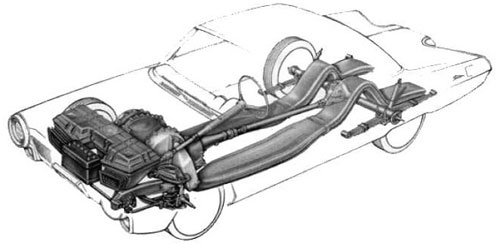
Built in ’63 to the tune of 55 examples, Chrysler’s Turbine Cars were never mass-produced, but did log an impressive number of miles as a demonstrator fleet. Essentially a completely normal car that happened to be powered, via the wheels, by a jet engine, the Turbine Car was a promising innovation dogged by politics all during its long gestation.

Chrysler Turbine Car Jet Engine Gas Engine Motor Powerplant Cutaway Diagram Schematic Drawing

How did it work? Quite simply. The turbine, which spun at up to 44,500 rpm, was connected to an ordinary torque converter and automatic transmission via a gear reduction unit. From there the power was transmitted to the back wheels by means of a basic Hotchkiss axle. The turbine required no liquid cooling system, and the bearings were sealed, so it needed no oil changes. A single spark plug provided the ignition source upon startup; after that the combustion flame was self-sustaining, much like the pilot light in a home furnace. Power output? A respectable 130 hp, and a startling 425 lb-ft of torque available just off idle, a characteristic of the turbine engine not unlike modern electric motors, and one that enabled the Turbine Car to hustle from a standstill to 60 mph in around 12 seconds, decent for the day.

What were some other upsides of the engine, besides the ones mentioned above? The engine could run on just about any combustible hydrocarbon (gasoline, diesel, kerosene, etc), and the operation of the turbine was exceedingly smooth. In addition the simplicity of the peripherals, the engine itself was blessed with only 60 or so moving parts, in contrast to the many hundreds of a typical piston engine. The reliability of the 55 demonstrators affirmed the turbine’s quality: They were an order of magnitude more durable than contemporary reciprocating engines, and that from a powerplant with a miniscule fraction of the development time undergone by its rivals.

Chrysler Turbine Car Jet Engine Gas Concept Cutaway Diagram Schematic Drawing

Disadvantages? In an era used to big, throbbing pushrod V8s, the vacuum cleaner-like sound of the turbine was off-putting. The engine did produce an excessive amount of exhaust heat—being, as it was, an actual jet engine—and Chrysler fitted an oversized and flattened exhaust system to absorb and diffuse as much of the heat as possible. Also, because of the temperatures inside the turbine, some exotic materials were used in its construction, raising the price tag a bit—though mass production and economies of scale would have certainly lessened the blow. One of the biggest downsides to the engine, and one Chrysler worked tirelessly to correct, was persistent throttle lag, caused by the time it took for the turbine to spool up and deliver power to the wheels. Drivers in the muscle car era of the ’60s expected instant power when they punched the gas pedal, and throttle lag cooled considerably whatever enthusiasm they might have felt for the new technology.

It’s a shame the Turbine Car wasn’t picked up for production, killed by politics and a general lack of public enthusiasm in the early ’70s. Perhaps if the red tape hadn’t been present, and the engine had had a company whose devotion to the engine was as strong as, say, Mazda’s for the rotary, we might see a handful of gas turbine-powered models for sale today. Who knows.

Editor’s note: This post is part of an ongoing series spotlighting obscure automotive engineering solutions. Read the other installments here:

5 Comments on Technical Curiosities: The Turbine Car

Datsun 240Z Restoration: Carbs’ Return

March 12, 2012 by Matt

Datsun 240Z SU Carbs Carburetors Carburettors Hitachi S30 Refurbished Rebuilt ZTherapy

The Z’s SU carbs returned from their visit to ZTherapy today, and I couldn’t be more pleased with them.

They’re clean as a whistle, and the action of every shaft and linkage is buttery smooth. The founder of ZTherapy had rebuilt them in the late ’90s, fitting them with the company’s signature ball-bearing throttle shafts in an effort to cure tune-distorting vacuum leaks; however, the seals failed and the founder’s remanufacturing process removed too much material from the aluminum bodies of the carbs for them to be refitted with new bearings. ZTherapy’s current owner was forced to use new cores during this latest rebuild, and he cleaned them, replacing all gaskets and rubber in the process too.

Datsun 240Z SU Carbs Carburetors Carburettors Hitachi S30 Refurbished Rebuilt ZTherapy

The icing on the cake was the presence of the mid-production-style knurled mixture adjustment knobs, shown above. Early Z SUs were fitted with knob without knurls, making it difficult to count turns when tuning, and late-model SUs had thin, notched discs, hard to grasp when rooting around under the carb bodies. I requested the knurled knobs, but ZTherapy declined to fit them, as they (understandably) like to keep the cores together and avoid mixing and matching parts. But then they did it anyway, a fact that really made my evening.

Datsun 240Z SU Carbs Carburetors Carburettors Hitachi S30 Refurbished Rebuilt ZTherapy

A view of the sealed (outer) end of the throttle shaft. A ball bearing resides under here. The new owner’s machining process removes much less material from the carb body, making for a much tighter fit around the throttle shaft, greatly reducing the chance the dust shields or retaining clips will work their way loose.

In other Z news, the wheels have been cleaned and fitted with the BF Goodrich Radial T/As, sized 225/60-14. Pictures forthcoming.

Editor’s note: This post is Part 10 of an ongoing series chronicling my efforts toward the restoration of my 1972 Datsun 240Z, originally my father’s. Read the other installments here:

7 Comments on Datsun 240Z Restoration: Carbs’ Return

Would You Own a Convertible?

March 11, 2012 by Matt

Mazdaspeed Miata Red Turbo Drift Drifting

Some just don’t care for the body style. As for me, I’m on the fence.

I realize the merits of the following bullet points depend greatly on the particular car under consideration, but nevertheless, let’s list some general pros and cons:

Pros:

  • The wide open sky over your head. This is the biggest draw, and a revelation for those who’ve never ridden in a ‘vert. I remember my first ride in a Miata with the top down, and I remember saying to myself, “Ah, so this is what the big deal is.” There’s no substitute for the connection with the elements, the sensation of the road, the engine noise… I have very fond memories of blasting up and down Florida’s beachside A1A state road at night in my old Supra, targa top removed, stereo playing just loud enough not to distract me from the sensations outside.
  • The style factor. Much the draw here depends on the environment—pulling up with shades on and the top down doesn’t command the same level of appeal in Minneapolis as it does in, say, San Diego, but the fact remains that convertibles do possess connotations of style and glamor in the larger public’s eye.

Honda S2000 Yellow Top Down Driving

Cons:

  • Chassis rigidity. This isn’t so much a problem for cars that were designed for topless activity from the outset, like the Honda S2000, Porsche Boxster or Mazda MX-5 Miata, where the rest of the structure can be optimized for the car’s configuration, but for most convertibles, based as they are on a corresponding hardtop model, shimmies and shakes are the order of the day. Even with additional (and heavy!) door and floor pan bracing, it’s impossible to make up for the loss of the roof as a structural component.
  • All-season practicality. Even the most well-made, weatherproof convertible top fails to measure up to the insulation and soundproofing standards of a typical fixed roof.
  • Complexity. And even if the car remains leak- and draft-free its whole life, there’s still a great deal of mechanism behind the front seats—linkages, hinges, clips and in many cases, electric motors to wear out, fail and add weight.

Porsche Boxster Green Driving Top Down Seaside Ocean

Would you take the plunge, throw caution to the wind and purchase a convertible? If so, which ones (or one) are on your short list?

3 Comments on Would You Own a Convertible?

Why Can Mazda Not Break Through?

March 9, 2012 by Matt

Mazda Logo Miata Shifter

A recent Left Lane report that Mazda will be cutting back its US workforce revived a question that’s been rolling around in my head for some time: Why is Mazda not more successful? Why can they not break into the “upper tier” of Japanese automakers, a plane occupied by companies like Toyota, Nissan and Honda?

Granted, all automakers have to lay off workers from time to time in order to adapt to changing demand, or an underperforming product, or increased competition. But Mazda seems to be a perpetual underachiever, almost always turning our cars that are among the best in their respective class, and well put-together at that, but unable to vault their manufacturer into the upper echelon of Japanese makes. As a result, they seem to experience crises every half dozen years or so where they’re compelled to pare down their workforce or seek a business alliance, never actually entering bankruptcy, but certainly experiencing hard times, with little surplus development money available for the projects they’d actually rather be working on, such a next-generation rotary engine, or putting together a factory race team and adding to their already-enviable racing pedigree.

Mazda MX-5 Miata Roadster Green Silver NC

A quick mental scan of Mazda’s product line over the past decade or so offers some insight into the company’s fortunes. As much as GM would like us to believe otherwise, an automaker’s success or failure is tied pretty directly to the quality of the cars they design, engineer and manufacture, and a glance at Mazda’s output—the 3, 6, RX-8, MX-5, CX-7, CX-9 and Tribute, among others—reveals vehicles that are almost always a joy to drive, but in terms of mass-market appeal, are a little out-of-step with mainstream tastes. They’re not boring transportation appliances, and as much as we enthusiasts would consider that a selling point, the hard truth is that much of the buying public is looking for the anonymous beige box to tote them around, never breaking down and getting 30 mpg and playing their MP3s via Bluetooth. That being the case, consideration of Mazda cars requires a bit more of a “leap of faith” from the consumer than say, an Accord or Camry, vehicles that all their friends have; known quantities. Success, no matter how it’s arrived at, begets success, and as such Toyota, Honda and Nissan occupy enviable positions atop the podium, leaving Mazda and other Japanese makes nibbling around the edges.

Is that the whole story, though? Interesting cars that are lovely to drive but are cursed by the fact that the words “Camry” or “Accord” aren’t affixed to their trunklids? Or is there more to it? Why do you think Mazda isn’t more successful?

4 Comments on Why Can Mazda Not Break Through?

Out of the Frying Pan…
Edmunds’ Take on New Energy Plan

March 8, 2012 by Matt

Honda Insight 2010 10 Blue Rear Taillights Trunk

In response to the Obama administration’s latest push for subsidies for electric and hybrid vehicles, Edmunds offers a classic example of how to refute a bad idea with a worse one. They write:

Rather than government pushing technology, we might all be better off if government policies — and spending — were directed at creating consumer demand. If use of oil in private transportation is the problem — from the viewpoints of national energy security and/or environmental concerns — then we need to make the use of oil-based fuels distasteful enough, through pricing and fuel efficiency regulations, that American consumers demand that automakers provide alternatives. That would bring useful and affordable alternative technologies, including electric and natural gas vehicles, into the mainstream market a lot quicker than will the present system.

What an awful, awful idea. Not only does it put forth a different method of achieving exactly the same end—distorting the marketplace and pushing vehicles that consumers simply don’t want—it takes money away from families already struggling in the slow economy in the form of an added energy tax, euphemized as “pricing and fuel efficiency regulations.” Edmunds‘ solution to the lack of green vehicles on the road isn’t to shovel truckloads of taxpayer cash at them to make them affordable enough for the average family to consider—the current administration’s agenda—it’s to force consumers to want the new vehicles. If Edmunds decries the government’s efforts to pick winners and losers in the marketplace, as they do earlier in the editorial, how is their solution not to do precisely that, except with whole segments of the industry rather than individual companies? You tell me which take, Edmunds‘ or the Obama administration’s, would do more damage to the economy in general. It’s not rocket surgery.

In the end, it’s all the same wherever the government intervenes in the economy in order to engineer an outcome or push an agenda: Frequently poorly-engineered products, more expensive than we can often afford, and that we don’t want in the first place. Memo to the current administration and Edmunds: Leave the industry alone, and we’ll all be better off.

No Comments on Out of the Frying Pan…
Edmunds’ Take on New Energy Plan