Spannerhead Dot ComSpannerhead.com

Audi Styling Mistakes

February 25, 2012 by Matt

Yes, they have happened.

Regular readers here may think I’ve adopted an “Audi can do no wrong” mindset, especially after posts like this, this or this. Certainly, when it comes to beautifully tasteful and understated design, Audi is in a class by themselves. They’re perhaps unique among automakers in that, unlike virtually all their competitors, Audi has never released a car that was a styling disaster. So I can’t critique whole cars; if I’m going to pick apart their design missteps, I’ll have to do it piecemeal. Note that what follows isn’t a comprehensive list; they’re simply the three aberrations that came most immediately to mind:

Audi B3 80 90 S2 C-pillar Red

’88-’95 80/90 C-pillar. This issue could just as easily apply to the C3 5000/100/200 as well, but it’s most pronounced on the 80/90, given that car’s more bathtub-ish below-the-beltline shape. The C-pillar is simply far too visually thin—there’s no “return” to the greenhouse that would accentuate the car’s wedge shape in profile. No, the C-pillar just looks flimsy, and the design suffers from its lack of visual strength.

Audi B7 A4 Front Silver Gray Grey

’05-’08 A4/S4/RS4 Fascia. It’s difficult to determine what Audi was thinking when they put this together. Let’s start with the obvious: The nose could just as well belong to a generic Japanese or Korean econobox. It looks completely plastic, there’s nothing distinctive about it, and the grille’s “dip” is very characteristic of lower-end cars’ styling. The bottom edges of the headlights are inexplicably convoluted. And this being Audi’s first attempt at their now-trademark front plate-surrounding grille design, the rest of the car’s lines weren’t yet in harmony with such a strong nose element.

Audi C6 A6 Rear Taillights Trunk Boot

’04-’10 A6/S6/RS6 Rear. I don’t take issue with the shape of the taillights—although their simple square-ish shape is perhaps a bit too safe—so much as the dip in the lower edge of the trunklid. There are no other lines in the car that agree with this one. The trunklid edge is isolated, random, and as such it draws attention to itself and gives the rear of the car an unfinished look—very atypical for Audi.

Interestingly, in most cases, the offending element is gone by the car’s next generation, or even with a mid-cycle refresh; to their credit, Audi seems to quickly recognize where they went wrong and rectify matters post haste. The A6’s taillights were much more integrated with the trunklid after the refresh, and the ’96-’01 A4’s C-pillar was beefed-up considerably in order to strengthen the rear styling. And the A4’s front end came beautifully back into focus with the ’09-present generation; no more awkwardly tortured headlights or irresolute lines.

6 Comments on Audi Styling Mistakes

New Ferrari F620 GT: Diabolically Boring

February 24, 2012 by Matt

New Ferrari F620 GT F620GT Silver Gray Grey V12

Hot off the presses (h/t Jalopnik and GTSpirit), here’s the first photo of the new front-engined V12 flagship from Ferrari, to be named the F620 GT.

The replacement for the outgoing 599 Fiorano will be the most powerful road-going Ferrari ever made, with a staggering output of 740 hp from its 6.3l mill. A RWD car, one can’t help but wonder how just the rear tires will manage to put all that power to the ground effectively. We’ve long reached the point where AWD is practically a necessity for any self-respecting supercar with an engine output north of 600 hp or so, but… That’s a post for another day.

Back to the F620. Design-wise, the car looks like an unfortunate pastiche of styling cues from past and current Ferraris, including the FF’s gaping maw, the 458 Italia’s vertical headlight lenses and even the long-dead 550 Maranello’s bulging rear fenders. Perhaps stung by criticism of the 599 as too avant-garde—specifically with respect to the jerky grille and “flying buttress” C-pillar treatment—Ferrari seems to have penned a very conservative-looking replacement.

Every new Ferrari has a chance to be a design trendsetter, perhaps none more so than their classic front-engine V12 model, and it’s a shame when Ferrari doesn’t seize the opportunity to push the envelope stylistically. Not only that, but if the car looks dated before it’s even rolled out at the Geneva Motor Show in a few weeks, the fact that Ferrari dialed down the design’s edginess doesn’t bode well for its long-term viability in a market so driven by looks and visual impact. With any luck, as with the reveal of the F-117 Nighthawk, the car will look much better in subsequent photos than it does in the initial first grainy snapshot.

No Comments on New Ferrari F620 GT: Diabolically Boring

Will BMW buy Saab?

February 22, 2012 by Matt

BMW Kidneys Grille Nostrils Blue Saab Grille Fascia

Saab’s body isn’t even cold yet, having just filed for bankruptcy and liquidation a few months ago, and yet, as Left Lane reports, BMW appears to be in the running to be the one to perform a Dr. Frankenstein-style reanimation of Saab’s cadaver, jolting new life into the Swedish automaker.

The article points out:

The association between the two companies wouldn’t be as random as it might seem. In 2010, BMW agreed to provide Saab with 1.6-liter four-cylinder engines. The cooperation between the two was supposed to start this year.

Furthermore, the Munich-based company has announced recently that it needs extra production capacity in order to expand its MINI brand. Picking up the Trollhättan facility could be a viable solution to the problem.

If they decide to acquire Saab, BMW would undoubtedly be a better partner than GM had been. During its 20-year partnership with the Swedish automaker, GM drained from it every last ounce of brand identity, shamelessly rebadging Cadillacs, Chevys and even Subarus as Saabs in a series of flailing attempts to create a successful model. BMW’s history of alliances with other automakers is a bit spotty (Rover got the shaft), but chances are much better they’d give Saab more autonomy and restore at least some of its brand identity, as the German concern has done for Rolls-Royce and MINI. BMW would likely supply engines and provide engineering assistance when needed, rather than completely manhandling Saab’s product line, a la GM.

Unfortunately, GM holds the patents to many key Saab engine and chassis components, since all recent Saabs have been built on GM platforms, and for any sale to proceed, the American giant would have to give their blessing to the union. That said, I can see GM being a bit less hesitant about a BMW purchase than one by a Chinese firm, given the fast and loose relationship between many Chinese companies and international copyrights and patents, and thus the increased likelihood of GM having to compete against its own innovations in the Chinese domestic market, an area of exponential growth for the American automaker. BMW faces off a bit less directly with GM, and access to certain proprietary GM technologies by BMW wouldn’t put the former at as much of a competitive disadvantage.

We’ll see what happens. I for one hope BMW goes through with the sale and keeps Saab alive.

6 Comments on Will BMW buy Saab?

Datsun 240Z Restoration:
First Triad Z Club Meet

February 21, 2012 by Matt

Triad Z Club Logo Datsun Nissan 240Z 260Z 280Z 280ZX 300ZX 350Z 370Z

Attended my first monthly meet of the Triad Z Club earlier this evening. Paid my annual dues, my laminated (!) membership card will soon be in my sweaty palms.

I had a great time. I printed out a big stack of pictures of my 240Z to discuss, and I think the guys appreciated having the visual reference. 7-8 guys showed, mostly older, and from what I could tell all with their heads on straight as far as restoring and modifying their Z-cars; in other words, no preoccupations with “stance,” sound systems or 19-inch wheels. They, like me, were refreshingly focused on retaining the classic look and feel of their cars even as they upgraded them, and that more for the simple enjoyment of driving rather than all-conquering speed. Their priorities tracked with mine.

Perhaps more than that, I was struck with how friendly everyone was. More often than not, when I go to a car meet I’ll be the only one talking, sharing stories, asking questions and so on; most of the guys who show seem to think standing mute posturing next to their “ride” amounts to participation, but the Triad Z guys were gregarious to a fault. I thoroughly enjoyed talking to everyone.

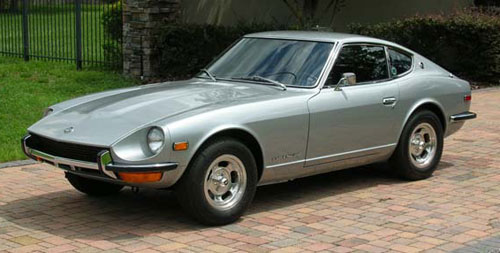
I didn’t think anyone would actually venture out in their Z, so I didn’t take my camera, but when I arrived, I kicked myself for not having brought it just in case. One of the members drove his restored ’74 260Z with tucked bumpers, in 901 Silver (same color mine will be) with BF Goodrich Radial T/As (same tires mine will have). It wore an air dam, headlight bucket covers and a fresh coat of foot-deep paint. It was beautiful. Interestingly, the car was running de-emission-ed Hitachi “flattop” carbs as fitted to the later 240Zs and early 260Zs, which most will dismiss as particularly poor carbs; however, the car ran perfectly fine with them.

I received a deluge of advice and contacts concerning all aspects of the upcoming restoration effort, which, along with the social aspect of the meet, was exactly what I wanted. I have a mind to invite some of the guys over when I try to start my Z for the first time; it would be great to have an experienced set of eyes and ears trained on the car during that effort. Great group.

Editor’s note: This post is Part 9 of an ongoing series chronicling my efforts toward the restoration of my 1972 Datsun 240Z, originally my father’s. Read the other installments here:

No Comments on Datsun 240Z Restoration:
First Triad Z Club Meet

New Chevy Camaro: Muscle Caricature

February 20, 2012 by Matt

2011 11 Chevy Chevrolet Camaro SS Red

The new Camaro is really ugly.

There; I said it.

The new 571-hp Camaro ZL1 stares at me from the cover of the latest issue of Car and Driver whenever I walk by my desk, and I’ll occasionally stop and let my eyes linger on the angular nose and convoluted haunches, trying to like the shape, but… I just can’t muster it.

I vividly remember watching Transformers in the theater and hearing an audible intake of breath from the guys in the audience when Bumblebee morphed into his new Camaro shape. The film was released in ’07, and was a showcase for the upcoming car, which wouldn’t hit showrooms until March ’09. The new muscle car was duly spectacular in its movie role, and perhaps it fit the big screen too well, in a sense, its cartoonish, hyper-charged lines a better match for film stardom than real-life city streets.

1969 69 Chevy Chevrolet Camaro SS Blue

That touches on my main objection to its shape, I think. The original Camaro (shown above) was an instant classic, a shape at once lovely, well-proportioned, sensual and aggressive—without turning into a parody of itself. It helped, of course, that there was nothing to parody in ’67, the year the original was released, and the stylists were forced to pen a fresh shape. The latest Camaro, by contrast, plagiarizes far too much from its ancestor, and does nothing with its lines except pull and distort them into a blocky, awkward mess. Also, with the first-generation car, manufacturing materials and processes then weren’t what they are now, able to turn just about any designer’s fantasy into reality. But as with so many great movies, the limitations of the technology sometimes create a better film, or better-looking car in this case. As it is, though, the new Camaro banks far too heavily on the nostalgia of potential owners; hardly any of its lines are of the quality I would call enduring, in the sense that they aren’t visually exhausting to behold for more than 30 seconds or so. Don’t get me wrong; it’s nowhere near the nadir of modern car design, but if I owned one, I can confidently say it would quickly wear out its welcome in my garage. If the original Camaro was a timeless superhero on the order of Spider-Man or Batman, the new car is more analogous to one of the more modern crop of comic book characters, all of whom shamelessly borrow story lines and super powers from their forebears, and have yet to truly catch on.

5 Comments on New Chevy Camaro: Muscle Caricature

Honda CBX: Superbike Godfather

February 19, 2012 by Matt

Honda CBX CBX1000 Red

I’ve never been much into bikes, but this one almost made a believer out of me.

Actually, having never really experienced it, that’s not altogether true; however, I can confidently say it was the first motorcycle to actually interest me. The power, the ahead-of-its-time sophistication, the speed and the fact that it sported an inline-6 (my favorite engine configuration) all drew me in. I knew nothing about bikes at the time, and I had absolutely no idea that the ’78-’82 Honda CBX is far, far “too much bike” for a beginner to even contemplate, but I knew I wanted one. It was the equivalent of a 15-year-old lusting after a Lamborghini Countach, in other words.

Honda CBX CBX1000 Red

What made it so special? Well, just look at it. I defy any enthusiast of things mechanical to lay eyes on the six chromed exhaust pipes curling down and away from the cylinder head and not dissolve in paroxysms of desire. The bike has an undeniably vintage look, but that massive engine wedged underneath the fuel tank speaks volumes about its accelerative capabilities. Powered by a 1047cc, 24-valve, DOHC, 6-carb straight six developing 105 hp, the CBX could destroy the 1/4 mile in 11.5 seconds, and the engine’s size and refinement meant it could pull readily from lower in the rev range as well. Even if the engine’s girth meant it would never be quite as nimble as its lower-displacement, more compact stablemates such as the CB750, the CBX was beautifully flexible and brutally fast in its own right. I still want one.

2 Comments on Honda CBX: Superbike Godfather

Mitsubishi Starion:
Japanese Glam Rocker

February 18, 2012 by Matt

Mitsubishi Mitsu Starion Chrysler Dodge Plymouth Conquest Silver Gray Grey Wide Body Widebody

In the Editor’s Letter of the March ’12 issue of Car and Driver, Eddie Alterman offers an endorsement of the latest sports cars to emanate from Japan—the Subaru BRZ and Scion FR-S twins—by comparing their spirit to that of the fun, iconic Japanese sports cars of the ’80s—the Mitsubishi Starion among them—and contrasting them with the output of the past 10 years or so:

The Supra turbo, the 300ZX TT, and the RX-7 died 10 or more years ago, supplanted by a veritable tea ceremony of Priuses, Insights, and Odysseys. Certainly, there were some enthusiast holdouts such as the S2000, the Evo, and the reborn, simplified Nissan Z, but even these had made some concessions to common sense, having undergone the sort of tempering that made them smoother and less idiotic than the glam-rock Starions of yore—proffering either too many doors, too few cylinders, or too subdued styling.

It’s a succinct set of adjectives to describe the appeal of the Starion: Idiotic, with glam-rock overtones. In other words, bold, brash, loud, flamboyant, somewhat immature and underdeveloped, but strangely endearing and able to have a good time like nobody’s business.

Mitsubishi Mitsu Starion Chrysler Dodge Plymouth Conquest Interior Inside Cockpit Dash Dashboard Instrument Gauge Cluster

Given its extroverted nature, it’s ironic that the Starion is frequently forgotten about whenever ’80s Japanese sports cars are discussed, overshadowed by the epic battles of the day that raged between the RX-7, Supra and 300ZX. Fundamentally, it’s a good car, if not quite as well-sorted as its rivals, and it really does deserve to be mentioned in the same breath as its competitors from Mazda, Toyota and Nissan.

Offered from ’83 to ’89 in the US and powered exclusively by Mitsu’s 2.6l, turbocharged 4G54 engine, the Starion was one of the very first mass-market turbocharged cars available. A generation newer than Nissan’s aging 280ZX Turbo, it heralded a new wave of sport car sophistication from across the Pacific, and was also offered for a time as the badge-engineered Chrysler/Dodge/Plymouth Conquest as part of the DSM consortium. During its 7-year model run, there were slight design variations (narrow and wide body, small bumper updates, etc) and detail changes (interior refreshes, engine management revisions, etc), but a few things remained constant: a ~150 hp turbocharged 4-cylinder engine, RWD, the option of a manual transmission, and a curb weight of around 2,900 lbs. Its performance was competitive when it first burst on the scene, but was rapidly eclipsed by the arrival of the considerably quicker and more refined Supra Turbo and RX-7 Turbo II. The Starion was primarily hampered by a SOHC, single-point-injection engine and a generally crude feeling compared to its rivals, whose development teams had substantially more experience than Mitsubishi’s in fine-tuning sports cars.

Mitsubishi Mitsu Starion Chrysler Dodge Plymouth Conquest Engine Motor Bay 4G54

That said, it still retained (and retains to this day) its appeal. If not quite the gem Mitsu’s later 4G63 engine is, the Starion’s 4G54 engine is quite responsive to upgrades, and the basic chassis layout of the car means handling is perfectly in line with how a front-engined, RWD sports car should feel. And its expressive styling paired with its rough-around-the-edges-nature give it a sort of “Japanese IROC-Z” feeling. Couple that with the car’s rarity—the “What is that?” factor—and you have a recipe for an irrepressibly fun ride.

11 Comments on Mitsubishi Starion:
Japanese Glam Rocker

Burger Dots (02/16)

February 16, 2012 by Matt

Burger Image Random Car Posts Links News

  • Here’s an incredibly cool poster featuring profiles of 50 significant Japanese sports cars. While I’m a little disappointed the Starion made the cut instead of the superior FC RX-7, for the most part, the “breed,” if you will, is well represented. Bonus points if you can name all 50!
  • Car and Driver offers a preview of an upcoming road test of the refreshed Audi A4 and S4. It goes without saying, but they’re just stunning cars. The resolution of lines around the trunklid area (particularly the horizontal taillights that give the rear a low, wide aspect) is especially successful. If I were in the market for a new, small European 4-door, Audi’s entry-level cars would be on my short list.
  • Ever wondered what you’d do caught behind the wheel of a car with a stuck throttle? Edmunds relays some helpful advice for those of us apt to completely freak out in such a situation. Hint: A little more knowledge about how your car actually works would go a long way.
  • Another in a long line of cars not destined for the US that I’m not really sure we’d even want here, Renault plans to inject a little visual pep into their subcompact Twingo (yes, that’s its name). Lifting styling cues—notably the front and rear wing shapes—from F1 cars, the Twingo R.S. is identical to its less speedily-adorned stablemates under the hood (a 133 hp 4-banger provides the go). It’s factory-sanctioned rice, in other words.

No Comments on Burger Dots (02/16)

The Joys of a Paid-Off Car

February 15, 2012 by Matt

Mazda MPV 05 2005 LX Grey Gray Gunmetal

We paid off our minivan yesterday. It was our first—and to date only—car to have been financed, and after 2 years and 10 months, I’m proud to say we’re in the clear again, considerably earlier than the term of the loan. The extra money in our pocket will be helpful for a whole host of things, from kid activities to home improvement and assistance in paying off other debts. It’s incredibly liberating and satisfying to know that we now hold our cars’ titles, not the bank.

It also makes me want to take better care of the minivan. It’s an ’05 Mazda MPV LX, powered by a 3.0l, 200 hp V6, and it’s been incredibly faithful. 3,000 more miles to go to hit the big 100K, and our only failures to date have been:

  • A PCV hose around the back of the intake manifold a year ago. $50 worth of parts and tools later, and it was good as new.
  • The door handle cable inside the drivers’ door. Found a gentleman online (I love the internet for sourcing car parts) with a spare and was able to fix it for around $20.

Mazda MPV 05 2005 LX Grey Gray Gunmetal Rear Taillights Back

Other than that, it’s been bulletproof, with a couple of trips to the beach and many, many errands around town under its belt. It does have to sleep outside, unlike its siblings (the 240Z and the BMW get the garage), but it doesn’t seem to mind too much. It does need a good wash and wax and clean-out, though, along with a potential transmission service at 100K. Debating about that last one.

Having the minivan paid off makes me think about the ways in which car acquisition and ownership have changed since my parents’ day. My dad always paid cash, and almost always bought new, even if he had to sell some stocks or dip into his other investments to do so. To my knowledge, my parents have never had a car payment, and I have a feeling it was like that for many more families than just mine. New car prices have increased significantly over the past 30 years, and not just because of inflation—modern cars are packed with electronics and safety features, a dozen airbags, traction and stability control, navigation systems, and so on. It makes me wonder how far the avalanche of features and gadgets can really go, how far the market can really sustain the one-up-manship between automakers.

Mazda MPV 05 2005 LX Grey Gray Gunmetal Interior Inside Cockpit Dashboard Dash Console

If I had to put forth a prediction, I really do see car ownership going in the same direction as home ownership in the sense that 20-30 years out, everyone will finance their cars; they will simply be an investment on the same level as buying a house. Debt coaches will advise their clients on another type of “acceptable debt” besides a home loan: the car loan. Between cars’ rapid increase in sophistication, the growing complacency (the past few years excepted) toward consumer debt and the looming specter of federal regulations that threatens to hike the price of the average car even more, only a very small percentage of buyers will pay entirely out of pocket for a new car. It’s unfortunate, really, symptomatic as it is of the decline in the average consumer’s purchasing power, even as the shift has the potential to be a boon for the used car and auto repair industries. I really don’t think we’d be surrendering a great deal by shifting our buying habits toward smaller, simpler, less expensive cars and simply taking more responsibility for ourselves behind the wheel in terms of driving safely, entertaining ourselves and finding where we need to go.

6 Comments on The Joys of a Paid-Off Car