Spannerhead Dot ComSpannerhead.com

The Supra Story

February 14, 2012 by Matt

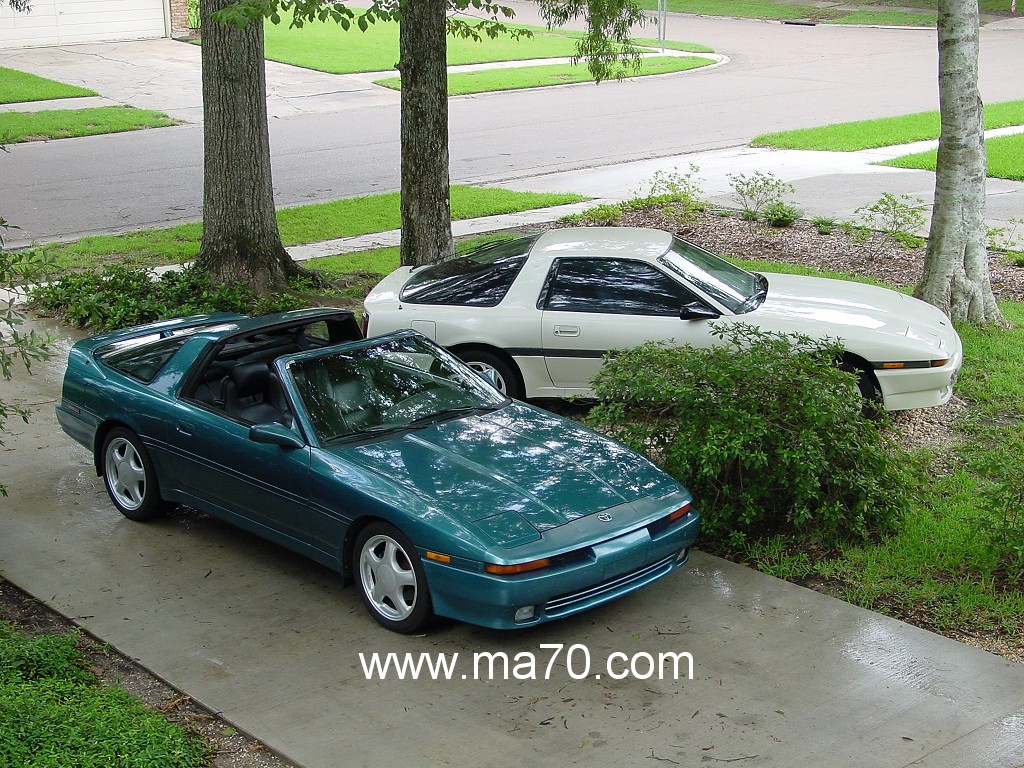
Mark Mk 3 MkIII Mk3 Toyota Supra Turbo JZA70 MA70 MA71 White 1JZ 1JZ-GTE 1JZGTE

Other than my current ’95 BMW 525i, this is really the only “modern” car I’ve owned.

It was an ’88 Toyota Supra Turbo with a 5-speed manual transmission. Power everything, double-wishbone suspension and a 3.0l, 24-valve, DOHC, turbocharged and intercooled straight six were just some of its features. It was smooth, powerful, reasonably agile and a class act. I felt confident taking this car on dates. I purchased it sight-unseen in while living in St. Augustine, Florida; the car was located in Atlanta and I bought a one-way plane ticket, flew up, got the car and drove it back down to my home on the coast.

Mark Mk 3 MkIII Mk3 Toyota Supra Turbo JZA70 MA70 MA71 Maroon Brown 1JZ 1JZ-GTE 1JZGTE Interior Inside Cockpit Cluster Dash Dashboard Momo Steering Wheel

I miss it very much. I have fond memories of driving it along Florida State Road A1A beachside at dusk with the targa top removed, stereo cranked and enough heat directed at my feet to keep me warm. It was a perfect trip car, with wonderful seats and enough power to pass at will and cruise effortlessly at 75 for hours. It might be an odd thing to miss, but the instrument layout in particular appealed to me. It was a Toyota, and as such there was a clarity and precision to the instrumentation: The needles were thin and seemed to pivot along their arcs with a kind of reassuring accuracy.

Mark Mk 3 MkIII Mk3 Toyota Supra Turbo JZA70 MA70 MA71 White 1JZ 1JZ-GTE 1JZGTE Engine Swap

I bit off more than I could chew, or was willing to chew, in modifying the Supra. Aside from the odd repairs it served me well for over a year when I decided it needed more power. I pulled out the tired 7M-GTE engine (whose turbo seal had failed) and through divers transactions acquired a Japanese-only, never-imported-to-the-US twin-turbo 1JZ-GTE engine that had about a third again as much power as the original and was much more responsive to upgrades. At the time I was one of only about a dozen guys across the country who had attempted the swap, and liked the feeling of being a trailblazer, even as I knew troubleshooting would be difficult without the advice of guys who had gone before me.

You can read much of the story here. The car ran well for about two days before the bugs set in anew, and during those two days was far and away the fastest car I had ever owned. But in the end the Supra became too much of a money pit, and with its increasing potential would have been a source of constant temptation in terms of upgrades. It would have been very hard for me to be content with the car, even with the new engine, so I pulled out of the “power rat race” while I still had some money left in my bank account. At least, that’s what I told myself at the time…

The real bummer, as I found out, was how close I really was to having it running properly again. During the winter and spring of ’04, I spent countless hours combing through the car’s wiring harness trying to resolve intractable engine management glitches. I sold the car with the understanding the new owner could use my apartment complex garage for as long as it took to get the Supra into a state where it could be driven to its new home. A few evenings and he had it eating out of the palm of his hand, having simply connected the knock sensors (which I had neglected, thinking they weren’t essential to the engine management system’s well-being for the purpose of just getting the car to start) and swapped a few more wires. Granted, he was a Toyota tech, but still… Bygones.

Mark Mk 3 MkIII Mk3 Toyota Supra Turbo JZA70 MA70 MA71 White 1JZ 1JZ-GTE 1JZGTE

I do miss it. I felt confident driving the car. I don’t know how to describe it… Maybe the feeling you get when you’re dressed to impress—something superficial like that. But I enjoyed it. Something about the combination of the power, the smoothness and the targa top made the whole experience more than the sum of its parts.

Editor’s note: This post is adapted from a “car history” post I wrote on an older blog of mine some years ago. It includes a few of the only pictures I have of the car, some of which are stills from a video. I apologize for the poor quality, but it’s all I got. Carry on.

No Comments on The Supra Story

Koenigsegg’s New Cam-Less Engine

February 13, 2012 by Matt

Camless Valves No Camshaft Cam Pneumatic Valve Springs Koenigsegg

Jalopnik reports on an upcoming supercar from Swedish boutique automaker Koenigsegg that will feature a twin-turbo V8 engine whole valves are actuated without camshafts.

Partnering with Swedish engineering firm Cargine, Koenigsegg plans to develop a valvetrain system whereby the valves are operated using pneumatic pressure alone. F1 car engines have used pneumatic valve springs since the Renault turbo engines of the mid-’80s, but always in conjunction with a camshaft. The Swedish performance car concern intends to do away with the camshaft altogether, actuating the valves directly via servos. The breakthrough has the potential to eliminate a great deal of complexity (the entire valvetrain, cam gears and tensioners) and offer benefits including infinitely variable valve timing and cylinder deactivation, among others. The challenges include reliability (how to make sure the valves remain closed in case of servo failure, to eliminate the potential for valve-to-piston contact) and noise (servos have exactly two states—open or closed—as opposed to the more gradual, less noisy opening and closing profile offered by a cam lobe).

This is a smart move for Koenigsegg. Publicity drives supercar sales, and without the resources to sustain an indefinite top speed pissing contest against Bugatti and SSC, the Swedish automaker has sidestepped that key issue and instead focused on innovation and efficiency. But rather than cooking up yet another oh-so-trendy hybrid supercar, they’ve decided to “borrow from the top,” as it were, and incorporate racing technology in their new engine. Instead of merely “going green” for the sake of going green, shoehorning in hybrid technology well aware of the weight and complexity drawbacks, as with a whole host of recent supercar concepts (New Acura NSX, Jaguar C-X75, Porsche 918, etc), Koenigsegg plans to boost efficiency in the pursuit of power and speed. It’s a win-win.

4 Comments on Koenigsegg’s New Cam-Less Engine

Underrated Lookers:
The ’96-’98 Chrysler Sebring Convertible

February 12, 2012 by Matt

Chrysler Sebring Convertible Vert Cabriolet Cabrio Droptop Ragtop Beige Brown Tan Bronze 1996 96

As the adage goes, even a stopped clock is right twice a day.

Ever in the midst of wild design flailings, everything miraculously came together for Chrysler with the above car, the ’96-’98 Chrysler Sebring Convertible. I want to be very specific about the model year range I have in mind, because the train jumped the tracks, as it were, very quickly.

For a moment, though, let’s examine the design under consideration. Long, low proportions? Check. Well-resolved lines and absence of fussy surface detail? Yessir. Understated grille shape with stroke-of-genius Jag E-Type chrome bar bisecting the opening? Got it. Nicely-shaped wheels complementing the overall styling? Yep. For what the car needed to be—a dedicated boulevard cruiser than drew just enough (but not too much) attention to itself to reflect well on its occupants—the design was absolutely, stunningly perfect. I honestly don’t know if even as established a high-roller droptop as the Mercedes SL has anything on the ’96-’98 Sebring Convertible, if you take the “badge prestige” factor out of the equation. It’s that good.

Chrysler Sebring Convertible Vert Cabriolet Cabrio Droptop Ragtop Green 1996 96

As mentioned above, though, Chrysler just couldn’t leave well enough (or in this case, excellent) alone and had to fiddle with the design. The car lost its lovely grille bar for ’99, and received a few other design tweaks that negatively altered the coherency of the shape. And the second- and third-generation Sebring convertibles aren’t really even worth mentioning in the same article as the ’96-’98 car; they’re as hideously abominable as the original was gorgeous. We’re talking paper-bag-over-the-head territory here.

But for one brief, shining moment, Chrysler pulled it together and delivered a stunner. Shame they didn’t learn from their success.

Editor’s note: This post is part of an ongoing series featuring cars whose design I find appealing, in contrast to mainstream opinion. Read the other installments here:

1 Comment on Underrated Lookers:
The ’96-’98 Chrysler Sebring Convertible

Mercs I Would Consider: The W202 C36 AMG

February 11, 2012 by Matt

Mercedes-Benz Merc MB W202 C36 AMG Silver Gray Grey

Any casual Spannerhead reader knows I’m a dedicated BMW and Audi fan. I may raise concerns over those two automakers’ (particular BMW’s) directions of late, but given the choice of an offering of one of the German “Big Three,” I’ll almost always opt for a BMW or Audi over the Mercedes-Benz equivalent.

There are a number of reasons for this: BMWs, for their part, are generally more enthusiast-oriented and almost universally available with manual transmission, whereas Mercedes’ cars typically aim more for the comfort side of the high-end German executive car spectrum. Also, the slushbox is practically an institution for M-B; range-topping sports GTs such as the SLR McLaren or SLS AMG that would normally be fitted with a manuals receive automatics in conformity with the automaker’s orthodoxy.

As far as Audi is concerned, they have design cred in spades; their rivals from Stuttgart tend to err on the conservative, stodgy side when drawing up their cars’ lines. And Audi has always appealed versus BMW and Merc as the underdog, the outsider, the German automaker with the market cornered on uniqueness, if nothing else. That non-conformist cachet is something I really dig.

So, Mercs are conventional, frumpy, boring, cushy and always equipped with an autotragic when it really counts. Are any really worthy of enthusiast consideration? In a word, yes.

Mercedes-Benz Merc MB W202 C36 AMG Interior Inside Cockpit Dashboard Dash Console

Take the car featured in this post: The ’95-’97 W202 (internal model code) C36 AMG. Hard on the heels of the legendary 500E, in response to the Bavarian salvo that was the E36 M3, Mercedes took their small sedan, the C-Class, and turned it over to in-house performance division AMG. The stock M104 DOHC, 24-valve inline 6 was bored out from 2.8 to 3.6 liters and blessed with number of external and internal fortifications that boosted output to a healthy 276 hp in Euro guise (268 here until ’97). AMG lowered the car, uprated the suspension and brakes and fitted an appropriately aggressive and functional body kit paired with gorgeous 17″ Monoblock wheels.

Mercedes-Benz Merc MB W202 C36 AMG Engine Motor M104

The resulting performance—0-60 in 6.4 seconds and an electronically-limited top speed of 155 mph—only tells part of the story. Again, much like its older brother the 500E, the persona of the C36 is a bit out of step with the typical enthusiast craving for a light and nimble corner carver. Instead of a direct point-by-point rebuttal of the E36 M3, Mercedes offered a vision of performance in keeping with their ethos: A iron fist wrapped in a velvet glove, an executive express of the highest order. It is an Autobahn dominator, a CEO cruise missile, but in a slightly smaller, slightly less exclusive form than the pricey, Porsche-developed 500E. As mentioned, it was never built to attack an autocross course, but the commendably low weight of 3400 lbs certainly helps handling, and to me, gives the C36 a more well-rounded feel than the larger, E-Class-derived siege weapon.

Motor Trend understood where Mercedes was coming from in developing the C36, and awarded it first place in a four-way comparo against some very worthy European hardware of the day. They wrote, “For the money, the C36 is the best performance sedan in America.” Accolades don’t get much higher than that, and truthfully, I don’t know if I’d go that far. As a Mercedes, though, it’s one of a select few I’d give thought to owning.

Editor’s note: This post is part of an ongoing series highlighting Mercedes models worthy of enthusiast consideration. Read the other installments here:

No Comments on Mercs I Would Consider: The W202 C36 AMG

Aston Martin V12 Zagato:
A Vantage in a Party Dress

February 9, 2012 by Matt

Aston Martin V12 Zagato Red

Autoblog reports today on the start of V12 Zagato production at Aston Martin. Not a totally new model so much as a V12 Vantage engine, drivetrain and chassis draped in new sheet metal, the new Zagato is an admirable effort by Aston to produce a car that at least looks somewhat different than their existing offerings. The DB9, DBS and Rapide and Vantage are gorgeous, to be sure, but a little hard to distinguish from one another beyond 50 yards or so. The arrival of the Zagato provides a nice point of contrast in their lineup and suggests some possible avenues for future styling directions, like the quarter lights and arc of the roofline.

Aston Martin DB4 GT Zagato Green Gray Grey 1961 61

For those wondering about the odd name, the Zagato in the latest in a line of rewrapped Astons dating back to the original DB4 GT Zagato of ’60-’63 (shown above). A competition version of the DB4, Aston commissioned Italian automotive design consultancy Zagato to develop their already-competitive DB4 into a racer with an additional turn of speed. The Italian firm replaced and reshaped the steel bodywork with more aerodynamic aluminum, lighting the car considerably, and bumped up the 3.7l inline-6’s compression to increase output to a stout 315 hp, considerable for the day. Only 25 were ever made, resulting in one of the rarest and most sought-after models produced by an already “exclusive” automaker. With its bold grille and substantial haunches, the new Zagato aims to capture some of the original’s mystique.

3 Comments on Aston Martin V12 Zagato:
A Vantage in a Party Dress

A Parade of 2012 F1 Cars

February 8, 2012 by Matt

McLaren MP4-27 F1 Formula 1 2012 Car

It’s that time of year again. The time when F1 awakes from its winter slumber, the teams shake the cobwebs off their drivers’ uniforms and the engineers reveal the designs they’ve been burning the midnight oil over all winter long.

First of the major teams to unveil a 2012 standard-bearer, McLaren rolled out their MP4-27 (shown at top) last Wednesday. With few appearance-altering regulation changes from 2011, other than livery adjustments, most teams’ 2012 cars will resemble last year’s a great deal, and McLaren’s is no exception, showing only a few sidepod tweaks, a lower aft body area and a reprofiled nose.

Williams FW34 F1 Formula 1 2012 Car

A once-great team that hasn’t seen much success since the ’03 season, Williams recently pulled the wraps off their latest effort at a comeback, the FW34 (pictured above). Having secured a supply of top-tier Renault RS27-2012 engines (shared with the dominant Red Bull team), if the chassis and drivers are competitive, this could well be the year of William’s revival.

Red Bull RB8 F1 Formula 1 2012 Car

Speaking of Red Bull, the defending 2011 champions presented their reloaded racer, the RB8, on Monday. With the return of their seasoned 2011 driver pair in Sebastian Vettel and Mark Webber, they’ll be the team to beat this year.

Can you tell I’ve been in withdrawal during the F1 off-season? March 18, Australia, here we come!

2 Comments on A Parade of 2012 F1 Cars

Chrysler Super Bowl Ads:
Misadventures in Promotion

February 7, 2012 by Matt

Chrysler Super Bowl Superbowl Ad Advert 2012 Clint Eastwood Halftime

One of the larger “controversies” (if you can call it that) to emerge from our NFL-sanctioned Super Bowl entertainment spectacle this past Sunday evening was the hubbub generated by Chrysler’s latest TV spot.

Reprising the rah-rah pro-America theme from last year’s ad, Chrysler’s 2012 effort aired during halftime and features narration by Clint Eastwood. In his inimitable voice, he extolls Detroit’s “revival,” extrapolating that to the country at large and encouraging us to “pull together” to fully recover from the economic malaise of the past few years. Chrysler isn’t explicitly mentioned other than brief glimpses of their cars and trucks throughout the clip, and the ad seems to focus more on drumming up latent positive feelings of patriotism which the viewer may or may not then translate to the automaker’s cars in particular.

Most of the online hand-wringing over the ad centered on the impression that it was a sort of thinly-veiled campaign spot for President Obama’s reelection. Tenuous parallels were drawn between the “halftime in America” line and the fact that a reelection campaign is a kind of “halftime” of a two-term president’s tenure. Also, the ad’s pleas for Americans to “pull together” seem to echo some of the administration’s rhetoric as they chastise Congress for its (in their eyes) intractability.

Rich Lowry at NRO, on the other hand, takes primary aim not at the ad’s tone, or at perceived implications of certain phrases, but at the spot’s revisionist history:

[It] is a half-baked tale about the revival of the automotive industry wrapped in economic nationalism: Dirty Harry does chest-thumping corporatism. Eastwood says that Americans are hurting and that “the people of Detroit know a little something about this. They almost lost everything. But we all pulled together. Now, Motor City is fighting again.”

We all pulled together? As euphemism, this is clever; as history, it is false. Congress never approved the bailouts. Given the option to do so explicitly, it declined. The Bush and Obama administrations acted on their own, diverting TARP funds to Detroit regardless of the letter of the law. In Eastwood’s telling, a legally dubious act of executive highhandedness qualifies as patriotic collective action.

This is the correct line of criticism: Not directed toward vague implications of the ad, but at what it calls out explicitly. We can debate all day over what Chrysler may or may not have suggested, but when actual facts are presented, we have solid ground on which to build an argument.

In any case, in response to the flurry of conversation, Eastwood himself debunked speculation about his loyalties, and by extension, the actual meaning of several debated phrases in the ad:

l am certainly not politically affiliated with Mr. Obama. It was meant to be a message about just about job growth and the spirit of America. I think all politicians will agree with it. I thought the spirit was OK.

There you have it, from the horse’s mouth. If critics want something more substantial to seize upon, perhaps they should target last year’s Chrysler ad, which features rapper and Detroit native Eminem. The 2011 spot is a paean to Detroit’s resilience, much like this year’s ad, only it features an actual Chrysler product more prominently: the then-new 200 sedan. The spot is well-produced, to be sure, but I’d be hard-pressed to find a genuine car guy who wasn’t a little put off by the image of a gritty rapper cruising through downtown Detroit behind the wheel of a very un-thug-like vehicle, the kind of car more likely to turn up in a Kroger parking lot or be the mainstay of a rental fleet. For car buffs, that juxtaposition is more jarring than anything that graced the small screen this year.

Click on the jump below to watch this year’s and last year’s Chrysler Super Bowl ads:

Watch the clips!

3 Comments on Chrysler Super Bowl Ads:
Misadventures in Promotion

Understated Masterpiece: The Audi A5

February 6, 2012 by Matt

2013 Audi A5 S5 Silver

Absolute design perfection. Give me a choice of any production car today (yes, that includes certain Aston Martins) and I’d pick an A5 without hesitation. It defines flawless, understated automotive design.

Inspired by and yet somehow even more attractive than Audi’s Nuvolari quattro concept car, the A5 exemplifies Audi’s position as a style leader in the automotive world. To a casual observer, the ideal proportions, the ready stance, the beautiful C-pillars and character line running down the car’s flanks—these are obvious points of interest. The most remarkable aspect of the A5, though, may be its restraint.

2013 Audi A5 S5 White

Relative to what they could have done, the geegaws and gimicks they could have peppered the exterior with, and especially compared to the manner in which other automakers vying for supremacy in the “personal GT” market niche adorn their cars, the A5 is a model of proportion over decoration—my favorite design refrain. The most immediate relation of the Audi coupe styling-wise may not be a car at all, but one of Apple’s latest creations. Gem-like consumer electronics such as the iPad or iPhone 4 share the A5’s clear focus on detail and shape and generate a similar sort of impression in that they’re initially unremarkable, but possess a sort of transcendent allure that compels and captivates the longer you look, the more you study the object and experience it.

Audi A5 S5 Interior Inside Cockpit Red

Of course, none of this would matter much to the average enthusiast if the car’s mechanicals and underpinnings weren’t in good order. And while the A5’s dynamics aren’t quite a match for those of, say, a BMW 3 Series, Audi has made huge progress preserving the benefits of its quattro AWD system while eliminating the drawbacks in terms of weight distribution, chassis balance and steering feel. It’s no light and nimble corner-carver, but the A5 is not just a cushy boulevardier, either—it can hold its own in the twisty stuff. And the car is available with a number of excellent engine options, from Audi’s direct-injection, turbocharged 1.8l 4-cylinder, all the way up to the range-topping RS5’s 444-hp, 4.2l V8, and a host of diesels in between.

The biggest draw for me, I think, is that it’s the kind of car that represents an ideal image of myself, so to speak. Some cars complement various individual aspects of my personality while ignoring others, but the A5 exudes a sense that it’s the kind of car that would be driven by me at my most successful, most put-together, most magnetic in all the best ways. If that sounds like the sort of pitch that a car salesman would use on a T-bird tire-kicker in the mid-’50s, perhaps it is: “The car for the man who’s arrived.” Times change; human nature doesn’t. But the triteness of my attraction to the A5 doesn’t lessen its appeal, which remains considerable.

3 Comments on Understated Masterpiece: The Audi A5

The Singer 911: The Ultimate Porsche?

February 5, 2012 by Matt

Singer 911 Orange

If the 911 is the quintessential Porsche, and the Singer 911 is the purest expression of that legendary sports car, is this the Mount Everest of Porsches? According to Top Gear‘s recent experience with it, quite possibly.

Tom Ford writes, in the midst of his test drive:

A slight lift, and we’re into pure old Porsche territory, all those familiar dynamic shortcomings bright and clear. Rather than pivot around a metaphysical point near the centre of the car, imagine a solid piton driven just behind the rear seats about which the 911 tries to swivel. If you’re used to relentlessly modern equipment, with refined and restructured dynamics, all the hairy aspects neatly shaved smooth by design and electronics, this will feel odd and old, verging on the cheerfully lethal. But here, right now, it feels like an ice-cold breath of fresh air after time spent in an overheated old people’s home. It feels like life.

It sounds like heaven. In an automotive world of speed appliances, where cars are simultaneously becoming massively powerful and utterly disconnected and foolproof, it’s refreshing to come across an automaker who reworks a classic, bringing it into the modern era in terms of speed, and preserving not only its benign character traits, but also its vices, knowing that those are nearly as critical to the car’s essence as its finer points.

Singer 911 Orange

As for the car itself, if you’ve been abreast of the recent trend of taking hallowed silhouettes and re-engineering them with a kind of OCD-fueled, no-holds-barred fanaticism (two examples being Mark Stielow’s ’69 Camaro and the Eagle Speedster), the Singer 911 will be familiar territory. It may carry all the 911’s well-known styling cues, but every body panel save the doors has been replaced with a carbon-fiber equivalent. The engine is a perfectly-crafted 3.8l, naturally-aspirated version of Porsche’s classic flat-6, delivering 425 hp. The suspension, driveline, wheels and interior have similarly familiar overtones, but conceal state-of-the-art engineering underneath. The whole car is an absolute jewel, and from Top Gear‘s description, an exhilarating drive. I’d love to have a few minutes behind the wheel.

2 Comments on The Singer 911: The Ultimate Porsche?